
How to Prepare Your Business for Sale: A Practical Checklist
A serious buyer calls and wants your financials and operating documents by tomorrow morning. You open the folder, and it is a mess of mixed personal expenses, outdated contracts, and half-documented processes. This is the point where sellers lose leverage fast. If you want to know how to prepare business for sale, start by making the company bankable and easy to buy.
If you are 6 to 24 months from a potential exit, you still have time to fix the structural issues that would otherwise drag down your valuation or scare off lenders. That window matters because buyers and SBA lenders punish preventable messes more aggressively than owners expect.
Short answer: prepare your business for sale by cleaning up financials, documenting defensible add-backs, reducing owner dependency, organizing contracts and diligence materials, and fixing obvious risks like customer concentration before buyers show up. The goal is to make the business easy to verify, finance, and transfer.
Start With Financial Cleanup
Financial cleanup comes first because buyers and lenders need verifiable earnings before they trust anything else in the deal.
Most buyers of small businesses with $500,000 to $2 million in revenue will use SBA-backed financing. This means your business doesn't just have to satisfy the buyer, it has to satisfy a bank's underwriting team. If the bank can't verify your earnings, the buyer can't get the loan, and the deal collapses.
The first step is separating yourself from the company financially.
Stop Hiding Profits
For years, your accountant probably helped you minimize your tax liability by maximizing expenses. While this helps cash flow, it hurts valuation. Valuation is based on a multiple of your earnings. If you hide $50,000 in profit through aggressive expensing and your industry multiple is 3x, you just wiped $150,000 off your sale price.
In the 12 to 24 months before a sale, start showing the true profitability of the business. Pay the tax now to collect the 3x or 4x multiple later.
Verify Your Add-Backs
Add-backs need to be documented, defensible, and clearly separate from real operating costs that stay in the business after closing.
Buyers and lenders look for "clean" earnings. You'll likely use Seller's Discretionary Earnings (SDE) as your primary metric for an owner-operated business. This includes your net profit plus add-backs like your salary, personal health insurance, and one-time repairs. For the full SDE logic, see Seller's Discretionary Earnings (SDE). If you need the buyer-type context behind that, see SDE vs EBITDA.
However, many owners try to add back things that a buyer will still have to pay for. If you add back a "consultant" who is actually a vital part-time employee, the buyer will catch it during diligence. Keep a detailed log of every add-back with receipts and a short explanation of why that expense will not continue under new ownership.
(MyExitNumber provides a dedicated SDE calculation walkthrough in the paid report to help you categorize these correctly.)
Reducing Owner Dependency Is a Sale-Readiness Test
Owner dependency lowers value because a buyer is purchasing a business that must keep working after you leave, not a role that only functions while you stay involved.
Buyers are looking for an investment, not a 60-hour-a-week obligation. If you are the primary salesperson, the lead technician, and the only person with the keys to the warehouse, your valuation will absorb a key-man discount.
To prepare for a sale, you need to make yourself operationally replaceable.
Document Your Processes
Processes should be written down before a buyer asks how the business actually runs.
Buyers should not need an interview with the owner to understand how dispatching, quoting, collections, and team management work. Document the operating routines that keep the business moving, including:
- how you find and win customers
- how you fulfill orders or deliver services
- how you handle billing and collections
- how you manage your team
A buyer wants to see that they can step in and keep the business moving from day one without daily direction from you.
The 30-Day Vacation Test
The fastest way to measure owner dependency is to test whether the business stays functional without your daily involvement.
If you want to know how ready your business is for sale, try to take a 30-day vacation where you don't check your email. If the business is still standing and profitable when you return, you have a more transferable asset. If it's on fire, you have work to do. Buyers will perform their own version of this test by looking at your org chart and customer communication patterns.
Customer and Vendor Concentration Can Kill a Deal
Concentration risk matters because one customer or supplier can threaten the revenue stream a buyer thinks they are acquiring.
One of the most common reasons deals fall apart is customer concentration. If 40% of your revenue comes from a single client, a buyer sees a massive risk. If that client leaves the day after the sale, the buyer loses 40% of the investment while still carrying 100% of the debt.
Diversify Your Revenue
Ideally, no single customer should represent more than 10% to 15% of total revenue.
If you have a concentration issue, use the months leading up to the sale to grow other accounts or win new ones. The same applies to vendors. If you rely on one supplier for a critical component and you do not have a transferable long-term contract, you have a vulnerability a serious buyer will use to negotiate price. If you want the buyer-cash-flow lens behind that discussion, see EBITDA for Small Business Owners.
Your Due Diligence Folder Should Exist Before an LOI
A prepared seller has the core diligence documents organized before the first serious buyer requests them.
Don't wait for a Letter of Intent to start gathering documents. Create a secure data room now. Being organized signals to a buyer that you are a disciplined operator, which builds trust and speeds up closing.
The Essential Document List
You should have the following ready and organized by year:
- Financials: three years of federal tax returns and year-to-date profit and loss statements. These should match the story told by your business valuation multiples and current earnings.
- Legal: formation documents, operating agreements, and any active litigation files.
- Facilities: leases for property and equipment. Confirm the lease can be assigned to a buyer.
- Staff: employee handbook, payroll records, and any non-compete or non-disclosure agreements.
- Customers: a top-10 customer list with total annual spend and relationship length, anonymized if needed.
Worked Example: The Cost of Disorganization
Preparation changes the multiple when it changes buyer confidence, not when it changes revenue on paper.
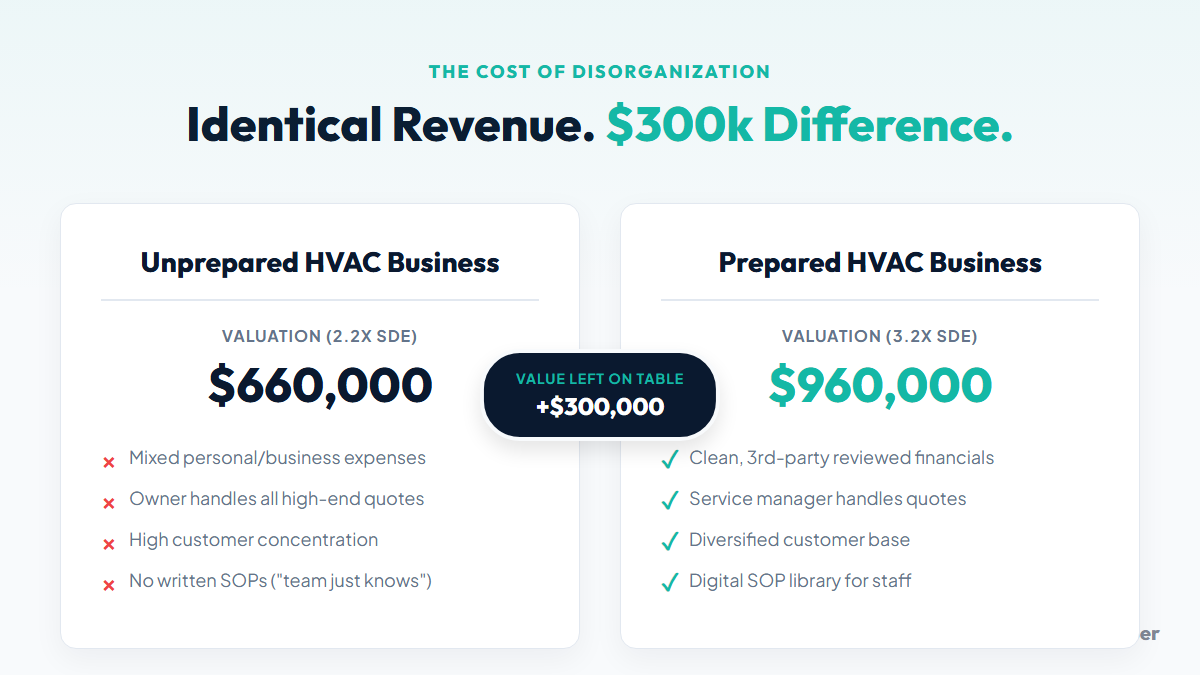
Consider two identical HVAC companies, both doing $1.2 million in revenue with $300,000 in owner's earnings.
Owner A (Unprepared):
- mixed personal and business expenses that are hard to verify
- owner handles all the high-end quotes and troubleshooting
- 50% of revenue comes from three local property developers
- no written SOPs - the team just knows what to do
- Likely valuation: 2.2x SDE = $660,000
Owner B (Prepared):
- clean, third-party reviewed financials with clear owner compensation records
- service manager handles quotes while the owner stays at a higher level
- largest customer is 8% of revenue
- digital SOP library for technicians and office staff
- Likely valuation: 3.2x SDE = $960,000
By spending 12 months preparing, Owner B walks away with $300,000 more than Owner A for the same top line. Preparation is one of the highest-ROI categories of work in the business.
Your 90-Day Pre-Sale Sprint
A short pre-sale sprint should focus on the tasks that remove friction fastest and improve buyer confidence immediately.
- Conduct a mini-audit: ask your CPA to review the last two years of financials specifically for deal-readiness.
- Review your lease: make sure there are no clauses that block assignment to a buyer.
- Clean up the physical space: fix obvious neglect, organize storage, and remove broken equipment.
- Update your valuation: get a current estimate of how much your business is worth so you know the range before negotiations start.
If you need the step-by-step math behind that number, see How to Calculate the Value of a Small Business. If you want to stress-test the result the way a buyer intermediary would, read what business brokers look for in a valuation. This post is about making the business easier to buy, not re-running the formulas from scratch.
Common Mistakes That Hurt Deals
Deals lose momentum when sellers introduce avoidable uncertainty right before buyers are ready to commit.
Talking to employees too early. Unless a key employee is critical to the sale process, keep the process confidential until the deal is close. Uncertainty can push strong people to look elsewhere.
Letting your foot off the gas. Many owners get deal fatigue and stop focusing on growth while buyers are in diligence. If revenue dips during the 60 to 90 days before closing, the buyer can ask for a price cut or walk.
Ignoring working capital. Buyers expect a normal level of inventory, receivables, and operating liquidity to stay in the business, often enough to cover roughly 30 to 60 days of operating needs. If you strip too much out just before closing, the buyer will treat it as a trust problem and adjust the price.
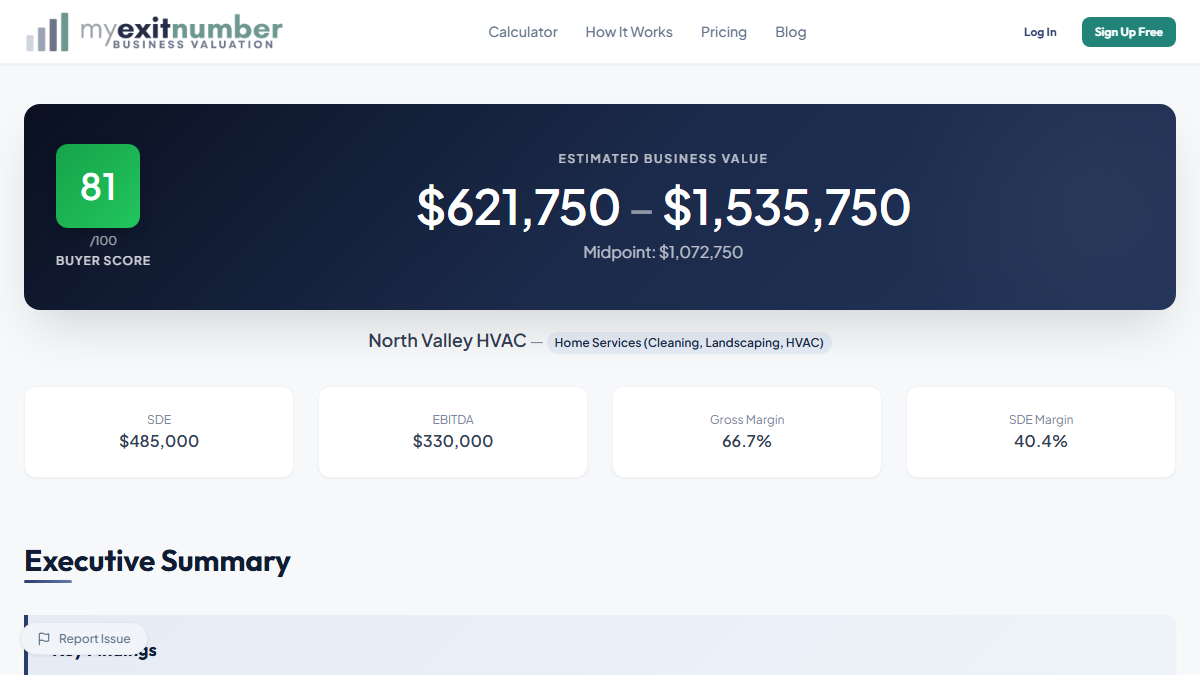
Before you go to market, get a baseline valuation so you can see whether the cleanup work actually changed the number. MyExitNumber runs the SDE, EBITDA, and revenue methods in minutes, free and with no signup required.
Frequently Asked Questions
How long before selling should I start preparing my business?
Twenty-four months is ideal because it gives you time to clean up two full tax years, reduce owner dependency, and document the business properly. Even six focused months can still improve valuation and deal certainty.
What do buyers usually ask for first during due diligence?
They usually start with tax returns, year-to-date financials, customer concentration details, leases, payroll records, and organizational information. If those are disorganized, the buyer immediately questions the rest of the story.
What is the biggest operational issue buyers discount?
Owner dependency is often the biggest operational discount because it creates transition risk the day after closing. If the business only works because the seller is still doing key jobs, the buyer pays less for it.
Can preparation really change the multiple that much?
Yes. Preparation can improve the multiple when it makes earnings easier to verify, lowers concentration risk, and proves the business can run without the owner. Buyers pay more for a business that feels transferable and financeable.
Should I get a valuation before I talk to buyers or brokers?
Yes. A current valuation range helps you pressure-test expectations before a buyer anchors the conversation for you. It also shows where cleanup work could increase value before you go to market.
Find Out What Your Business Is Worth
MyExitNumber calculates your business value using three proven methods - SDE, EBITDA, and Revenue multiples - so you get the full picture, not just one number.