
How to Calculate the Value of a Small Business (3 Methods)
Most sellers have a number in mind long before they have a method behind it. Buyers, brokers, and lenders do the opposite: they start with a method, then back into the number. If your valuation does not come from a recognizable calculation, it will not hold up for long in a real negotiation.
The three methods are SDE multiples, EBITDA multiples, and revenue multiples. This page is the worksheet version of the topic: calculation order, formulas, and weighting, with as little theory as possible. If you want the broader valuation context first, read How Much Is My Business Worth?. If you want to do the math yourself, start here.
The Three Methods at a Glance
Each method starts with a different measure of earnings and multiplies it by an industry-specific factor.
| Method | Earnings Metric | What It Answers | Typical Multiples |
|---|---|---|---|
| SDE Multiple | Seller's Discretionary Earnings | What does the business put in the owner's pocket? | 1.5x - 4.0x |
| EBITDA Multiple | EBITDA | What does the business earn as a standalone operation? | 3.0x - 6.0x |
| Revenue Multiple | Gross Revenue | How does the top line compare to industry norms? | 0.2x - 1.0x |
For a deeper look at when SDE or EBITDA applies to your situation and how industry multiples are determined, see the dedicated guides. This post focuses on the calculation mechanics.
We will use one example throughout: a residential cleaning service generating $320,000 in annual revenue with 12 part-time employees and the owner managing operations full-time.
| Line Item | Amount |
|---|---|
| Annual revenue | $320,000 |
| Cost of goods sold (supplies, equipment) | $64,000 |
| Operating expenses (staff, insurance, vehicle, marketing) | $144,000 |
| Owner's total compensation (salary + benefits) | $72,000 |
| Depreciation & amortization | $4,000 |
| Interest expense | $2,000 |
| Non-recurring expenses (van down payment) | $6,000 |
First, two numbers you will need for all three methods:
Gross Profit = $320,000 - $64,000 = $256,000
Net Operating Income = $256,000 - $144,000 = $112,000
Method 1: SDE Multiple
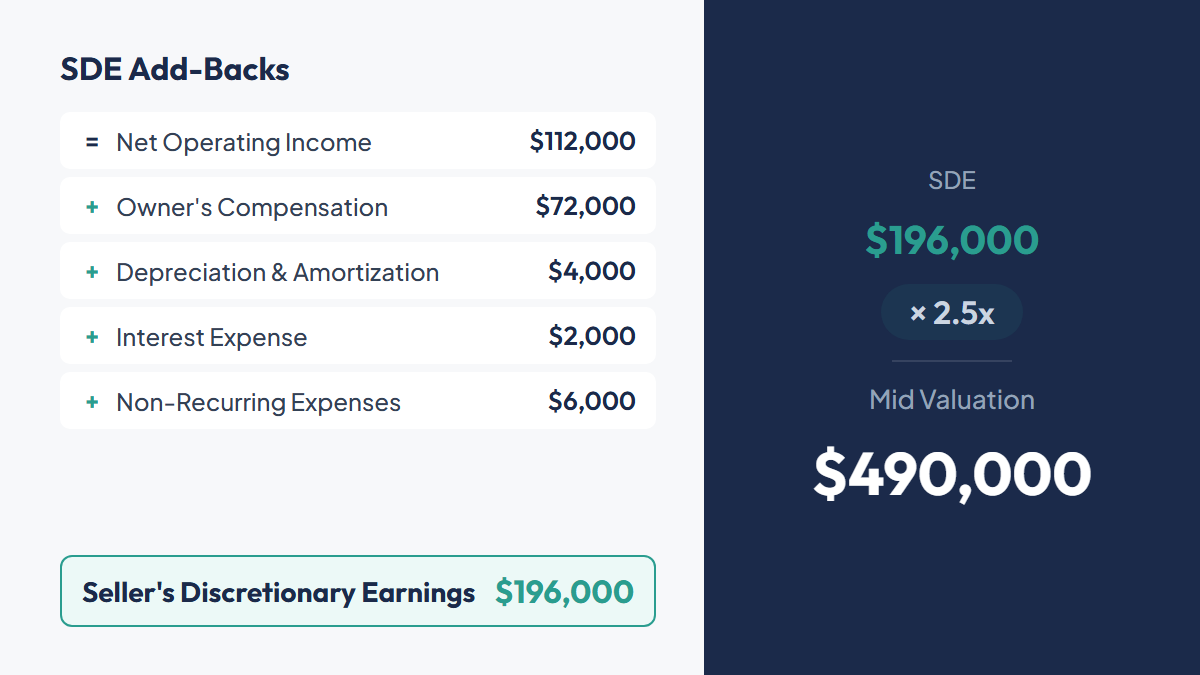
The SDE method is the most common approach for owner-operated small businesses. It calculates the total financial benefit the business provides to a single owner by adding back personal, non-cash, and non-recurring expenses.
Formula: SDE = Net Operating Income + Owner's Comp + D&A + Interest + Non-recurring
$112,000 + $72,000 + $4,000 + $2,000 + $6,000 = $196,000
Now multiply by the industry multiple. For home services, SDE multiples range from 2.0x to 3.0x:
| Multiple | Calculation | Value |
|---|---|---|
| Low (2.0x) | $196,000 x 2.0 | $392,000 |
| Mid (2.5x) | $196,000 x 2.5 | $490,000 |
| High (3.0x) | $196,000 x 3.0 | $588,000 |
SDE-based range: $392,000 - $588,000
This is the range an individual buyer who plans to run the cleaning service themselves would use. The $196,000 SDE represents their total annual benefit.
Method 2: EBITDA Multiple
EBITDA strips the calculation down to operating performance, adding back only depreciation and interest.
Formula: EBITDA = Net Operating Income + D&A + Interest
$112,000 + $4,000 + $2,000 = $118,000
For home services, EBITDA multiples range from 3.0x to 5.0x:
| Multiple | Calculation | Value |
|---|---|---|
| Low (3.0x) | $118,000 x 3.0 | $354,000 |
| Mid (4.0x) | $118,000 x 4.0 | $472,000 |
| High (5.0x) | $118,000 x 5.0 | $590,000 |
EBITDA-based range: $354,000 - $590,000
The range overlaps significantly with the SDE method. That internal consistency is a positive signal. A corporate buyer acquiring this cleaning service would hire a manager at $72,000 per year and evaluate the business on the $118,000 EBITDA.
Method 3: Revenue Multiple
The revenue method is the simplest and the least reliable on its own. It uses top-line revenue without adjusting for profitability.
Formula: Value = Revenue x Industry Revenue Multiple
For home services, revenue multiples range from 0.3x to 0.6x:
| Multiple | Calculation | Value |
|---|---|---|
| Low (0.3x) | $320,000 x 0.3 | $96,000 |
| Mid (0.45x) | $320,000 x 0.45 | $144,000 |
| High (0.6x) | $320,000 x 0.6 | $192,000 |
Revenue-based range: $96,000 - $192,000
This comes in dramatically lower than the earnings-based methods. That is normal for profitable service businesses where margins are healthy. The revenue method is most useful as a floor and a sanity check. It carries real weight in high-growth businesses that are not yet profitable, or in businesses with thin margins where earnings-based methods produce unreliably low numbers. For those cases, see when a revenue multiple deserves more weight.
Blending the Three Methods
A blended estimate combines all three methods into a single weighted range, producing a more balanced and defensible number than any single calculation.
| Method | Weight | Mid Value | Weighted |
|---|---|---|---|
| SDE | 50% | $490,000 | $245,000 |
| EBITDA | 30% | $472,000 | $141,600 |
| Revenue | 20% | $144,000 | $28,800 |
| Blended estimate | $415,400 |
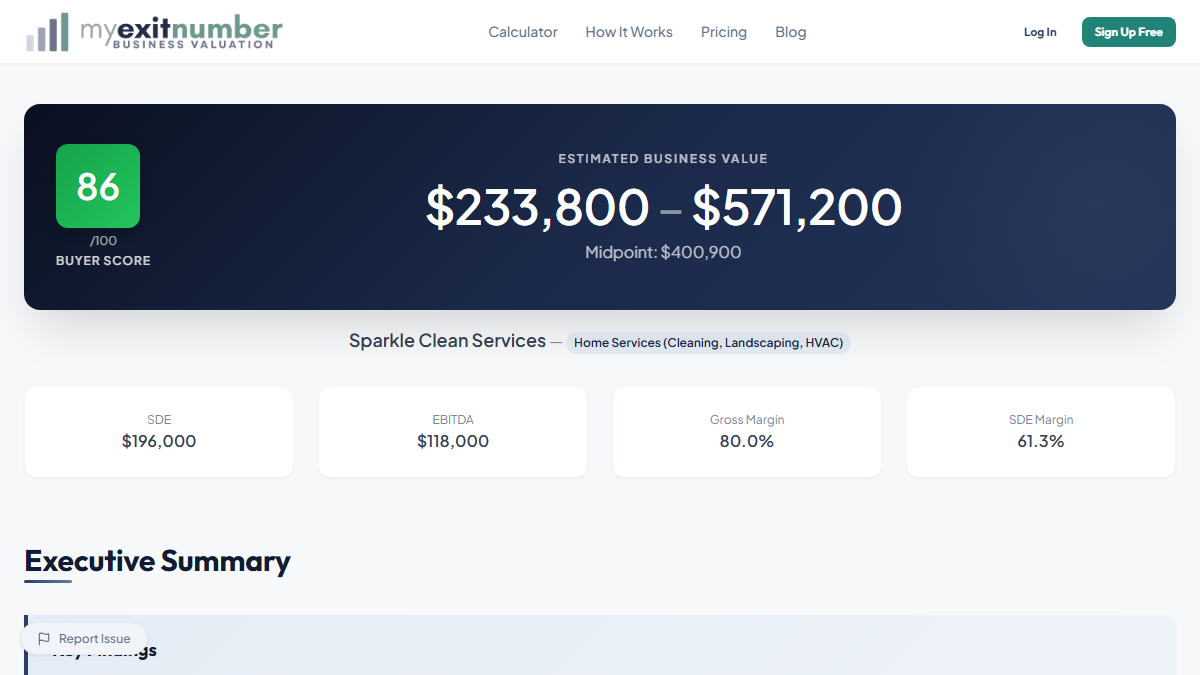
This cleaning service is worth roughly $350,000 to $590,000, with a blended midpoint around $415,000.
The weights reflect how relevant each method is. SDE gets the heaviest weight because the owner operates the business full-time. If the business had professional management, EBITDA would carry more weight. If the business were high-growth but unprofitable, revenue would matter more. If you want to challenge those assumptions before a buyer does, compare the buyer-lens differences in SDE vs EBITDA.
Which Method Carries the Most Weight?
The primary method depends on your situation and buyer type.
| Your Situation | Primary Method | Why |
|---|---|---|
| Owner-operated, under $1M SDE, individual buyer | SDE | Buyer replaces you and receives the full SDE |
| Professional management, corporate or PE buyer | EBITDA | Buyer installs a manager, owner's comp stays as expense |
| High-growth, pre-profit, or very thin margins | Revenue | Earnings-based methods produce unreliably low numbers |
| Not sure who will buy | All three, blended | Covers the full range of buyer types |
For most small businesses in the $200K-$5M revenue range with an active owner, SDE drives the valuation. But calculating all three methods protects you from surprises and gives you a complete picture.
Your Valuation Starts with Math
Calculating the value of a small business is not subjective. Three formulas, your financial statements, and your industry's multiples produce a defensible range. What matters is not just finishing the math, but being able to explain the assumptions behind it when a buyer, broker, or lender pushes back.
Frequently Asked Questions
What numbers do I need before I start calculating?
You need annual revenue, COGS, operating expenses, owner's compensation, depreciation and amortization, interest expense, and any clearly non-recurring costs. If you do not separate those items cleanly first, the formulas will produce false precision.
In what order should I run the three valuation methods?
Start with SDE if the business is owner-operated, then calculate EBITDA, then use revenue as a floor or sanity check. That order keeps you anchored in the economics of the business before you look at the simpler top-line shortcut.
What is the easiest calculation mistake to make?
The easiest mistake is mixing operating expenses and owner-specific add-backs too early. Keep the math sequential: revenue to gross profit, gross profit to net operating income, then build SDE and EBITDA from there. If you skip that order, errors compound fast.
When should I stop doing DIY math and get outside help?
If the business has unusual add-backs, multiple owners, inconsistent books, or a buyer already at the table, you should bring in a broker, CPA, or valuation professional. The formulas still matter, but the negotiation risk rises quickly when the facts are messy.
What does it mean if my three methods are far apart?
It means one of two things: either the business has unusual economics, or one method is less relevant for your buyer type and industry. Large gaps are not automatically wrong, but they are a signal to investigate margins, owner dependency, and whether the multiple set fits the business correctly.
Find Out What Your Business Is Worth
MyExitNumber calculates your business value using three proven methods - SDE, EBITDA, and Revenue multiples - so you get the full picture, not just one number.