
SDE vs EBITDA: Which One Matters When Selling
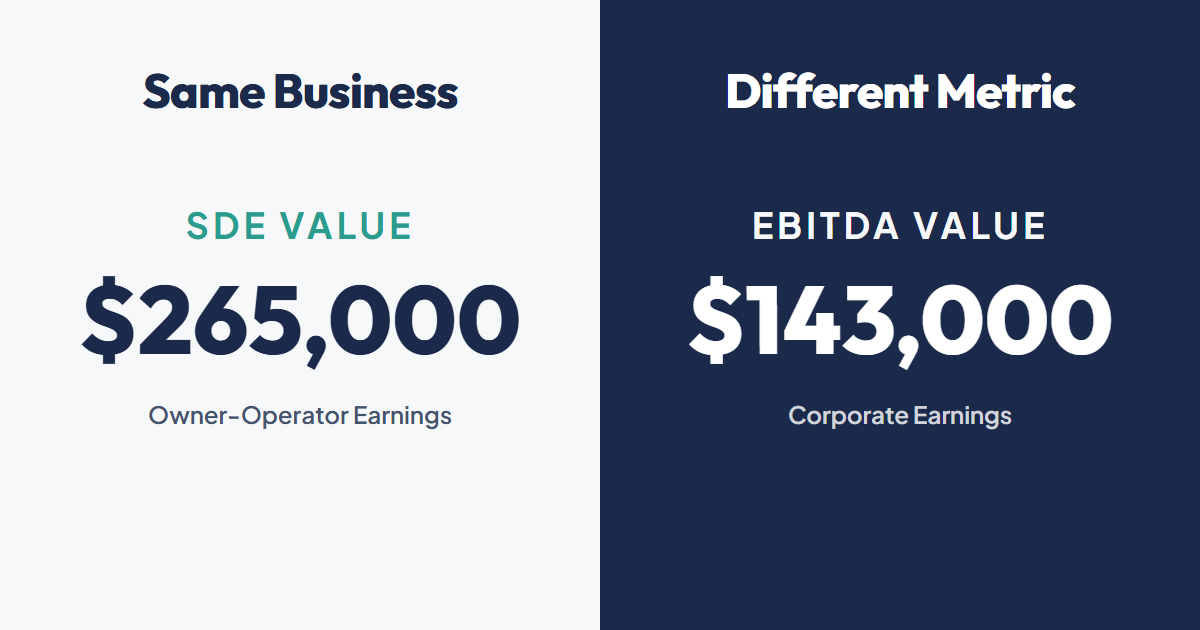
Which number should you use to value your business - SDE or EBITDA? The answer depends on one thing: who is buying. An individual buyer who plans to run your business day to day will value it using SDE. A corporate buyer who plans to hire a manager will use EBITDA. The same business, valued by the same method with the same financials, can produce a six-figure difference depending on which metric the buyer applies.
This is a decision guide, not a full primer on either metric. If you walk into a negotiation using SDE and the buyer is working from EBITDA, you will spend the first hour confused about why your numbers are $100,000 apart. This guide focuses on when each metric applies, how buyer type changes the conversation, and which number is likely to anchor the price.
Short answer: use SDE when the buyer is likely to replace the owner directly and use EBITDA when the buyer is underwriting the company as a stand-alone operation with hired management. If you do not know the buyer yet, calculate both, because smaller owner-operated deals usually start with SDE while lenders and institutional buyers will still pressure-test EBITDA.
The Quick Comparison
SDE vs EBITDA comes down to what gets added back to net operating income.
| SDE | EBITDA | |
|---|---|---|
| Full name | Seller's Discretionary Earnings | Earnings Before Interest, Taxes, Depreciation, and Amortization |
| Adds back owner's compensation | Yes | No |
| Adds back non-recurring expenses | Yes | No |
| Adds back depreciation & amortization | Yes | Yes |
| Adds back interest | Yes | Yes |
| Typical multiples | 1.5x - 3.5x | 3.0x - 6.0x |
| Used by | Individual buyers, SBA-financed deals, brokers | Corporate buyers, PE firms, banks |
| Best for | Owner-operated businesses under ~$1M earnings | Businesses with professional management or institutional buyers |
The core difference: SDE treats the owner's salary as part of the business's earning power. EBITDA treats it as an operating expense that stays on the books.
Same Business, Two Different Numbers
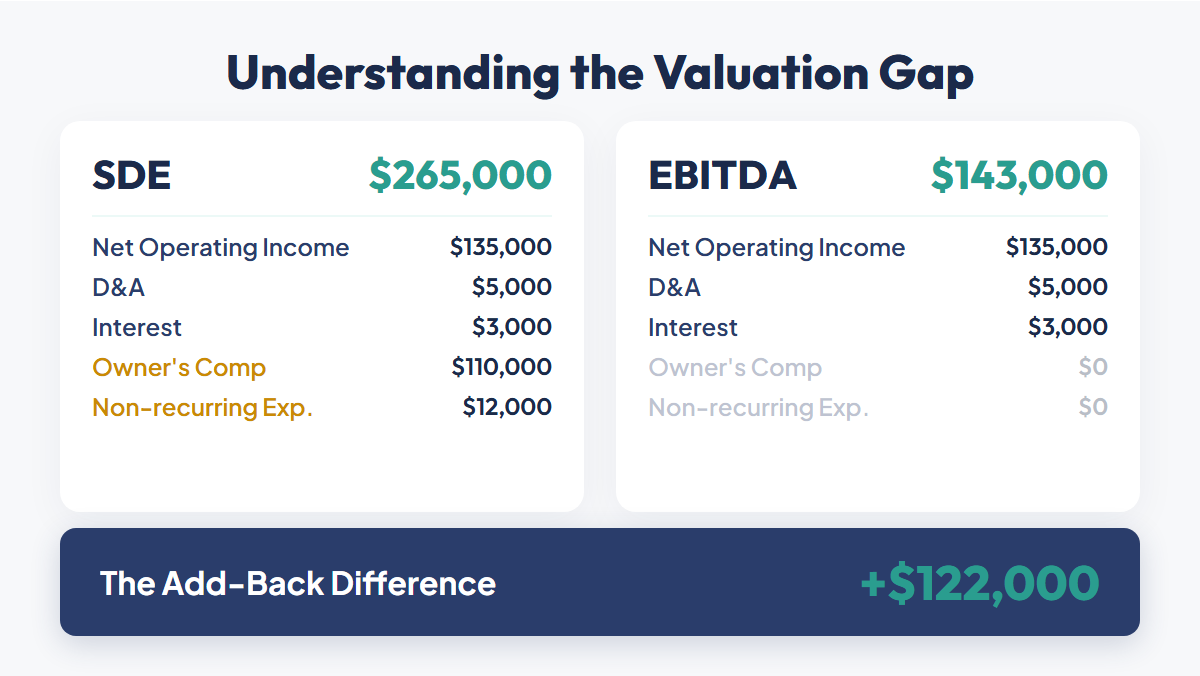
The gap between SDE and EBITDA is not small. Here is a worked example using a digital marketing agency with four employees generating $450,000 in annual revenue:
| Line Item | Amount |
|---|---|
| Annual revenue | $450,000 |
| Cost of goods sold (contractors, software) | $90,000 |
| Operating expenses (rent, staff wages, insurance) | $225,000 |
| Owner's total compensation (salary + benefits) | $110,000 |
| Depreciation & amortization | $5,000 |
| Interest expense | $3,000 |
| Non-recurring expenses (office build-out) | $12,000 |
Gross Profit = $450,000 - $90,000 = $360,000
Net Operating Income = $360,000 - $225,000 = $135,000
SDE = $135,000 + $110,000 + $5,000 + $3,000 + $12,000 = $265,000
EBITDA = $135,000 + $5,000 + $3,000 = $143,000
The $122,000 gap is the owner's $110,000 salary plus the $12,000 one-time office build-out. Neither metric is wrong. They just answer different questions about the same business.
Which Method Produces a Higher Valuation?
SDE produces a higher valuation for most small, owner-operated businesses because the owner's salary is a large share of total earnings. Higher EBITDA multiples do not fully compensate for the lower earnings base.
For the marketing agency, professional services multiples look like this:
| Method | Earnings | Low | Mid | High | Low Value | Mid Value | High Value |
|---|---|---|---|---|---|---|---|
| SDE | $265,000 | 2.0x | 2.75x | 3.5x | $530,000 | $728,750 | $927,500 |
| EBITDA | $143,000 | 3.5x | 4.5x | 5.5x | $500,500 | $643,500 | $786,500 |
The SDE method produces a higher valuation range: $530K-$928K vs $501K-$787K. The pattern reverses for larger businesses where the owner's compensation is a small percentage of total earnings.
Rule of thumb: For most small businesses under $1M SDE where the owner works full-time, the SDE method produces a higher midpoint. That is one reason individual buyers prefer SDE - it supports a higher price that reflects the full benefit they will receive as the new owner-operator.
How to Know Which One Applies to You
The metric choice depends on who your buyer is likely to be. Here is a practical decision framework:
Use SDE when:
- You work in the business full-time and handle significant operations
- Your likely buyer is an individual who will replace you as the operator
- The deal will be financed through an SBA loan
- Your business has fewer than 10-15 employees and no dedicated management team
Use EBITDA when:
- You have a general manager or management team running day-to-day operations
- Your likely buyer is a corporate acquirer, PE firm, or strategic buyer
- Your annual SDE exceeds roughly $1 million
- The buyer has explicitly stated they use EBITDA
Use both when:
- You are not sure who will buy (most situations)
- You want to understand the full range of what your business might sell for
- You are comparing offers from different types of buyers
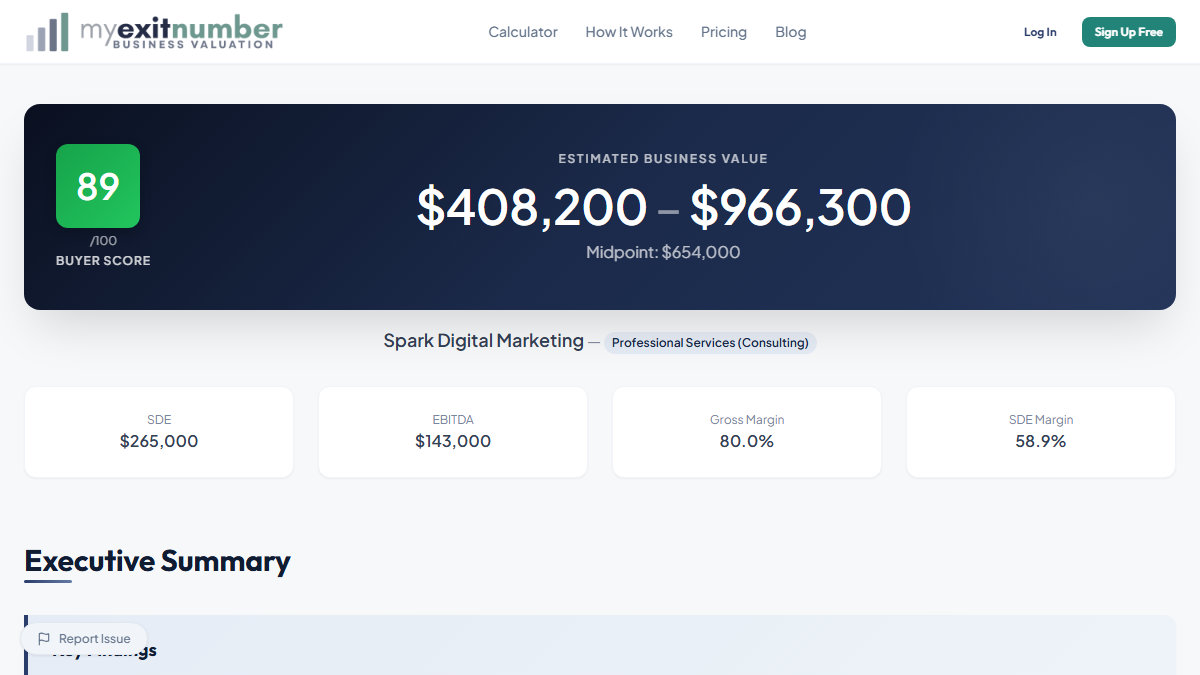
Calculating both uses the same financial inputs. The only difference is which expenses get added back and how a buyer interprets the result. (MyExitNumber calculates SDE, EBITDA, and revenue multiples simultaneously from 11 financial inputs.)
The Real-World Impact on Your Sale
The SDE vs EBITDA choice affects more than the headline number - it ripples through negotiation, financing, and deal structure.
Negotiation leverage. If you only know your SDE and the buyer is working from EBITDA, you will spend the first meeting defending a gap you cannot explain. Knowing both numbers means you can speak either language and understand exactly why the buyer's offer differs from your broker's estimate.
Loan approval. SBA lenders use a modified EBITDA to calculate the debt service coverage ratio (DSCR). If your EBITDA is thin relative to the loan amount, the buyer may not qualify for financing - even if the SDE-based valuation supports the price.
Earnout structures. When there is a gap between the SDE-based price and the EBITDA-based price, buyers sometimes bridge it with an earnout: a portion of the sale price contingent on the business hitting targets after the transition. If a buyer offers $650,000 based on EBITDA when your SDE-based value is $730,000, the $80,000 difference might become a 12-month earnout tied to revenue retention.
One practitioner insight that rarely appears in valuation guides: the owner's compensation itself is negotiable in the context of a sale. If you pay yourself $110,000 but the market rate for a replacement manager is $75,000, a sophisticated buyer might argue that only $75,000 should be added back for SDE purposes. The remaining $35,000 is an above-market premium you pay yourself, not a true business expense. Be prepared to defend your compensation relative to market rates.
SDE vs EBITDA: The Bottom Line
SDE and EBITDA are not competing metrics. They are complementary lenses on the same business. SDE shows what the business puts in a single owner-operator's pocket. EBITDA shows what it earns as a standalone operation. Most small business sales under $1M earnings center on SDE, but every serious conversation will eventually involve EBITDA. Calculate both. For a full walkthrough of all three valuation methods, see How Much Is My Business Worth?.
Frequently Asked Questions
What metric should I lead with when talking to a buyer?
Lead with the metric your buyer will underwrite. If the buyer is an owner-operator or an SBA-backed individual, lead with SDE. If the buyer is a strategic acquirer, search fund, or PE-backed platform, lead with EBITDA and have SDE ready as context.
What is the biggest mistake sellers make in an SDE vs EBITDA discussion?
The biggest mistake is assuming the buyer sees the owner's salary the same way the seller does. Sellers often treat all owner pay as add-back value, while buyers test whether some of that pay is really the market cost of replacing the owner in the business.
Can one buyer use SDE while another uses EBITDA on the same business?
Yes. That happens all the time. An individual buyer may value the same company on SDE because they will step into the operator role, while a strategic buyer values it on EBITDA because they plan to keep management in place or hire a replacement.
How does the metric choice affect deal structure?
When buyers and sellers anchor on different metrics, the gap often shows up in structure rather than price alone. That can mean seller financing, earnouts, or contingent payments tied to retention and post-close performance.
Why does lender behavior matter in the SDE vs EBITDA debate?
Lenders care because the deal still has to cash-flow after debt service. Even if a seller prefers an SDE-based number, the buyer's financing package may effectively force the conversation back toward an EBITDA-style cash-flow test.
Find Out What Your Business Is Worth
MyExitNumber calculates your business value using three proven methods - SDE, EBITDA, and Revenue multiples - so you get the full picture, not just one number.