
Business Valuation Multiples Explained: How Your Industry Affects Value
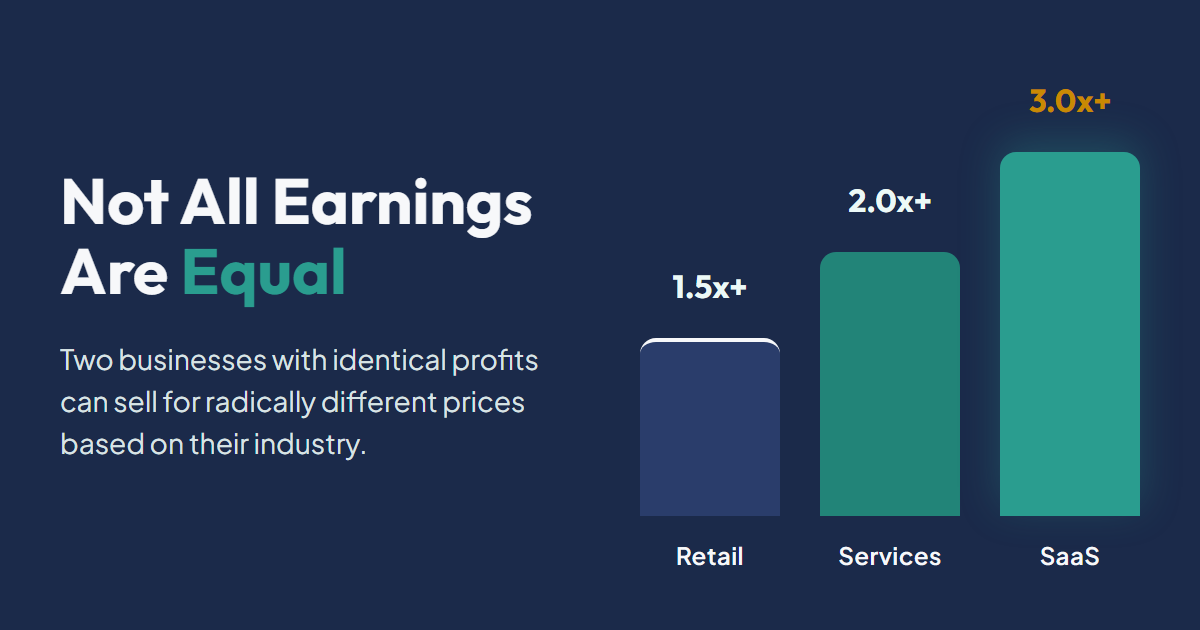
Owners often fixate on the earnings number and barely think about the multiple attached to it. That is backwards. Two businesses can each generate $250,000 in SDE and still sell hundreds of thousands of dollars apart because one sits in a low-multiple category and the other sits in a premium one. A general retail store and a SaaS company do not trade on the same terms, even when their current earnings look identical.
Business valuation multiples are the translation layer between what your business earns and what it is worth. If you do not understand why your industry trades where it does, you can be directionally right on earnings and still be way off on price. This page focuses on where the range comes from and what moves you up or down inside it.
What Is a Business Valuation Multiple?
A business valuation multiple converts an earnings metric into a value estimate with one formula: Business Value = Earnings x Multiple.
The earnings metric is usually SDE, EBITDA, or revenue. The multiple comes from transaction data - what businesses in your industry have actually sold for. If landscaping companies with similar earnings sell for 2.0x to 3.0x SDE, that range becomes the multiple you apply to your own SDE.
Multiples are not invented or negotiated from scratch. They emerge from completed transactions tracked by databases like BizBuySell, DealStats, and the Institute of Business Appraisers. When a broker says "your industry trades at 2.5x," they are usually referencing a mix of sold-deal data, current buyer appetite, and recent lender feedback. The exact range should always be treated as time-sensitive, because transaction markets move.
Each earnings metric uses its own set of multiples. SDE multiples are lower (1.5x-4.0x) because SDE is a larger number. EBITDA multiples are higher (3.0x-6.0x) because EBITDA excludes the owner's salary. Revenue multiples are the lowest (0.2x-1.0x) and serve primarily as a sanity check. For a detailed comparison of SDE vs EBITDA and when each applies, see the dedicated guide.
Why Multiples Vary by Industry
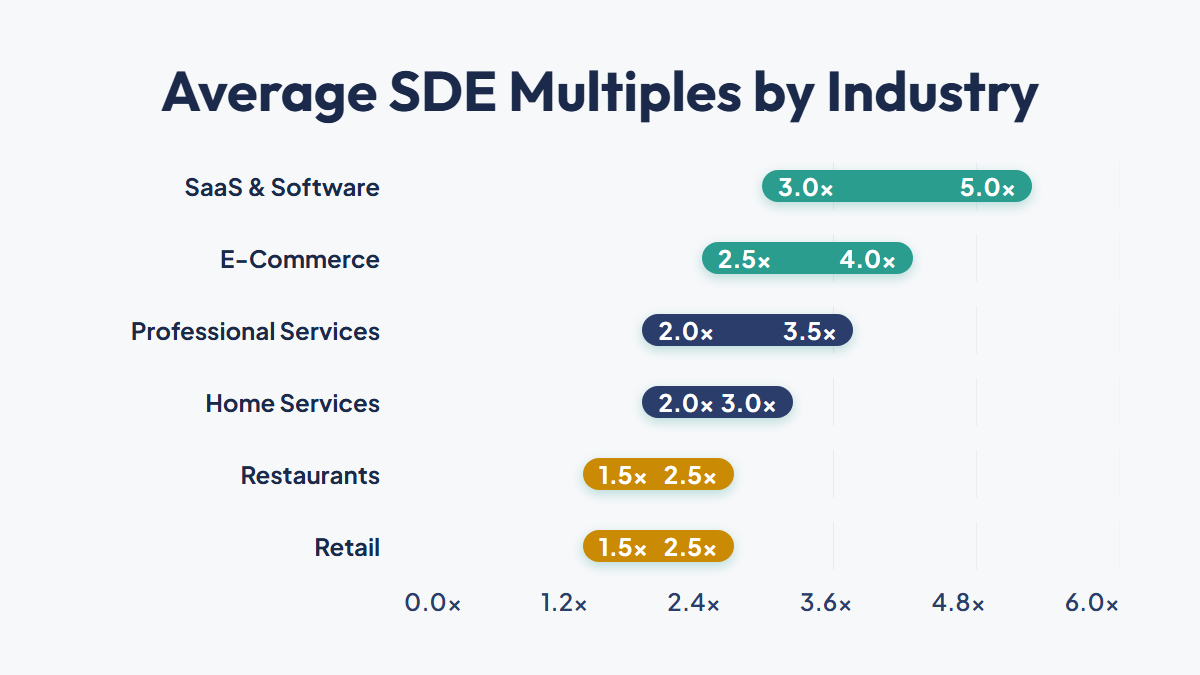
Not all businesses are equally attractive to buyers. Multiples reflect the risk profile, growth potential, and operational characteristics that make one industry more valuable per dollar of earnings than another.
Recurring revenue gives buyers more confidence in the durability of future cash flow. Businesses with subscription models, service contracts, or maintenance agreements command higher multiples because their future revenue is more predictable. A SaaS company with 90% monthly retention is a fundamentally different risk than a landscaping company that rebids every spring.
Scalability. Businesses that can grow revenue without proportionally increasing costs trade at higher multiples. Software scales with near-zero marginal cost. A plumbing company needs another truck and another plumber for every meaningful revenue increase.
Owner dependency. Businesses that operate independently of the owner are worth more. A consulting firm where the founder is the product sells for less per dollar of earnings than one with a team of consultants who deliver the work.
Barriers to entry. Industries with licensing requirements, proprietary technology, or high switching costs protect against competition. A medical practice with established patient relationships has a moat that a general cleaning service does not.
Growth trajectory. Buyers pay more for businesses in growing industries and less for businesses in contracting ones, even when current earnings are identical.
Industry Multiples: A Reference Table
These ranges represent typical transaction multiples for small businesses under $5M revenue. Actual multiples depend on the qualitative factors discussed below.
| Industry | SDE Multiple | EBITDA Multiple | Revenue Multiple |
|---|---|---|---|
| SaaS & Software | 3.0x - 5.0x | 5.0x - 8.0x | 0.8x - 2.0x |
| E-Commerce & Online Retail | 2.5x - 4.0x | 3.5x - 6.0x | 0.4x - 0.8x |
| Professional Services (Consulting) | 2.0x - 3.5x | 3.5x - 5.5x | 0.4x - 0.8x |
| Healthcare & Medical Practices | 2.0x - 3.5x | 3.5x - 5.5x | 0.5x - 1.0x |
| Home Services (Plumbing, HVAC) | 2.0x - 3.0x | 3.0x - 5.0x | 0.3x - 0.6x |
| Auto Repair & Maintenance | 2.0x - 3.0x | 3.0x - 5.0x | 0.3x - 0.6x |
| Restaurants & Food Service | 1.5x - 2.5x | 2.5x - 4.0x | 0.3x - 0.5x |
| Construction & Trades | 1.5x - 2.5x | 2.5x - 4.0x | 0.2x - 0.5x |
| Manufacturing | 2.0x - 3.5x | 3.0x - 5.0x | 0.3x - 0.7x |
| Retail (General) | 1.5x - 2.5x | 2.5x - 4.0x | 0.2x - 0.4x |
Notice the spread: a SaaS business and a general retail store with identical SDE could produce valuations that differ by more than 2x. That is not a flaw in the methodology. It reflects genuinely different risk and growth profiles.
What Pushes Your Multiple Higher or Lower
The industry range gives you a starting point. Where you land within it depends on your specific business characteristics.
Factors that command the high end:
- Revenue growing 10%+ annually with documentation
- High percentage of recurring or contracted revenue
- Diverse customer base with no single client above 10-15%
- Business operates independently of the owner for weeks at a time
- Clean, CPA-reviewed financial statements
- Established brand with strong online reviews and reputation
- Defensible competitive advantage (proprietary product, exclusive territory, patents)
Factors that push toward the low end:
- Flat or declining revenue
- Heavy owner dependency where the business cannot function without you
- Customer concentration risk
- Below-industry-average margins
- Messy or reconstructed financials
- Short operating history (under 3 years)
A home services company at the high end of its range (3.0x SDE) is often a stronger business than a SaaS company at the low end of its range (3.0x SDE). The multiple reflects the total picture, not just the industry label. (MyExitNumber applies industry-specific multiples and factors in business age, revenue trend, and margin benchmarks to position you within the range.)
How to Apply Multiples: A Worked Example
Here is a complete example using an e-commerce store selling specialty kitchen equipment with $750,000 in annual revenue:
SDE = $245,000 | EBITDA = $160,000
| Method | Earnings | Low | Mid | High | Low Value | Mid Value | High Value |
|---|---|---|---|---|---|---|---|
| SDE | $245,000 | 2.5x | 3.25x | 4.0x | $612,500 | $796,250 | $980,000 |
| EBITDA | $160,000 | 3.5x | 4.75x | 6.0x | $560,000 | $760,000 | $960,000 |
| Revenue | $750,000 | 0.4x | 0.6x | 0.8x | $300,000 | $450,000 | $600,000 |
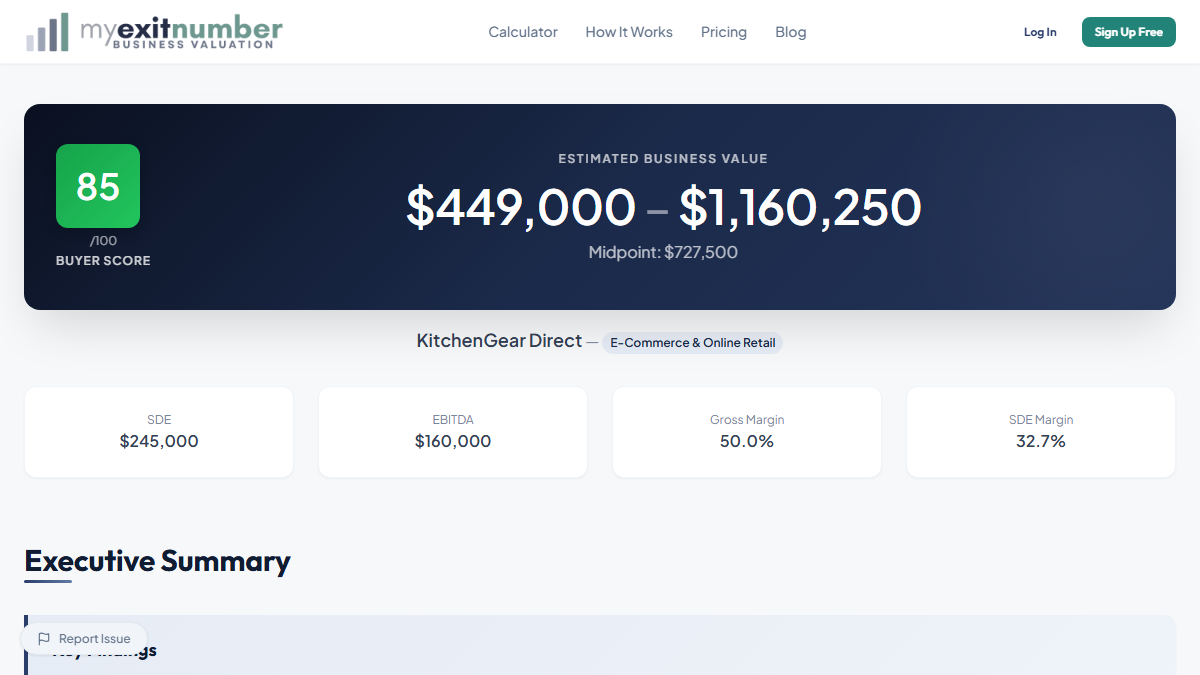
Blended estimate (SDE 50%, EBITDA 30%, Revenue 20%): $716,125. This store is worth roughly $560,000 to $980,000. If you want to sanity-check that range against buyer scrutiny, read what brokers pressure-test before they take a business to market.
Common Mistakes with Multiples
Using the wrong industry. A food truck is not the same as a full-service restaurant. A managed IT services company is not the same as a break-fix computer repair shop. Multiples are industry-specific, and misclassifying your business shifts the entire valuation.
Applying a multiple to the wrong earnings metric. An SDE multiple applied to EBITDA will undervalue the business. An EBITDA multiple applied to SDE will overvalue it. Always match the multiple to the metric it was designed for.
Assuming you deserve the top multiple. The high end of any range represents businesses with exceptional characteristics. If you cannot point to specific evidence that justifies the top multiple, pricing there will scare off informed buyers.
Ignoring the range entirely. A single point estimate ("my business is worth $750,000") is less useful than a range ("$560,000 to $980,000 depending on qualitative factors"). Ranges give you negotiating room and set realistic expectations.
Multiples Are the Starting Point, Not the Finish Line
Business valuation multiples translate your earnings into a value range. Your industry sets the boundaries. Your specific business characteristics - growth, margins, owner dependency, customer diversity - determine where you land within those boundaries. Knowing your industry's multiples before a conversation with a buyer or broker means you walk in with realistic expectations and the math to back them up.
Frequently Asked Questions
How do buyers decide if my business deserves the top of the range?
They look for evidence, not adjectives. Buyers want documented growth, low owner dependency, clean financial statements, diversified customers, and margins that hold up under diligence. If you cannot prove those traits, you will not get the top multiple just by claiming them.
What is the most common multiple mistake owners make?
The most common mistake is using the right metric with the wrong peer group. Owners often benchmark against a broader or more attractive industry category than the one buyers will actually use, which inflates expectations before negotiations even begin.
Why can two businesses in the same industry get different multiples?
Because industry only sets the range. One company may have recurring contracts, stronger margins, and lower customer concentration, while another may depend heavily on the owner and one or two major accounts. Those differences move the multiple inside the range.
Should I use asking-price data or sold-deal data for multiples?
Use sold-deal data whenever possible. Asking prices are useful for market sentiment, but buyers and lenders care about what actually closed, not what sellers hoped to get before diligence and negotiation.
Can a buyer challenge my industry classification itself?
Yes, and sophisticated buyers do it often. If your business sits between two categories, they will usually push toward the one with the lower multiple unless you can show that your revenue quality, margins, and operating model fit the stronger category more closely.
Find Out What Your Business Is Worth
MyExitNumber calculates your business value using three proven methods - SDE, EBITDA, and Revenue multiples - so you get the full picture, not just one number.