
EBITDA for Small Business Owners: What It Is and Why Buyers Care
One of the more jarring moments in a sale process is hearing two credible people give you two very different values for the same business. A broker may talk in SDE and land at $870,000. A corporate buyer may walk in using EBITDA and land at $580,000. Same company, same financials, completely different lens.
If you run a small business, EBITDA shows up the moment the conversation gets more institutional - a bank, a strategic buyer, a private equity-backed group, or anyone underwriting the business as an operation rather than as your personal income stream. Understanding what it measures, and what it deliberately leaves out, is the difference between being surprised by the number and being ready for it.
What EBITDA Actually Means (and What It Leaves Out)
EBITDA measures operating profitability by starting with net operating income and adding back two categories of expenses:
- Depreciation and amortization - non-cash charges that reduce taxable income but do not represent actual money leaving the business
- Interest expense - debt costs that reflect the current owner's financing choices, not the business's earning power
That is it. Unlike SDE, EBITDA does not add back the owner's compensation or non-recurring expenses. Those stay on the books as real costs.
Why leave them in? Because EBITDA answers a different question than SDE. SDE asks: "How much does this business put in the owner-operator's pocket?" EBITDA asks: "How much does this business earn as a standalone operation, regardless of who runs it?"
For a business where the owner is the business - answering calls, doing the work, managing everything personally - SDE is the more relevant number. For a business with a management layer, employees who handle operations, and an owner who could step away for months, EBITDA matters more.
How to Calculate EBITDA for Your Business
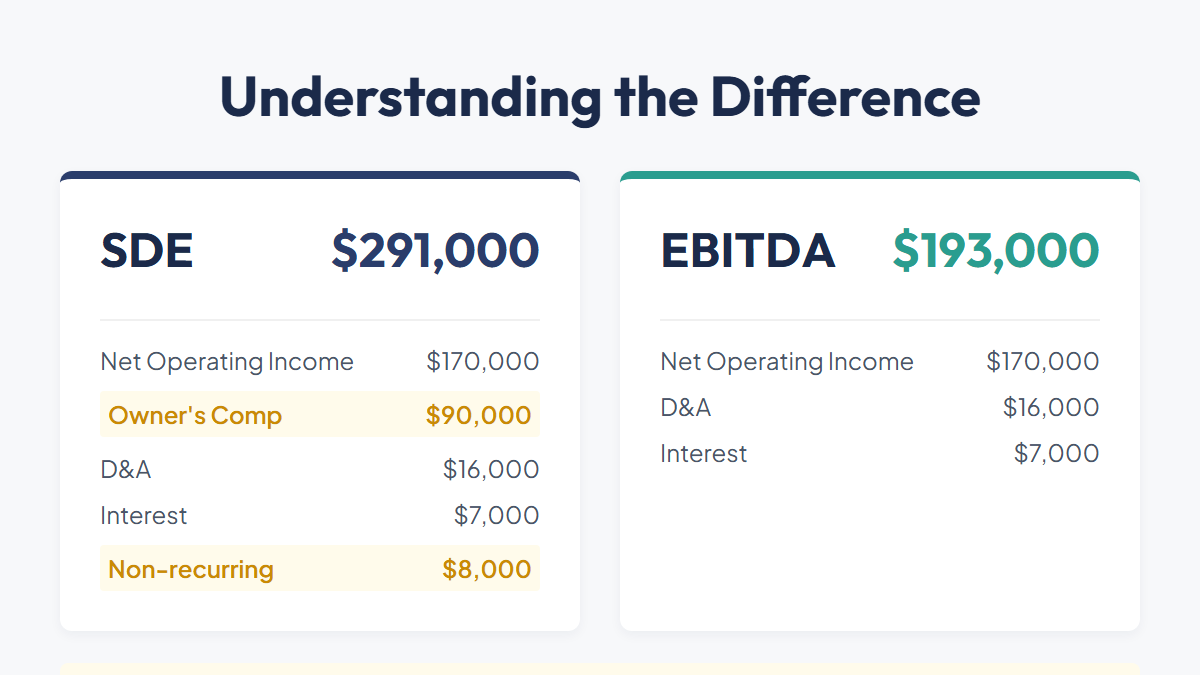
EBITDA equals net operating income plus depreciation and interest - nothing else. Here is a worked example using an auto repair shop generating $680,000 in annual revenue:
| Line Item | Amount |
|---|---|
| Annual revenue | $680,000 |
| Cost of goods sold (parts, materials, subcontractors) | $238,000 |
| Operating expenses (rent, staff wages, insurance, marketing) | $272,000 |
| Owner's total compensation (salary + benefits) | $90,000 |
| Depreciation & amortization | $16,000 |
| Interest expense | $7,000 |
| Non-recurring expenses (roof repair) | $8,000 |
Step 1: Gross Profit
$680,000 - $238,000 = $442,000
Step 2: Net Operating Income
$442,000 - $272,000 = $170,000
Step 3: Add back D&A and interest only
$170,000 + $16,000 (D&A) + $7,000 (interest) = $193,000
That $193,000 is the shop's EBITDA. Compare it to SDE, which adds back the owner's salary and non-recurring expenses too:
$170,000 + $90,000 + $16,000 + $7,000 + $8,000 = $291,000
The $98,000 gap between SDE ($291,000) and EBITDA ($193,000) is the owner's $90,000 salary plus the $8,000 one-time roof repair. That gap is not an error. It reflects a real disagreement between two types of buyers about what counts as the business's earnings.
Why Buyers Use EBITDA Instead of SDE
Different buyer types use different metrics because they plan to operate the business differently after the acquisition.
| Buyer Type | Metric | Why |
|---|---|---|
| Individual buyer running the business | SDE | They replace the owner, so owner's comp becomes their income |
| Search fund or small PE firm | SDE or EBITDA | Depends on whether they plan to operate or hire a manager |
| Corporate acquirer or strategic buyer | EBITDA | They will install a manager - owner's comp stays as an expense |
| Private equity (larger) | EBITDA | Standard PE metric for portfolio comparison |
| Bank underwriting an SBA loan | EBITDA (adjusted) | Cash flow analysis for debt service capacity |
For the auto repair shop: an individual buyer planning to turn wrenches and run the counter cares about the full $291,000 SDE. A regional auto chain acquiring the location will hire a shop manager at $90,000 per year and evaluate the business on $193,000 EBITDA.
The practical impact: EBITDA-based valuations use higher multiples (3x-6x) compared to SDE multiples (1.5x-3.5x). The higher multiple partially offsets the lower earnings base, but not always completely. That is why the same business can produce different valuations depending on who is buying. If you need to pressure-test that difference against financing and buyer type, compare it with SDE vs EBITDA and the broker's market-facing lens.
When EBITDA Is the Right Metric for Your Business
EBITDA becomes the primary valuation metric when the business has outgrown its dependence on a single owner-operator.
- The business has professional management. If a general manager or operations lead runs day-to-day operations and the owner focuses on strategy or is largely absent, EBITDA reflects the business's true operating performance.
- Annual SDE exceeds roughly $1 million. Above this threshold, the buyer pool shifts from individuals to institutional buyers who standardize on EBITDA for comparability across acquisitions.
- The buyer is a corporation or PE firm. These buyers evaluate hundreds of opportunities using EBITDA as a common yardstick. They will not entertain SDE-based conversations.
- You are seeking bank financing. Lenders calculate debt service coverage ratios (DSCR) using a version of EBITDA to determine whether the business generates enough cash to service the loan.
For most owner-operated small businesses in the $200K-$2M revenue range where the owner works full-time in the business, SDE remains the primary metric. But even then, calculating EBITDA gives you a second data point and prepares you for conversations with institutional buyers. (MyExitNumber calculates both SDE and EBITDA automatically from the same inputs.)
EBITDA Margins: What Healthy Looks Like
EBITDA margin - EBITDA as a percentage of revenue - measures how efficiently the business converts sales into operating profit.
EBITDA Margin = EBITDA / Revenue
For the auto repair shop: $193,000 / $680,000 = 28.4%
That means for every dollar of revenue, 28.4 cents becomes operating profit before the owner's financing and accounting decisions. Whether that is healthy depends on the industry:
| Industry | Typical EBITDA Margin |
|---|---|
| SaaS and software | 25-40% |
| Professional services (consulting, accounting) | 20-35% |
| Auto repair and maintenance | 20-30% |
| Home services (plumbing, HVAC, landscaping) | 15-25% |
| Restaurants and food service | 10-20% |
| Retail (general) | 8-15% |
| Construction and trades | 8-18% |
At 28.4%, this auto repair shop sits in the upper range for its industry. That signals operational efficiency and pricing power - both of which command higher multiples from buyers.
If your EBITDA margin falls below your industry's range, it points to one of three issues: pricing too low, operating costs too high, or COGS out of line with peers. All three are fixable before a sale, and improving your margin before listing directly impacts your valuation.
From EBITDA to a Valuation
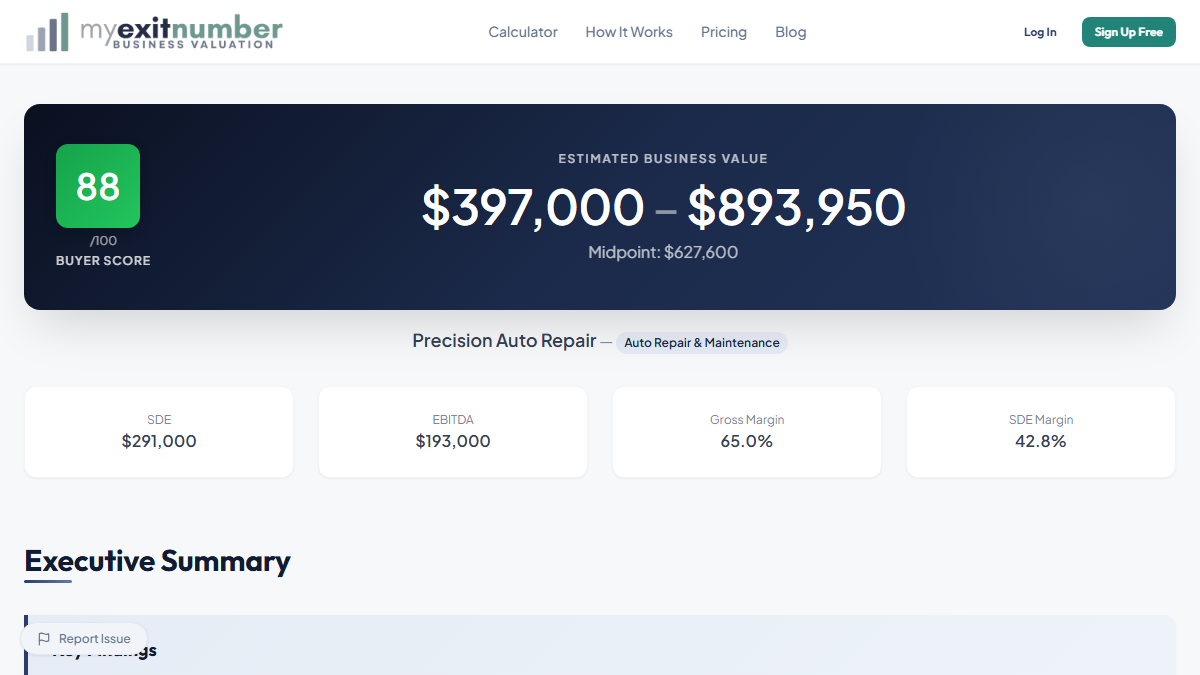
Converting EBITDA to a valuation uses the same multiplication step as SDE: multiply EBITDA by your industry multiple.
For auto repair and maintenance, EBITDA multiples range from about 3.0x to 5.0x:
| Multiple | Calculation | Estimated Value |
|---|---|---|
| Low (3.0x) | $193,000 x 3.0 | $579,000 |
| Mid (4.0x) | $193,000 x 4.0 | $772,000 |
| High (5.0x) | $193,000 x 5.0 | $965,000 |
Compare that to the SDE-based range: $291,000 x 2.0-3.0 = $582,000-$873,000. The midpoints are in the same neighborhood ($772,000 vs $728,000), which is a sign the valuation is internally consistent. When SDE and EBITDA methods produce wildly different ranges, it signals something unusual about the owner's compensation or expenses that warrants a closer look.
EBITDA is one of three methods used to estimate a business's value. The others - SDE multiples and revenue multiples - provide additional data points. Buyers and brokers cross-reference all three, and the final sale price falls somewhere in the overlap.
EBITDA Is Not Complicated - It Is Just Different
EBITDA measures the same business through a different lens than SDE. It strips away the owner's personal economics and one-time events to reveal what the business earns as an operation. That makes it essential for conversations with corporate buyers, PE firms, and lenders - even if SDE remains the more relevant number for your specific situation.
Frequently Asked Questions
What does a lender actually do with EBITDA?
Lenders use it as the starting point for debt service analysis. They want to know how much operating cash flow exists before financing decisions, then they compare that figure to the proposed loan payments to see whether the business can realistically carry the debt.
What kind of buyer insists on EBITDA first?
Strategic acquirers, private equity firms, and search funds with a manager-ready playbook usually start with EBITDA. They need a metric that lets them compare many businesses quickly without reworking every owner's compensation structure from scratch.
What gets normalized around EBITDA during diligence?
Buyers test whether expenses really belong in operations, whether the owner's salary reflects market compensation, and whether reported margins are sustainable. They are trying to figure out what the business earns after the current owner is no longer making one-off decisions.
Why can EBITDA matter even if my business is still owner-operated?
Because lenders and institutional buyers may still use it as a secondary lens, even when SDE is the primary anchor. If your EBITDA is weak, it can cap leverage, reduce buyer confidence, and narrow the pool of acquirers willing to pursue the deal.
When does EBITDA become more important than SDE?
Usually when the business has a real management layer, stronger scale, and a buyer pool that is no longer mostly individual operators. Once the owner is not the engine of day-to-day delivery, EBITDA starts to describe the business better than SDE does.
Find Out What Your Business Is Worth
MyExitNumber calculates your business value using three proven methods - SDE, EBITDA, and Revenue multiples - so you get the full picture, not just one number.