

SDE Explained: What Seller's Discretionary Earnings Really Means
Most small business owners can tell you their annual revenue faster than they can tell you their SDE. That is a problem, because the number that usually drives a small business sale is not revenue, net profit, or EBITDA. It is seller's discretionary earnings - the metric that tells a buyer what the business actually puts in an owner-operator's pocket.
SDE is the most important number in small business valuation. If you are thinking about selling, planning a future exit, or just curious what your business is worth, understanding seller's discretionary earnings is where you start.
What Seller's Discretionary Earnings Actually Measures
Seller's discretionary earnings represents the total financial benefit a single owner-operator takes from the business. Not just salary. Not just profit. Everything.
Think of it this way: if someone bought your business tomorrow and ran it themselves, how much cash would the business put in their pocket each year? That is SDE.
It includes your salary, your benefits, your personal expenses that flow through the business, and accounting entries like depreciation that reduce your taxable income but do not cost you actual cash. It also strips out one-time costs that will not carry over to a new owner.
The reason SDE matters more than net profit for small businesses is straightforward. Net profit on your tax return is designed to minimize what you owe the IRS. It does not represent what the business is actually producing for you. Business owners run personal vehicle leases, cell phone plans, retirement contributions, and health insurance through the business. That is rational tax planning, but it makes net profit a poor measure of earning power.
SDE corrects for all of that.
The SDE Formula, Step by Step
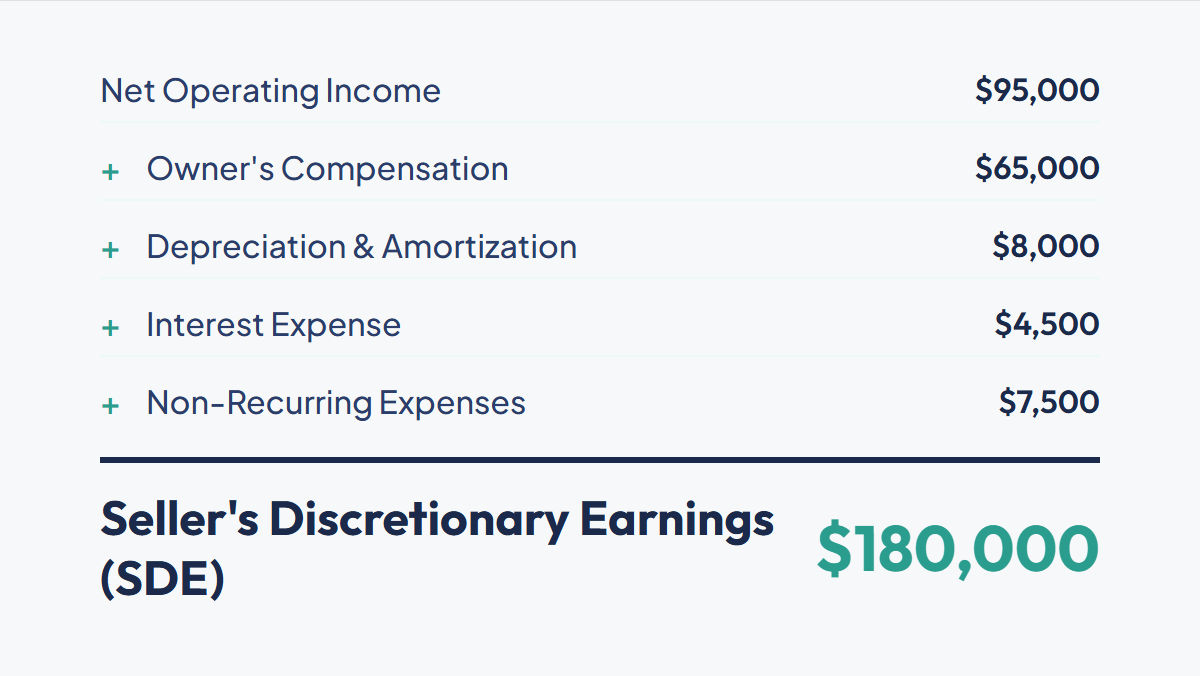
SDE equals net operating income plus owner's compensation, depreciation, interest, and non-recurring expenses - all in one formula. The calculation is straightforward arithmetic. Start with net operating income, then add back every expense that is personal to the owner, non-cash, or non-recurring.
Here is a worked example using a neighborhood bakery generating $380,000 in annual revenue:
| Line Item | Amount |
|---|---|
| Annual revenue | $380,000 |
| Cost of goods sold (flour, ingredients, packaging) | $133,000 |
| Operating expenses (rent, staff wages, utilities, insurance) | $152,000 |
| Owner's total compensation (salary + benefits) | $65,000 |
| Depreciation & amortization | $8,000 |
| Interest expense | $4,500 |
| Non-recurring expenses (new POS system installation) | $7,500 |
Step 1: Gross Profit
$380,000 - $133,000 = $247,000
Step 2: Net Operating Income
$247,000 - $152,000 = $95,000
Step 3: Add back owner-related, non-cash, and one-time expenses
$95,000 + $65,000 (owner's comp) + $8,000 (D&A) + $4,500 (interest) + $7,500 (non-recurring) = $180,000
That $180,000 is the bakery's SDE. Compare that to the net operating income of $95,000. The difference - $85,000 - represents real money flowing to the owner that standard accounting buries in expense categories.
If this bakery's tax return showed $95,000 in net income, a buyer looking only at that number would undervalue the business by nearly half.
Common SDE Add-Backs and Which Ones Buyers Accept
Add-backs are expenses added back to net income to calculate SDE because they are personal to the owner, non-cash, or non-recurring. Not every expense qualifies as a legitimate add-back. This is where negotiations get heated, and where inexperienced sellers lose credibility.
Here is how buyers and brokers categorize them:
| Add-Back Category | Examples | Buyer Acceptance |
|---|---|---|
| Owner's compensation | Salary, payroll taxes, health insurance, retirement contributions | Accepted without question |
| Depreciation & amortization | Equipment depreciation, leasehold improvements | Accepted - standard non-cash item |
| Interest expense | Loan payments, line of credit interest | Accepted - buyer's financing will differ |
| Owner perks on the books | Personal vehicle, cell phone, meals, travel | Accepted if documented in financial statements |
| Genuine one-time costs | Lawsuit settlement, fire damage repair, equipment replacement | Accepted with proof it was truly one-time |
| "Non-recurring" expenses that recur | Annual equipment repairs labeled "one-time," regular legal fees | Rejected - buyers will check 3 years of records |
| Above-market rent paid to yourself | Paying yourself $6,000/mo rent when market rate is $3,500 | Partially accepted - only the above-market portion |
The practitioner rule: if you cannot show an add-back on your tax return or financial statements, buyers will not accept it. Verbal claims like "I also take $20,000 in cash that is not on the books" kill deals. Every serious buyer will run your claimed SDE against your bank deposits and tax filings. The numbers need to match.
Brokers who handle SBA-financed deals apply an even stricter filter. SBA lenders require that every add-back be documented and verifiable. If the bank's underwriter rejects an add-back, it drops your SDE, which drops the valuation, which can sink the buyer's loan approval entirely.
SDE vs EBITDA: When Each One Matters
SDE and EBITDA (Earnings Before Interest, Taxes, Depreciation, and Amortization) both measure business earnings, but they answer different questions for different buyers.
| SDE | EBITDA | |
|---|---|---|
| Includes owner's compensation | Yes | No |
| Includes non-recurring expenses | Yes | No |
| Best for | Owner-operated businesses under ~$1M earnings | Larger businesses with professional management |
| Primary users | Individual buyers, search funds, SBA-financed deals | Corporate acquirers, private equity, strategic buyers |
For the bakery example: SDE is $180,000, while EBITDA is $107,500 ($95,000 + $8,000 + $4,500). The $72,500 gap is the owner's salary plus the one-time POS installation.
Why the distinction matters: a buyer who plans to run the bakery themselves cares about SDE because they are replacing the current owner. They get that full $180,000. A corporate buyer who will hire a manager at $65,000 per year cares about EBITDA because the owner's compensation stays as an expense on the books.
For businesses under roughly $1 million in earnings where the owner is actively involved in daily operations, SDE is the primary valuation metric. Above that threshold, buyers and sellers shift toward EBITDA. If you are running a business in the $200K-$5M revenue range and doing real work in it daily, your valuation conversation will center on SDE.
What Your SDE Margin Tells You
SDE margin is SDE expressed as a percentage of revenue, showing how efficiently a business converts sales into total owner benefit. Raw SDE in dollars only tells half the story. SDE as a percentage of revenue tells the other half.
SDE Margin = SDE / Revenue
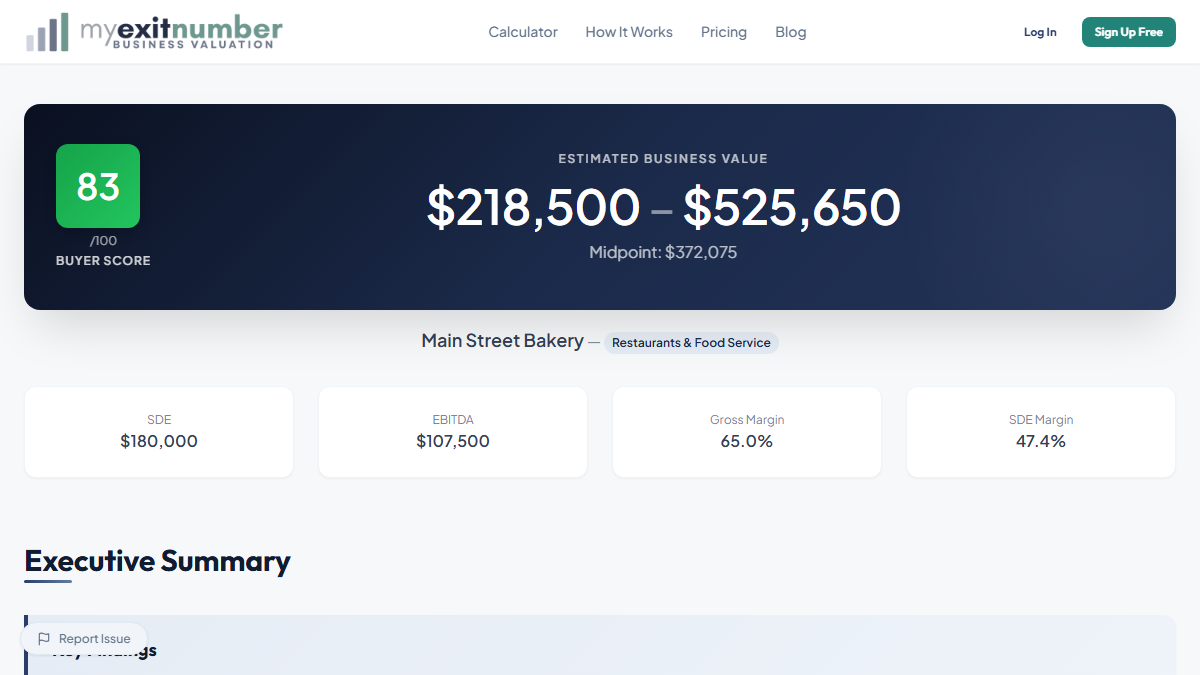
For the bakery: $180,000 / $380,000 = 47.4%
This means for every dollar of revenue, 47.4 cents flows to the owner as total financial benefit. That is a strong margin for a food service business.
Why SDE margin matters to buyers: two businesses can both show $180,000 in SDE, but the one generating it from $380,000 in revenue is a fundamentally different proposition than one generating it from $900,000 in revenue. The higher-margin business is more efficient, more resilient to revenue dips, and commands a higher multiple.
Healthy SDE margins vary by industry. Service businesses with low overhead - consulting, bookkeeping, IT services - run 50-65%. Retail and food service sit in the 30-50% range. Manufacturing and construction tend to be lower, around 20-35%, because of materials and labor costs.
If your SDE margin is significantly below your industry's median, it signals one of two things: either your expenses are too high relative to peers, or your pricing is too low. Both are fixable before a sale, and fixing them before listing directly increases what a buyer will pay. (MyExitNumber shows how your SDE margin compares to your industry median in the comparative analysis.)
How to Turn SDE into a Valuation
Once you know your SDE, calculating a business valuation is one multiplication step away: multiply SDE by your industry multiple, a figure derived from actual completed business sales in your sector.
Business Value = SDE x Industry Multiple
For bakeries and food service, SDE multiples range from about 1.5x to 2.5x. Applying that to the bakery:
| Multiple | Calculation | Estimated Value |
|---|---|---|
| Low (1.5x) | $180,000 x 1.5 | $270,000 |
| Mid (2.0x) | $180,000 x 2.0 | $360,000 |
| High (2.5x) | $180,000 x 2.5 | $450,000 |
This bakery is worth roughly $270,000 to $450,000 based on SDE alone. Where it falls within that range depends on qualitative factors: growth trend, owner dependency, customer diversity, and the quality of the financial records.
A mistake sellers make is assuming they deserve the top multiple. Multiples at the high end reflect businesses with growing revenue, diversified customers, documented processes, and an owner who could step away for a month without the business suffering. If that does not describe your situation, plan for the mid range and treat anything higher as upside.
Keep in mind that SDE is one of three methods buyers cross-reference. EBITDA multiples and revenue multiples provide additional data points, and the final sale price lands somewhere in the overlap. For a full walkthrough of all three methods with a worked example, see How Much Is My Business Worth? A Step-by-Step Guide.
Your SDE Is the Starting Line
Seller's discretionary earnings is not an inflated number or an accounting trick. It is the most accurate measure of what a small business puts in the owner's pocket each year, and it is the foundation of nearly every small business sale price under $1 million. Understanding what belongs in SDE, and what a buyer will push back on, puts you in a different position entirely when it comes to selling, financing, or growing your business.
Frequently Asked Questions
What add-back gets challenged most often in a sale?
Owner perks and “non-recurring” expenses get challenged first. Buyers usually accept salary, payroll taxes, depreciation, and interest quickly. They push hardest on travel, vehicle, meals, family payroll, and any one-time cost that looks suspiciously repeatable in prior years.
What documents prove an SDE add-back is real?
Tax returns, P&Ls, general ledger detail, bank statements, and invoices do the heavy lifting. If an add-back only exists in your explanation and not in your records, buyers and SBA lenders will treat it as unproven.
Can I add back all of my salary?
Usually yes for a truly owner-operated business sold to an individual buyer. But if the buyer is likely to hire a replacement manager, they may argue that some portion of your salary reflects a market operating role and should remain as an expense.
What makes buyers distrust an SDE calculation?
Inconsistent books, aggressive personal-expense adjustments, and add-backs that change depending on who is asking. If your SDE number keeps moving during diligence, buyers stop trusting the whole file, not just one adjustment.
How far back do buyers usually check SDE add-backs?
Usually at least three years, and sometimes longer if the trend looks erratic. They want to know whether your “one-time” expense is truly isolated or just the latest version of a recurring pattern.
Find Out What Your Business Is Worth
MyExitNumber calculates your business value using three proven methods - SDE, EBITDA, and Revenue multiples - so you get the full picture, not just one number.