
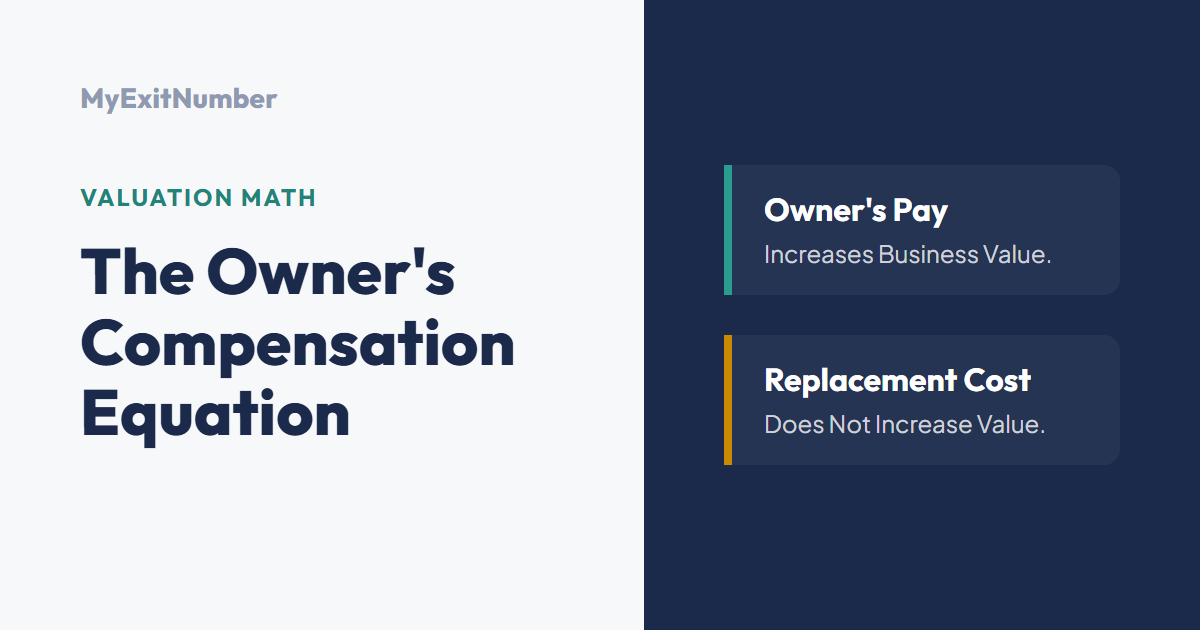
Owner's Compensation and Business Valuation: What Buyers Adjust For
The seller says, "I pay myself $150,000, so that all gets added back." The buyer says, "Not so fast. I still need someone to run this business after you leave." That one disagreement can move a valuation by six figures.
Owner's compensation is one of the most misunderstood parts of a small business valuation. Sellers often treat all of it as recoverable value. Buyers usually treat part of it as a real operating expense that stays with the business. The gap between those two views is where a lot of valuation negotiations get ugly.
Short answer: owner's compensation gets added back only to the extent it exceeds the market cost of replacing the owner in the business. If a buyer still needs to pay someone to do your job after closing, that portion is not a clean add-back. It stays in the operating model.
Owner's Compensation Business Valuation Basics
Owner's compensation in a business valuation is the total salary, benefits, perks, and distributions the owner takes from the company. The key question is not whether you get paid. It is whether that pay reflects ownership, labor, or both.
In an owner-operated business, your compensation often mixes three things together:
- return on ownership
- payment for day-to-day work
- personal perks run through the business
The valuation problem is that buyers do not pay the same multiple to all three.
If you answer sales calls, manage staff, handle scheduling, and close every major client yourself, a buyer will assume some replacement person has to be hired after you leave. That portion of your pay is not a clean add-back. It is an operating expense in disguise.
If part of your compensation is above-market owner profit, or includes benefits and perks that a replacement manager would not receive, that portion is more likely to be added back.
When Owner's Compensation Gets Added Back - and When It Does Not
Owner's compensation gets added back only to the extent that it exceeds the market cost of replacing the owner in the business.
That distinction is what separates a clean SDE discussion from a fight during diligence.
Usually added back in full:
- the business is sold to an individual buyer who will replace the owner directly
- the owner actively performs the operator role full-time
- the buyer is underwriting the deal on SDE, not EBITDA
Usually not added back in full:
- the buyer is a strategic acquirer or PE-backed group using EBITDA
- the business needs a market-rate manager, sales lead, or operator after the owner exits
- part of the owner's current pay reflects a real job that will still exist after closing
Common gray area:
- the business is still owner-led, but the owner's pay is well above what a replacement would cost
That gray area is where negotiations usually happen. A buyer may say, "You pay yourself $150,000, but the market says I can replace you for $95,000. So only $55,000 is a real add-back."
That is not a bad-faith argument. It is a standard valuation adjustment.
Market-Rate Replacement Cost Is the Real Battleground
The fight is usually not about the existence of owner's compensation. It is about replacement cost.
Buyers ask a simple question: if the seller disappeared tomorrow, what would it cost to hire someone to do that work competently?
That replacement-cost estimate usually comes from:
- local salary benchmarks
- recruiter conversations
- industry-specific compensation norms
- org-chart reality inside the business
The seller's title does not decide the answer. The work does.
If you call yourself "CEO" but spend 70% of your week doing account management and operations, buyers will not value you like a passive owner. They will value you like an operator with an expensive title.
This is also where lenders get cautious. If the deal depends on adding back a salary that really belongs in normalized operating costs, underwriting can unravel fast unless the replacement-cost case is documented clearly.
Worked Example: Bookkeeping Firm
This bookkeeping practice shows how big the adjustment can get.
| Line Item | Amount |
|---|---|
| Annual revenue | $480,000 |
| Cost of goods sold | $48,000 |
| Operating expenses | $210,000 |
| Owner's total compensation | $150,000 |
| Depreciation & amortization | $3,000 |
| Interest expense | $2,000 |
| Non-recurring expenses | $5,000 |
Gross Profit = $480,000 - $48,000 = $432,000
Net Operating Income = $432,000 - $210,000 = $222,000
If you add back the full owner's compensation, the calculation looks like this:
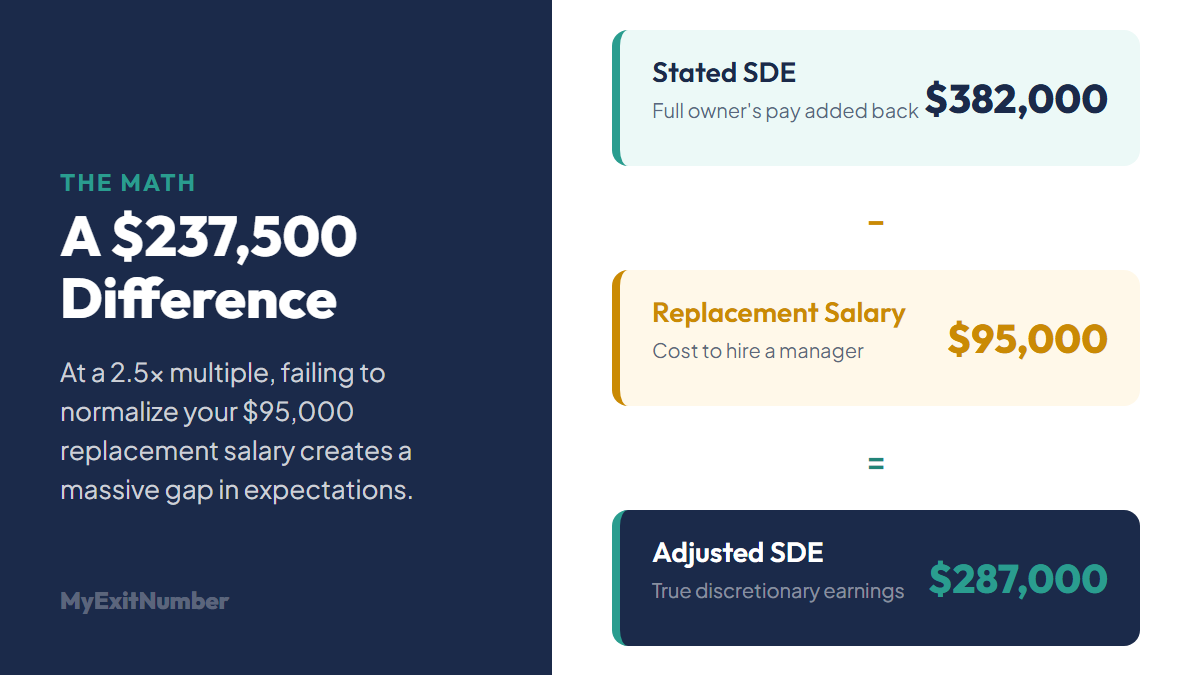
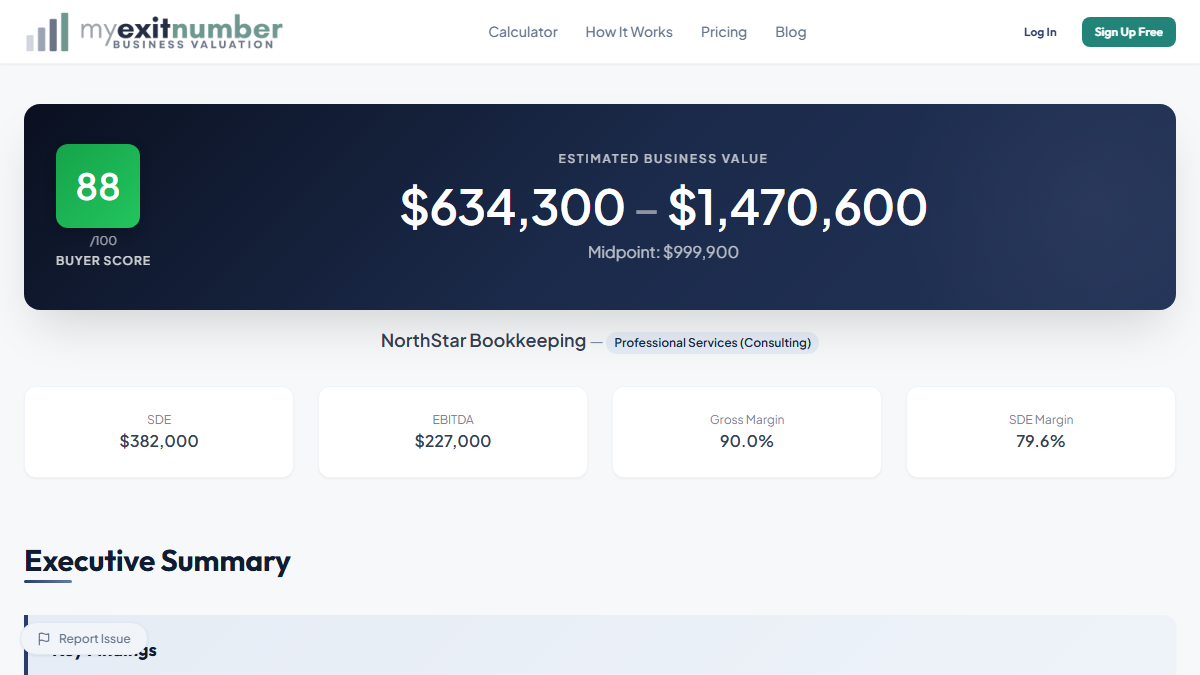
SDE = $222,000 + $150,000 + $3,000 + $2,000 + $5,000 = $382,000
But now assume a buyer concludes the firm needs a replacement operator or bookkeeping manager paid $95,000.
In that case, only the difference between the owner's current pay and the replacement salary is truly discretionary:
True compensation add-back = $150,000 - $95,000 = $55,000
Adjusted SDE becomes:
Adjusted SDE = $222,000 + $55,000 + $3,000 + $2,000 + $5,000 = $287,000
That is a $95,000 difference in earnings before you even apply a multiple.
At a 2.5x SDE multiple:
- Full add-back valuation: $382,000 x 2.5 = $955,000
- Replacement-cost-adjusted valuation: $287,000 x 2.5 = $717,500
That is a valuation gap of $237,500 created by one compensation judgment.
This is why owners should never assume their full salary will survive buyer scrutiny. (If you want to test different replacement-salary assumptions, MyExitNumber's scenario tools make the effect visible right away.)
How Buyers, Brokers, and Lenders Look at It
Different counterparties adjust owner's compensation differently because they are solving different problems.
| Party | Main Question | How They View Owner's Compensation |
|---|---|---|
| Individual buyer | What will I personally earn if I replace the seller? | More willing to add back the full amount |
| Broker | What price range is realistic for the likely buyer pool? | Often starts with full SDE, then normalizes if needed |
| Strategic buyer | What operating cost remains after closing? | More likely to leave replacement salary in the business |
| SBA lender | Can debt still be serviced after normalization? | Wants conservative, documented replacement cost |
In practice, brokers often show sellers the optimistic version first - the one using full SDE. Buyers and lenders then work backward toward a normalized number. That does not mean the broker is wrong. It means the broker is framing for the broadest possible market while the buyer is underwriting real post-close economics. If you want the broader earnings context around that negotiation, see SDE vs EBITDA.
One thing owners underestimate: if your org chart is vague, buyers will assume the replacement cost is higher, not lower. When nobody knows exactly what you do all week, they price in risk.
Common Mistakes Owners Make
Mistake 1: treating all compensation as discretionary. If your business still needs someone doing your job after the sale, not all of that pay is discretionary.
Mistake 2: ignoring market salary benchmarks. If the market says a replacement GM costs $95,000, arguing that your $150,000 is fully add-backable will not go far.
Mistake 3: mixing perks with core operating labor. Vehicle, meals, family cell plans, and extra distributions may be legitimate add-backs. The salary attached to a real operating role is a separate issue.
Mistake 4: waiting until diligence to explain it. If you only start justifying owner's compensation after a buyer challenges it, you are already on defense.
The best time to deal with this is before going to market. Build a simple replacement-role memo for yourself: what functions you perform, what a replacement would cost, and what part of your current compensation is truly discretionary. That one page can save a lot of friction later.
The Right Question Is Not "Can I Add It Back?"
The right valuation question is not whether owner's compensation exists. It is how much of it would survive a buyer's normalization test.
If the answer is "not much," your SDE holds up well. If the answer is "$80,000 to $120,000 a year," your valuation probably needs to be normalized before the buyer does it for you.
MyExitNumber calculates SDE and EBITDA side by side, so you can see how compensation normalization changes the result before a buyer does it for you. It is free to use with no signup required, and the full report with scenario modeling and benchmarks is $49 at myexitnumber.com.
Frequently Asked Questions
Is owner's compensation always an add-back in business valuation?
No. It is only a full add-back if a buyer can truly remove it without replacing the work behind it. If the business still needs someone doing the owner's job after the sale, part of that compensation remains an operating expense.
How do buyers decide the replacement salary?
Buyers usually use market salary benchmarks, recruiter input, local compensation norms, and the actual functions the owner performs. Titles matter much less than the underlying work.
Why does owner's compensation matter more in small business valuation than in large-company valuation?
Because in small businesses the owner is often deeply involved in operations, sales, or delivery. That means the owner's pay mixes return on ownership with labor cost, and buyers need to separate those pieces to value the business correctly.
Can a lender reject an aggressive compensation add-back?
Yes. SBA lenders and conservative underwriters often challenge owner's compensation adjustments if the replacement-cost logic is weak or poorly documented. If the normalization does not hold up, the loan structure can break.
What is the easiest way to prepare for this issue before selling?
Create a simple role-and-replacement memo before you go to market. Document what you actually do, what a replacement would cost, and which parts of your compensation are true owner benefit versus operator pay.
Find Out What Your Business Is Worth
MyExitNumber calculates your business value using three proven methods - SDE, EBITDA, and Revenue multiples - so you get the full picture, not just one number.