
What Do Business Brokers Look for in a Valuation?
A broker opens the tax returns, scans the profit and loss statement, and starts crossing things out. Personal expenses. Soft add-backs. Revenue concentration the seller barely mentions. Before the conversation reaches price, the broker is already deciding whether the number can survive a buyer, a bank, and diligence. That is what dealability means in practice.
The difference between a theoretical valuation and a listable price is where a broker earns the fee. They have to account for the qualitative risks that a spreadsheet often ignores but a buyer will use to grind the price down. If you are preparing to go to market, understanding the broker's lens is one of the best ways to protect your equity.
Short answer: brokers recast your earnings, test dealability, adjust the multiple for risk, and decide whether the asking price can survive buyer scrutiny, lender underwriting, and due diligence. A broker valuation is less about the prettiest number and more about the number that can actually close.
What Brokers Mean by Valuation
In practice, that means choosing the right earnings lens first. Brokers focus heavily on SDE (Seller's Discretionary Earnings) for businesses with less than about $1 million in earnings. For larger entities, they shift toward EBITDA (Earnings Before Interest, Taxes, Depreciation, and Amortization). If you want the line where brokers make that call, see SDE vs EBITDA.
However, the metric itself is only the starting point. A broker's primary job is to determine the appropriate valuation multiple to apply to those earnings. Two businesses in the same industry can land at very different multiples if one is easier to finance, transfer, and defend in diligence.
What They Check First: The Quality of Earnings
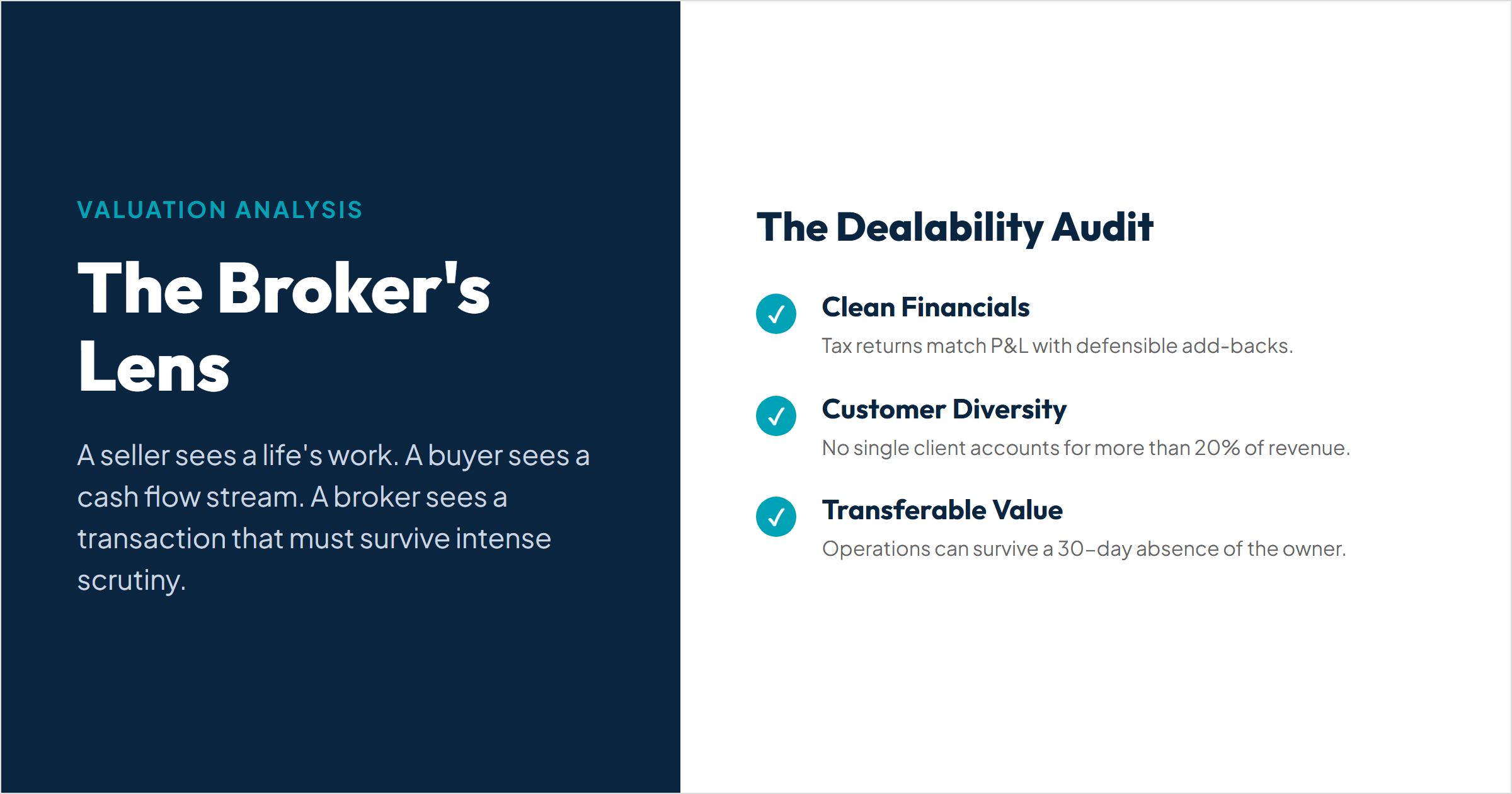
The first broker review focuses on whether the earnings are clean enough to survive diligence and lender scrutiny.
The first thing a broker does is recast your financials. They take your tax returns and profit and loss statements and strip away everything that is not essential to the operation of the business. If the recast produces earnings a lender will not recognize, the listing price is theoretical from day one.
A broker looks for:
- Clean Tax Returns: If you have been managing taxes by burying personal expenses in the business, a broker will find them. If those expenses are not easily defensible to a lender, they will not be added back to the valuation.
- Owner Compensation Consistency: They will analyze owner compensation to ensure it reflects a fair market salary for a replacement manager. If you are underpaying yourself to inflate the bottom line, the broker will adjust the earnings downward.
- Non-Recurring Events: One-time legal settlements, unusual repairs, or clearly non-recurring costs are the add-backs brokers look for when they normalize the earnings.
If the financial records are messy, the broker knows the buyer's due diligence will be a nightmare. A business with $500,000 in clean, audited earnings is worth significantly more than a business claiming $600,000 in earnings that require a forensic map to find.
(MyExitNumber gives you the same SDE, EBITDA, and multiple framework brokers will pressure-test later, so you can see the baseline before the broker applies a marketability discount.)
The Dealability Audit: What Brokers Flag Before Going to Market
Brokers move from math to dealability once they know the earnings base is directionally credible.
Once the math is settled, the broker moves into the dealability phase. This is where they look for red flags that could kill a deal mid-process. A high valuation is meaningless if the business is hard to finance, hard to transfer, or hard to close.
Customer Concentration
If 40% of your revenue comes from a single client, a broker will immediately discount your valuation. They know that a buyer, and more importantly an SBA lender, will see this as an existential risk. If that client leaves the day after the sale, the business may no longer be able to service its debt.
Owner Dependency
Can the business run for 30 days without the owner's involvement? If the answer is no, the broker will flag this as high risk. To a buyer, an owner-dependent business is harder to transfer and harder to finance. Brokers prefer businesses with transferable value: systems, processes, and a management layer that does not rely entirely on the founder. If you want the seller-side prep work behind that, see How to Prepare Your Business for Sale.
Lease Terms and Landlord Relations
In many small business sales, the lease is the most underrated deal-killer. A broker will check how much time is left on your lease and whether it is assignable. If you have two years left on a lease with no options to renew, the business is effectively unsellable to anyone requiring bank financing.
Worked Example: The Tale of Two Sellers
The broker's real job is deciding whether identical earnings deserve identical pricing in the market.
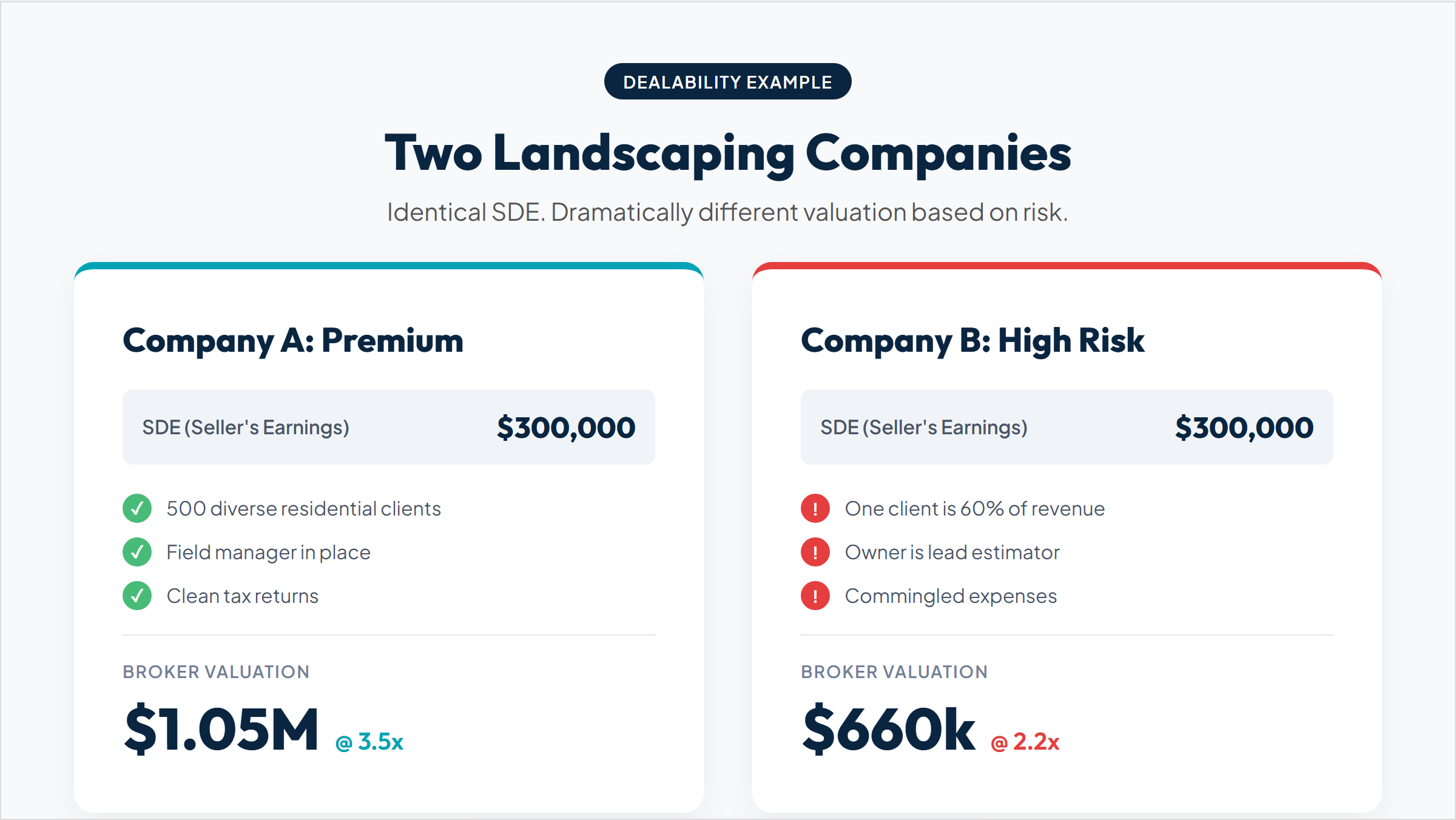
To illustrate how brokers view valuation differently than a simple calculator, consider two local landscaping companies: Company A and Company B.
Company A:
- Revenue: $1.2M
- SDE: $300,000
- Customer Base: 500 residential clients, none over 1% of revenue
- Operations: has a field manager, owner works 15 hours a week on strategy
- Records: three years of clean, consistent tax returns
- Broker Reaction: this is a premium listing. We can go to market at a 3.5x multiple, or $1.05M, and likely get multiple offers because it is bankable.
Company B:
- Revenue: $1.2M
- SDE: $300,000
- Customer Base: 3 major commercial contracts, with one at 60% of revenue
- Operations: owner is the lead estimator and no one else can quote jobs
- Records: commingled expenses and personal spending run through the books
- Broker Reaction: we have a problem. The SDE might be $300k on paper, but between the customer concentration and messy books, no bank will touch this. We have to list at a 2.2x multiple, or $660k, and look for a buyer who understands the risk.
On the same $300,000 SDE, Company A supports roughly $1.05M in value ($300,000 x 3.5), while Company B supports about $660,000 ($300,000 x 2.2).
Both businesses have the same earnings according to a basic formula, but the broker sees a $390,000 difference in value because of dealability.
Listing Price vs. Fair Market Value
Brokers separate paper value from listing strategy because seller expectations and market behavior are not the same thing.
There is a practical gap between what a business is worth on paper and what it should be listed for in the market. A broker's strategy usually involves one of three pricing tiers:
- The Aspiration Price: pricing at the top of the range to leave room for negotiation
- The Market Price: pricing where the data suggests it will attract serious buyers quickly
- The Fast-Exit Price: pricing below market to increase urgency and speed
Brokers also have to manage seller expectations. If a seller insists on a $2M price for a business that only supports a $1.2M valuation, most reputable brokers will pass on the listing. They do not want to spend months marketing a business that will never close.
What Sellers Should Fix Before Meeting a Broker
When the books are clean and the operating basics are documented, the broker spends less time reconstructing the past and more time positioning the deal.
Before you even call a broker for a formal valuation, there are several low-friction items you can address to improve your standing. Preparing your business for sale is a multi-month process, but these specific financial fixes make the broker's job easier:
- Separate Personal and Business Expenses: for at least one full fiscal year, stop running personal items through the business
- Standardize Financial Reporting: if miscellaneous is your third-largest expense line, fix it
- Document Your Systems: create a basic SOP manual and show the broker that the business can function without you
- Address Obvious Debt: if you have high-interest short-term debt, pay it down or have a clear closing plan
Questions to Ask a Broker About Your Valuation
The quality of a broker valuation depends as much on the assumptions as on the final number.
When a broker presents you with a valuation, do not just look at the bottom-line number. Challenge the assumptions behind it.
1. What data sources did you use for the multiples?
A good broker should be able to explain whether the pricing came from recent comps, current buyer conversations, lender feedback, or industry transaction data.
2. What is the biggest risk in this deal that would scare away a bank?
You want a broker who is honest about the weaknesses, not one who is just trying to win the listing.
3. How many similar businesses have you sold in this price range lately?
Market conditions change fast. A valuation built on stale assumptions can miss what today's lenders and buyers will actually support.
4. Which valuation method did you weigh most heavily?
Ask why they chose SDE over EBITDA, or whether they used an asset-heavy floor in the background.
The Number Still Has to Survive the Bank
A broker-ready valuation has to survive more than seller optimism - it has to survive lender logic, buyer skepticism, and diligence.
A business broker valuation is a dress rehearsal for the scrutiny that comes later from the buyer, the lender, and diligence. Many small business sales rely on SBA financing, which means the valuation logic eventually has to survive an outside review.
If the broker's valuation is too aggressive, the lender or buyer will cut it down later, and the deal can break near the finish line because the financing no longer works. By focusing on dealability, clean recasting, and risk mitigation, you give yourself a better chance of listing at a number you can actually defend.
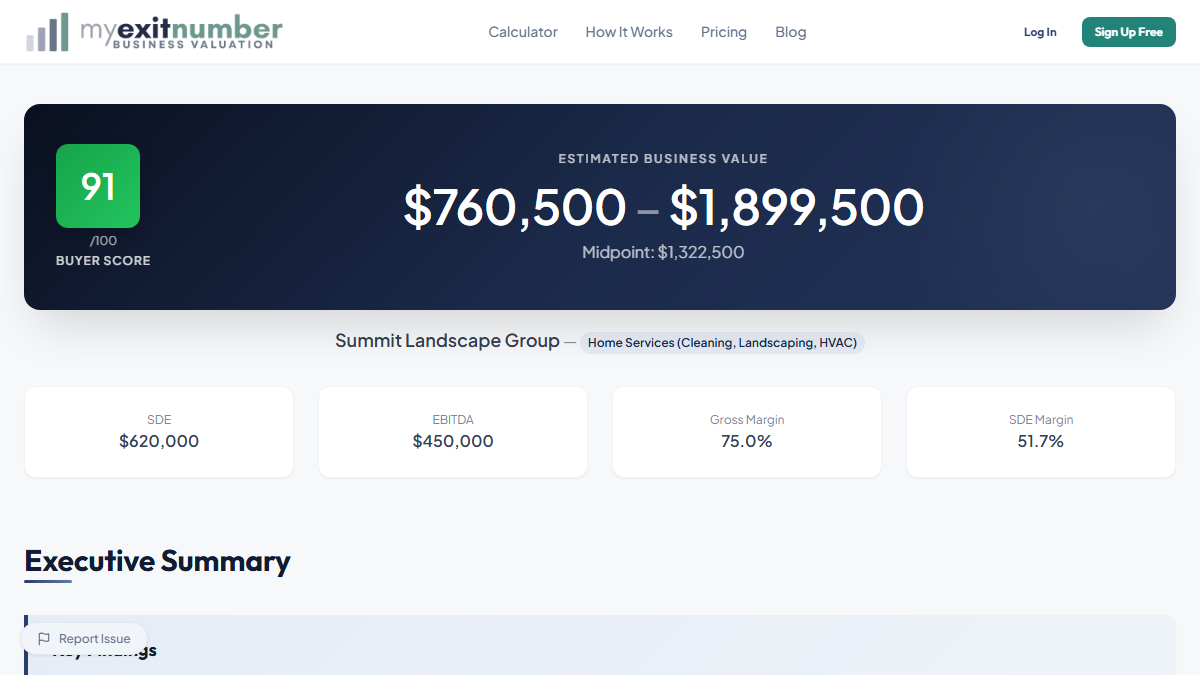
Before you meet a broker, get your own baseline first. MyExitNumber shows your SDE, EBITDA, and valuation range, then lets you compare how different assumptions change the outcome, so you walk into the first conversation with numbers instead of guesses.
Frequently Asked Questions
Why is a broker's valuation different from an online calculator?
An online calculator provides a baseline based on general industry data. A broker's valuation includes a qualitative dealability filter, adjusting for risks like lease terms, customer concentration, and management depth that a calculator cannot see on its own.
What makes a broker lower the multiple even if earnings look strong?
Usually the same patterns show up: customer concentration, owner dependency, weak lease terms, messy books, and earnings that do not survive normalization. Strong profit alone does not guarantee a strong multiple.
Can I use a broker's valuation for a legal dispute or divorce?
Usually not. A broker's valuation is designed for marketing and sale decisions, not for legal, tax, or litigation contexts that may require a formal appraisal or specialist opinion.
How long is a broker's valuation valid?
Only as long as the market conditions behind it still hold. If rates move sharply, buyer demand shifts, or business performance changes, the valuation may need to be refreshed much sooner than the seller expects.
Will a broker value my future growth?
Rarely. Brokers value what has already happened. They may market upside to buyers, but they do not usually build future projections directly into the listing price because the financing still has to work on current performance.
Find Out What Your Business Is Worth
MyExitNumber calculates your business value using three proven methods - SDE, EBITDA, and Revenue multiples - so you get the full picture, not just one number.