

How Much Is My Business Worth? A Step-by-Step Guide
You are sitting across from a banker, a buyer, or a business broker, and they ask the question: how much is your business worth? If you do not have a number backed by real math, you are negotiating blind. The good news is that the math is straightforward once you organize the right inputs.
Buyers and brokers use three valuation methods for small businesses - SDE multiples, EBITDA multiples, and revenue multiples. Each one looks at your business through a different lens. Running all three and blending the results gives you a range you can actually defend in a conversation.
Short answer: most owner-operated small businesses are worth a range based primarily on SDE, checked against EBITDA and revenue multiples. SDE usually carries the most weight for a Main Street business, EBITDA matters more as the business becomes manager-run, and revenue is mainly a sanity check unless the company is high-growth or margin-distorted.
Start here if you want the broad answer first: what buyers look at, how the three methods fit together, and why your result should be a range instead of one magic number. If you already know where you are stuck, you can branch into the deeper guides on SDE, EBITDA, multiples, or sale prep from this page.
Why Revenue Is Not Value
Revenue and value are not the same thing. A plumbing company generating $520,000 in revenue might be worth $500,000 or $830,000 depending on how much profit it produces, how dependent it is on the owner, and what industry multiples apply.
Two businesses with identical revenue can sell for vastly different prices. The difference comes down to earnings - specifically, how much money the business actually puts in the owner's pocket after expenses. That is why valuation methods focus on earnings metrics, not top-line revenue.
The second common mistake is using a single multiplier from a friend or an article. "Businesses sell for 2x earnings" is technically true for some businesses in some industries, but the range is wide. Without knowing which earnings metric and which multiple applies to your situation, a single number is more misleading than helpful.
Three Methods Buyers Actually Use
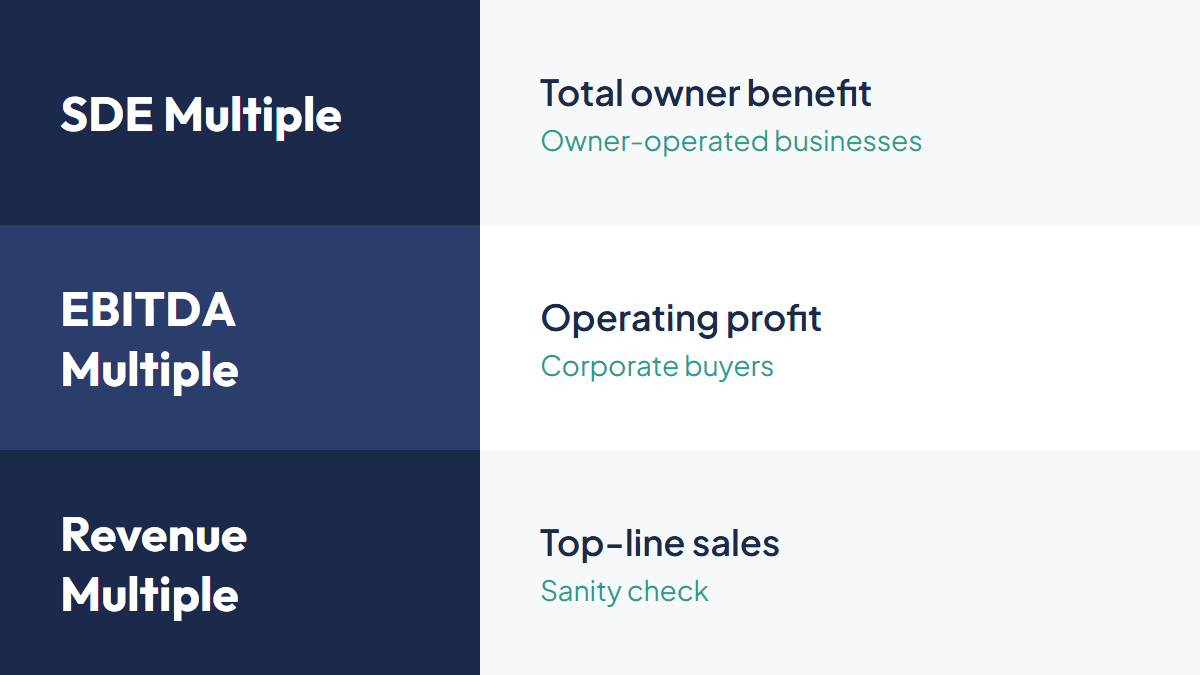
Small business valuations rely on three approaches, each producing a range based on your industry. The overlap between them is where your realistic value sits.
| Method | Best For | What It Measures |
|---|---|---|
| SDE Multiple | Owner-operated businesses under ~$1M earnings | Total financial benefit to a single owner |
| EBITDA Multiple | Larger businesses or corporate buyers | Operating profit independent of ownership |
| Revenue Multiple | Quick sanity check, high-growth businesses | Top-line sales relative to industry norms |
If you want the detailed version of one method, go deeper in SDE Explained, EBITDA for Small Business Owners, or What Is a Revenue Multiple and When Should You Use It?. If you want the calculation mechanics only, jump to How to Calculate the Value of a Small Business.
For the rest of this guide, we will use a real example: a residential plumbing company with eight years in business and steady growth. Here are the numbers from the most recent fiscal year.
| Line Item | Amount |
|---|---|
| Annual revenue | $520,000 |
| Cost of goods sold (materials, subcontractors) | $156,000 |
| Total operating expenses (rent, payroll, insurance, marketing) | $208,000 |
| Owner's total compensation (salary + benefits + truck) | $85,000 |
| Depreciation & amortization | $14,000 |
| Interest expense | $5,000 |
| Non-recurring expenses (truck replacement) | $10,000 |
Step 1: Calculate Your SDE and EBITDA
Before applying any multiples, you need two earnings metrics. Both start from the same place - net operating income - but add back different items.
Gross Profit = $520,000 - $156,000 = $364,000
Net Operating Income = $364,000 - $208,000 = $156,000
SDE (Seller's Discretionary Earnings)
Seller's Discretionary Earnings adds back every expense that is personal to the current owner, non-cash, or non-recurring. It represents the total annual benefit to a single owner-operator.
$156,000 + $85,000 (owner's comp) + $14,000 (D&A) + $5,000 (interest) + $10,000 (non-recurring) = $270,000
If your tax return shows $156,000 in net income, a buyer looking only at that number would undervalue your business by 42%. The add-backs represent real money flowing to you that standard accounting obscures. For a deeper explanation of SDE and which add-backs buyers accept, see SDE Explained: What Seller's Discretionary Earnings Really Means.
EBITDA (Earnings Before Interest, Taxes, Depreciation, and Amortization)
EBITDA does not include the owner's salary or non-recurring expenses. It represents the business's operating performance independent of who runs it.
$156,000 + $14,000 (D&A) + $5,000 (interest) = $175,000
The $95,000 gap between SDE ($270,000) and EBITDA ($175,000) is the owner's compensation plus the one-time truck replacement. Individual buyers planning to run the business themselves focus on SDE. Corporate buyers who will hire a manager focus on EBITDA.
Step 2: Apply Industry Multiples
Industry multiples convert your earnings into a value estimate based on what similar businesses have actually sold for. Sources like BizBuySell and the Institute of Business Appraisers track completed sales and publish median multiples.
For home services businesses like plumbing, the multiples look like this:
| Method | Earnings | Low | Mid | High | Low Value | Mid Value | High Value |
|---|---|---|---|---|---|---|---|
| SDE | $270,000 | 2.0x | 2.5x | 3.0x | $540,000 | $675,000 | $810,000 |
| EBITDA | $175,000 | 3.0x | 4.0x | 5.0x | $525,000 | $700,000 | $875,000 |
| Revenue | $520,000 | 0.30x | 0.45x | 0.60x | $156,000 | $234,000 | $312,000 |
Notice that the SDE and EBITDA methods produce similar ranges. That internal consistency is a good sign because the valuation holds up from multiple angles. The revenue method comes in much lower, which is normal for service businesses where margins matter more than top-line sales.
Where you land within each range depends on qualitative factors we will cover in a moment. A business with recurring service contracts, a trained team, and clean financial records will command the higher multiples. One with declining revenue and an owner who handles every service call will sit at the low end. If you want to see how buyers and brokers adjust for those real-world frictions, read what business brokers look for in a valuation.
Step 3: Blend the Results
A blended estimate weights each valuation method according to its relevance, then averages the results into a single range. No single method tells the full story.
A standard weighting for a small, owner-operated business:
| Method | Weight | Mid Value | Weighted |
|---|---|---|---|
| SDE | 50% | $675,000 | $337,500 |
| EBITDA | 30% | $700,000 | $210,000 |
| Revenue | 20% | $234,000 | $46,800 |
| Blended estimate | $594,300 |
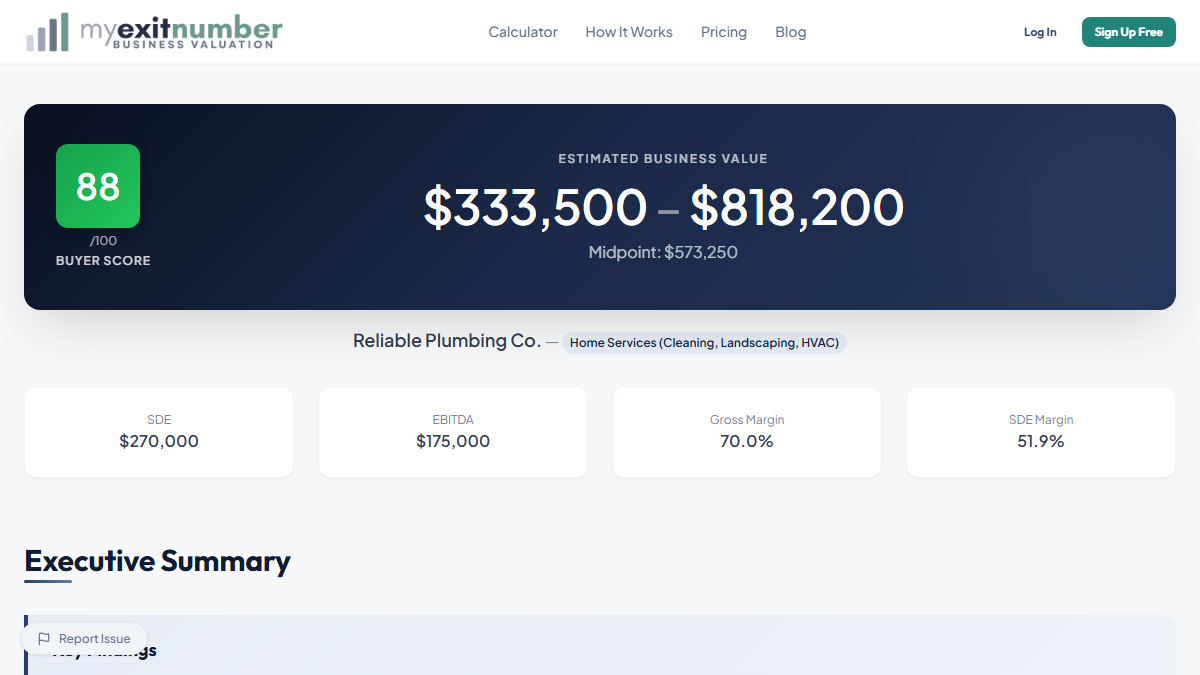
This plumbing company is worth roughly $500,000 to $830,000, with a midpoint around $594,000. That is a number you can bring to a conversation with a buyer, a broker, or a bank.
The range matters more than the point estimate. No valuation method produces a single "correct" number. When a buyer offers $550,000 and a broker suggests listing at $750,000, both figures fall within a defensible range. The final sale price depends on negotiation, deal structure, and the qualitative factors below.
What Moves You Inside the Range
Qualitative factors like owner dependency, revenue trends, and customer concentration determine whether your business sells at the low or high end of its multiple range.
Factors that push value higher:
- Revenue growing year over year, with documentation to prove it
- Recurring revenue streams like maintenance contracts or service agreements
- A diverse customer base with no single client over 10-15% of revenue
- Documented processes and a trained team that operates without the owner present daily
- Clean, organized financial records reviewed or prepared by a CPA
- A real lease or owned property, not a handshake arrangement
Factors that push value lower:
- Owner dependency - if you personally handle key client relationships and the business cannot function without you, buyers see risk and discount accordingly
- Customer concentration - one client at 30% of revenue means losing them tanks the business
- Declining or flat revenue over the past two to three years
- Verbal agreements instead of written contracts with customers and vendors
- Financial records that require reconstruction before a buyer can do due diligence
One thing that catches sellers off guard: buyers discount for the transition period. The first year under new ownership almost always sees some revenue dip as the seller exits and customers adjust. Buyers factor in a 10-20% dip, which effectively reduces what they will pay. If you can demonstrate that your business runs for weeks without you - vacations, illness, anything - you eliminate that discount. Start delegating before you list, not after.
Another reality check: brokers charge 8-12% commission on the sale price. On a $600,000 deal, that is $48,000-$72,000 off the top. SBA lenders require a debt service coverage ratio (DSCR) of at least 1.25x, which caps how much a buyer can borrow against the business. Both of these factors affect what you actually walk away with, not just what the valuation says on paper.
How Much Is Your Business Worth?
Figuring out how much your business is worth is not guesswork. The same methods buyers use - SDE, EBITDA, and revenue multiples - are available to you with your financial statements and a clean set of assumptions. Running all three methods and blending the results puts you in a fundamentally different position than guessing or relying on a single number from a friend.
Frequently Asked Questions
What is the best first valuation method to start with?
For most owner-operated small businesses, start with SDE because it captures the total annual benefit a buyer-operator would receive. Then calculate EBITDA and revenue as cross-checks so you can see whether all three methods point to the same neighborhood.
Why do buyers care more about a range than one exact number?
Because sale price depends on buyer type, financing, owner dependency, and deal structure. A range gives both sides room to negotiate while staying anchored to a defensible methodology instead of pretending there is one exact “correct” price.
Should I trust a broker's rule of thumb like 2x earnings?
Use it as a starting point, not a conclusion. The right multiple depends on the metric being used, your industry, and whether the business deserves the low end or high end of the range. A blanket rule of thumb is too coarse for a real exit conversation.
What documents do I need before valuing my business?
You need at minimum a profit and loss statement, revenue detail, expense detail, and a clean view of owner compensation, interest, depreciation, and one-time costs. If those numbers are messy, the valuation will be messy too, and buyers will immediately discount it.
What should I read next after this overview?
If you need to understand add-backs, read the SDE guide. If you're talking to a corporate buyer or lender, read the EBITDA guide. If you're trying to understand industry ranges, read the multiples guide. If you want only the math, read the calculation walkthrough. If you are preparing for an exit in the next year or two, the next practical step is preparing the business for sale.
Find Out What Your Business Is Worth
MyExitNumber calculates your business value using three proven methods - SDE, EBITDA, and Revenue multiples - so you get the full picture, not just one number.