
What Is a Revenue Multiple and When Should You Use It?
"The offer is two times revenue," the buyer said, leaning back in the Zoom frame. For a SaaS founder or a high-growth business owner, that sentence is the start of a serious negotiation. For a traditional brick and mortar shop owner, it might sound like a dream or a misunderstanding. In the world of business exits, the revenue multiple is both the simplest metric to track and the easiest one to misinterpret.
Most small businesses are valued based on their earnings, specifically Seller's Discretionary Earnings (SDE) or EBITDA. These methods answer a fundamental question: how much cash does this business put in a buyer's pocket? But a revenue multiple business valuation takes a different approach. It ignores the bottom line entirely and looks at the top line - the gross sales of the business.
While earnings multiples are the standard, revenue multiples carry significant weight in specific industries and scenarios. The practical question is not whether revenue multiples exist. It is when they deserve to lead the conversation and when they should stay in the background as a cross-check.
What Is a Revenue Multiple Business Valuation?
A revenue multiple values a business using gross sales instead of earnings. A revenue multiple is a ratio used to estimate a business's value by multiplying its total annual gross revenue by an industry-specific factor. Unlike earnings-based methods, it does not subtract COGS, operating expenses, or interest.
If a business generates $1,000,000 in revenue and the industry multiple is 0.8x, the valuation is $800,000. If the multiple is 4.0x, the valuation is $4,000,000.
The range of multiples varies widely across sectors. A retail store might see 0.3x to 0.5x revenue, while a high-margin software company with recurring revenue might see 3.0x to 8.0x. Those are directional market ranges, not universal rules. The right starting point is your own industry and revenue quality, which is why knowing your business valuation multiples by industry matters so much.
When a Revenue Multiple Is Most Useful
Revenue multiples are most useful when current profit understates the real economic potential of the business. There are four specific situations where a revenue multiple business valuation becomes a primary tool rather than just a secondary check.
1. High-Growth, Pre-Profit Businesses
If a company is growing at 50% or 100% year over year, it is often intentionally unprofitable. Every dollar of gross profit is being reinvested into marketing, sales, and product development to capture market share. In these cases, calculating the value of the business using SDE or EBITDA would result in a zero or negative valuation, which does not reflect the actual market value of the assets, customer base, and growth trajectory.
2. Software as a Service and Subscription Models
SaaS companies are the poster children for revenue multiples. Because recurring revenue is highly predictable and margins are typically very high, buyers are willing to pay for the future earnings that the current revenue stream represents. A buyer knows that if they stopped spending on aggressive growth today, the existing revenue would drop much more directly to profit.
3. Professional Practices with Standardized Pricing
Some industries, like accounting practices or insurance agencies, have extremely stable retention rates and standardized operating models. In these niches, it is common for businesses to trade at a fixed multiple of recurring billings or assets under management. The revenue becomes a reliable proxy for earnings potential because the margins are so consistent across the industry.
4. A Floor and Sanity Check
Even for a traditional profitable business, the revenue multiple serves as a floor. If an earnings-based valuation produces a number that is only 0.1x revenue, it suggests the business is severely underperforming or has a structural margin problem. Conversely, if your SDE valuation suggests a price of 2.0x revenue in an industry where 0.5x is the norm, you need a very strong argument for why your business is four times more valuable than your peers.
When the Revenue Multiple Is Misleading
Revenue multiples become misleading when the top line hides weak economics underneath. The biggest danger of the revenue multiple is that it ignores the cost of producing that revenue. Two businesses can both generate $2,000,000 in sales, but if one has a 40% net margin and the other has a 4% net margin, they are not worth the same amount.
Relying solely on revenue can lead to top-line obsession where an owner grows sales at any cost, only to find that the increased complexity and lower margins have actually decreased the business's total value. This is why comparing SDE vs EBITDA alongside revenue is the only way to get a complete picture.
Worked Example: The $900k SaaS Business
A SaaS business shows why revenue multiples sometimes dominate the conversation. To see how these methods interact, consider a growing SaaS company. This business has high margins and is reinvesting heavily in growth, but it is currently profitable.
| Line Item | Amount |
|---|---|
| Annual Revenue | $900,000 |
| Cost of Goods Sold (hosting, customer support) | $180,000 |
| Operating Expenses (marketing, R&D, rent) | $540,000 |
| Owner's Compensation | $120,000 |
| Depreciation & Amortization | $10,000 |
| Interest Expense | $5,000 |
| Non-Recurring Expenses | $15,000 |
Gross Profit = $900,000 - $180,000 = $720,000
Net Operating Income = $720,000 - $540,000 = $180,000
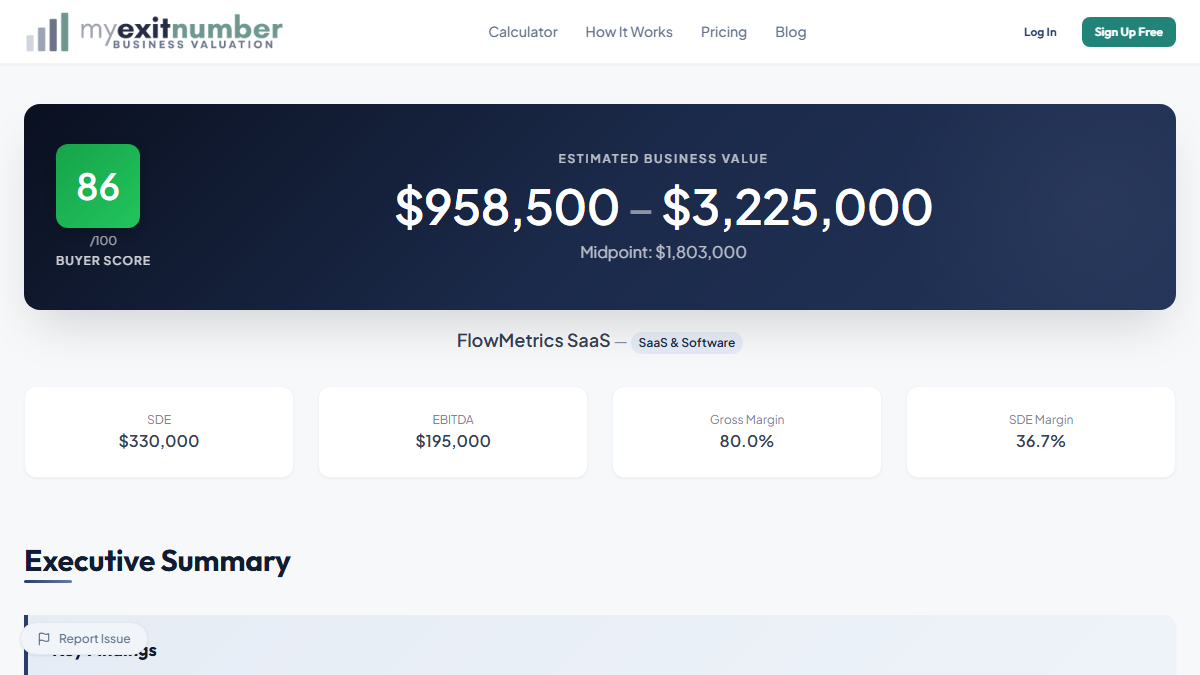
SDE = $180,000 + $120,000 + $10,000 + $5,000 + $15,000 = $330,000
EBITDA = $180,000 + $10,000 + $5,000 = $195,000
For a SaaS business of this size, industry multiples might look like this:
| Method | Metric | Multiple (Mid) | Valuation |
|---|---|---|---|
| SDE | $330,000 | 4.0x | $1,320,000 |
| EBITDA | $195,000 | 6.5x | $1,267,500 |
| Revenue | $900,000 | 3.5x | $3,150,000 |

In this example, the revenue multiple produces a valuation more than double the earnings-based methods. Why the massive gap? Because this is a high-growth SaaS business. A buyer is not just buying the $195,000 in current EBITDA. They are buying the $720,000 in gross profit and the ability to scale that $900,000 revenue without a proportional increase in costs.
In this specific case, the revenue multiple is likely the most accurate reflection of what the market would pay. If this were a landscaping business with the same $900,000 revenue, the revenue multiple would be closer to 0.5x ($450,000), while the SDE method would still point toward a much higher valuation. The context of the industry changes everything, and the buyer still needs to believe the revenue is durable enough to survive diligence.
How Buyers Choose the Right Revenue Multiple
Buyers adjust the multiple up or down based on the quality of the revenue, not just the size of it. The multiple itself is not random. Buyers start with the industry range, then move up or down based on four specific factors:
- Growth rate - 30% year-over-year growth earns a different multiple than 5% growth
- Gross margin - 80% gross margin supports a premium, while 25% does not
- Retention and churn - recurring revenue only matters if customers stay
- Customer concentration - one customer at 30% of revenue lowers the multiple immediately
This is why two SaaS companies with the same $900,000 in revenue can trade at 2.5x and 4.5x respectively. One may have 95% gross margins, 90% annual retention, and no customer over 5% of revenue. The other may have weak retention and a handful of oversized accounts. The top line is the same. The quality of that top line is not.
Practitioner Insight: The Quality of Revenue Trap
The same revenue number can hide radically different risk. Not all revenue is created equal. A $1,000,000 revenue stream from 1,000 customers paying $83 a month is worth significantly more than $1,000,000 from a single customer.
Buyers apply a revenue quality filter before deciding on a multiple. They look for concentration, retention, and whether revenue is contractual or voluntary. When a buyer looks at your top line, they are not just looking at the number. They are looking at how much effort it will take to keep that number from shrinking the day after the sale.
Blending the Results for a Defensible Price
Revenue multiples should still be checked against earnings-based methods before you set a price. Even if you are in a revenue-driven industry like SaaS, you should never ignore the other two methods. A balanced valuation uses a weighted average. For the SaaS example above, a buyer might weight the revenue method at 70%, EBITDA at 20%, and SDE at 10%.
(MyExitNumber handles this weighting automatically based on the industry and growth trend you select.)
Using multiple methods prevents you from becoming blinded by a single high number. It also prepares you for the due diligence phase of a sale. If a buyer challenges your 3.5x revenue multiple, you can point to your 80% gross margins and consistent SDE growth as the justification for that premium.
How to Improve Your Revenue Multiple
If you want a stronger revenue multiple, make the revenue stream look safer and more scalable. The goal is to make the revenue look durable enough that a buyer can underwrite tomorrow's cash flow, not just admire last year's sales total.
- Move to recurring billing: Even if you are a service business, package your services into monthly retainers.
- Document your acquisition costs: If you can prove that spending $1.00 on ads consistently generates $3.00 in lifetime revenue, your revenue multiple will climb.
- Diversify your customer base: Actively work to reduce the percentage of revenue coming from your top three clients.
Your Revenue Is Only the Beginning
A revenue multiple business valuation is a powerful tool, but it is not a shortcut. It is a reflection of the market's confidence in your future profitability. For high-growth or high-margin businesses, it is often the metric that defines the deal. For everyone else, it is the essential sanity check that keeps your valuation grounded in reality.
Frequently Asked Questions
What kind of small business is most likely to get a revenue-based valuation?
Businesses with recurring revenue, high gross margins, and strong scalability are the best candidates. SaaS is the clearest example, but some agencies, insurance books, and subscription-like service businesses can also attract revenue-based pricing.
Why doesn't the revenue multiple work as well for traditional service businesses?
Because revenue alone says nothing about how much profit survives after labor, delivery, scheduling, and owner involvement. In traditional service businesses, two firms with the same top line can have radically different margins, which makes SDE or EBITDA more reliable anchors.
What makes one $1M revenue business worth more than another?
Retention, gross margin, customer concentration, and growth rate. Buyers are not paying for the top line by itself. They are paying for the quality and durability of that top line.
Should I ever quote only a revenue multiple to a buyer?
Only if you are in a market where buyers already think that way, such as SaaS or other recurring-revenue businesses. Even then, you should still have SDE and EBITDA ready, because serious buyers will test whether the revenue story holds up under earnings scrutiny.
What is the fastest way to improve a revenue-based valuation?
Improve retention and reduce concentration. A business with stable repeat revenue from many customers will almost always get a stronger multiple than one with the same sales spread across a few fragile accounts or one-time deals.
Find Out What Your Business Is Worth
MyExitNumber calculates your business value using three proven methods - SDE, EBITDA, and Revenue multiples - so you get the full picture, not just one number.