
Seller Financing Business Sale: What Is Your Offer Worth?
Is a $750,000 offer better than $740,000 in cash? The answer changes when $150,000 of the larger offer is a promise to pay over the next five years. The purchase agreement's headline number does not tell you how much money arrives at closing or what the remaining payments are worth today.
A seller financing business sale turns part of your exit proceeds into a loan to the buyer. You become a creditor after you stop being the owner. That creates a second decision alongside negotiating the business price: whether to accept the repayment terms and exposure.
This guide compares the economics of those offers for US owner-operated businesses. It uses an illustrative note, with every rate and amount stated as an assumption. For estimating the underlying company's value, use the three-method valuation walkthrough.
What Changes When You Finance the Buyer?
Seller financing changes how and when the buyer pays the agreed price; it does not automatically improve the business's earnings or underlying value.
Seller financing means the seller accepts repayment of part of the purchase price over time. A promissory note records the debt and its payment terms. Acquire.com's financing explainer describes this arrangement and the importance of documenting the schedule, interest, and security. There is no single percentage or interest rate that suits every transaction.
Compare three separate figures: the agreed purchase price, gross cash paid to you at closing, and the economic value of deferred receipts. Existing debt repayment, transaction costs, taxes, and closing adjustments can reduce what you keep. Do not compare an offer stated before those deductions with another stated after them.
Financing may help bridge a buyer's funding gap, but an increased offer is not evidence that the company suddenly became more profitable. Retain your earnings analysis and industry-multiple comparison as the basis for discussing price. Assess the proposed loan separately.
(MyExitNumber's free calculator estimates business value using SDE, EBITDA, and revenue multiples.)
Seller Financing Business Sale Example: Follow the Money
Separate the purchase-price principal from interest before comparing a financed offer with cash.
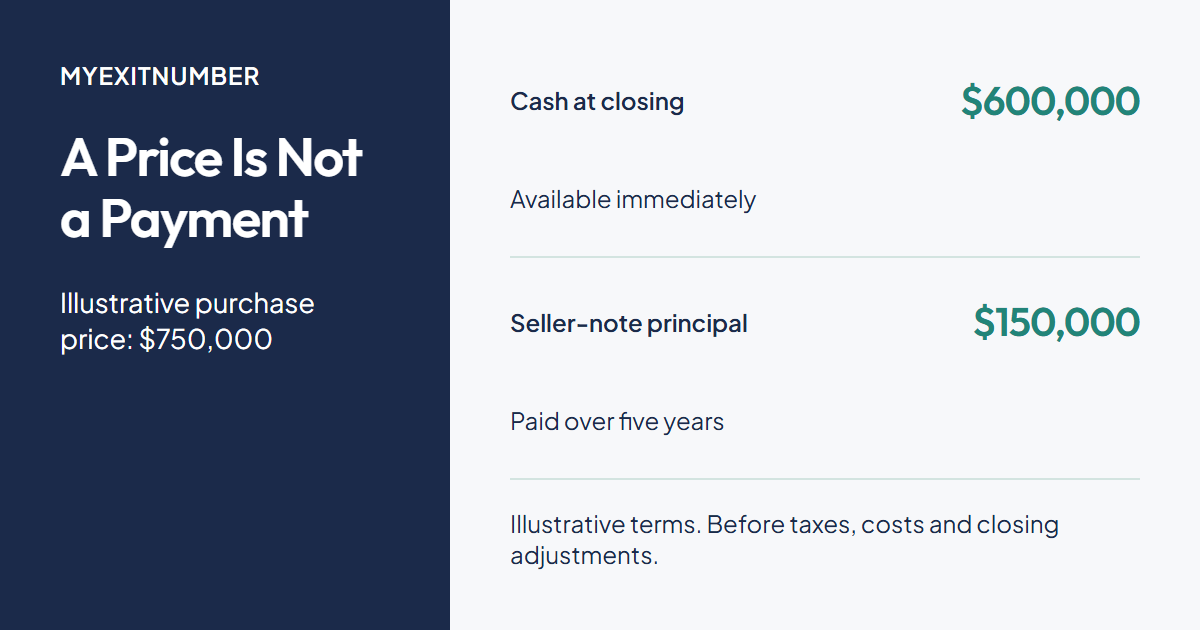
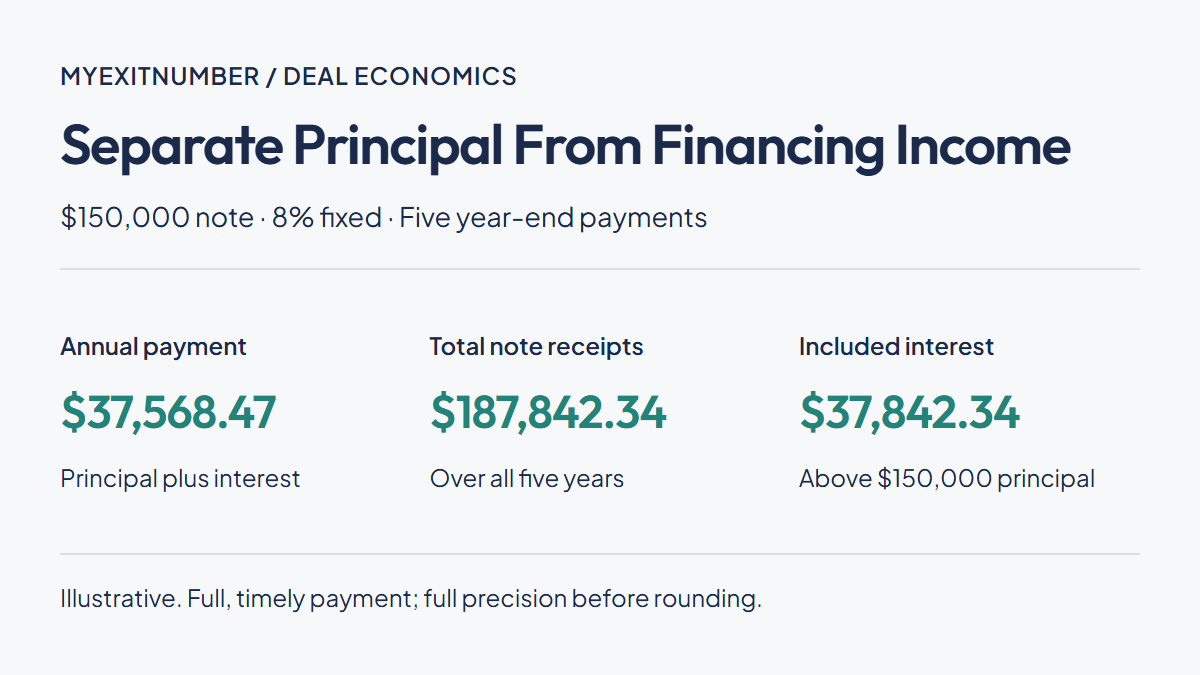
Assume a buyer offers $750,000, pays $600,000 at closing, and signs a $150,000 seller note. The note has an assumed fixed annual interest rate of 8%, with five equal annual payments, each at year-end. It fully amortizes, meaning scheduled payments repay all principal by maturity. There is no balloon, payment deferral, fee, or prepayment in this example.
Annual payments make the arithmetic visible; this is not a claim about customary payment frequency or available loan terms. All amounts are US dollars. The example excludes existing seller debt, taxes, transaction expenses, and other closing adjustments. It is not an SBA financing illustration.
| Component | Illustrative amount |
|---|---|
| Purchase price | $750,000.00 |
| Cash paid at closing | $600,000.00 |
| Seller-note principal | $150,000.00 |
| Annual note payment | $37,568.47 |
| Total scheduled note receipts over five years | $187,842.34 |
| Interest included in those note receipts | $37,842.34 |
The loan-payment formula is payment = principal × r ÷ [1 - (1 + r)^(-n)], where r is the interest rate per payment period and n is the number of payments. Substituting the assumptions gives $150,000 × 0.08 ÷ [1 - 1.08^(-5)] = $37,568.468185... each year.
Using that unrounded payment, 5 × $37,568.468185... = $187,842.34 after rounding. Subtracting $150,000 principal leaves $37,842.34 interest. The first year's interest is $150,000 × 8% = $12,000; approximately $25,568.47 of the first payment reduces principal. Later payments contain less interest as the balance falls.
If all payments arrive, total nominal receipts are $600,000 + $187,842.34 = $787,842.34. That is principal plus financing income received over time, not a $787,842.34 business price. Figures use full precision until final rounding; a servicing schedule rounded to cents needs a small final-payment adjustment.
Put Deferred Payments on the Same Date
Present value translates future receipts into an amount today using a stated discount rate.
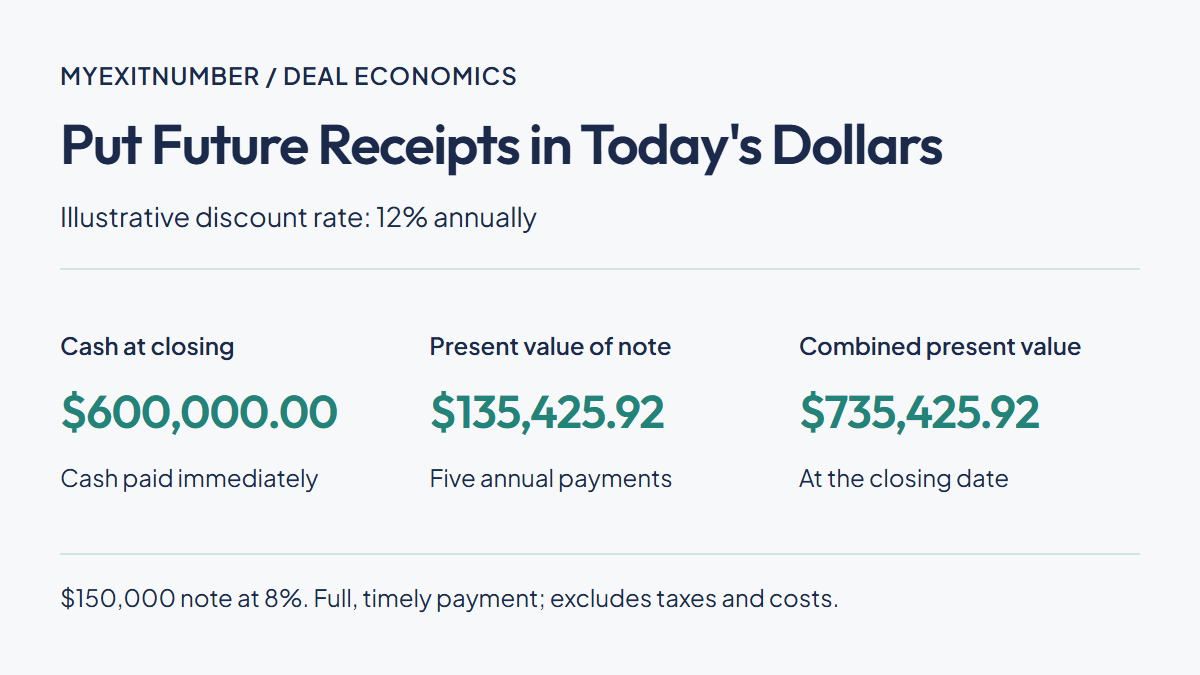
Present value discounts each payment for the time until receipt. For this comparison, assume a 12% annual discount rate, selected only to demonstrate the method. It is not a market benchmark, a recommended return, or an independently assessed rate for this borrower. The 8% note rate determines contractual payments; the 12% discount rate is a separate valuation assumption.
Discounting the scheduled receipts gives PV of note = $37,568.468185... × [1 - 1.12^(-5)] ÷ 0.12 = $135,425.92. Adding immediate cash produces $600,000 + $135,425.92 = $735,425.92 of illustrative present value. The calculation assumes every payment is made in full and on time; it does not explicitly model default, recovery costs, or taxes.
| Offer comparison on the same assumed basis | Value at closing |
|---|---|
| $740,000 paid entirely at closing | $740,000.00 |
| $750,000 price: $600,000 cash plus discounted note receipts | $735,425.92 |
| Difference favoring the cash offer under these assumptions | $4,574.08 |
The higher headline offer has the lower calculated present value in this scenario: $740,000 - $735,425.92 = $4,574.08. Changing the discount rate changes the comparison. At an 8% discount rate, equal to the note rate, the scheduled note payments have a present value of $150,000, so the financed offer totals $750,000 on that basis.
Neither result establishes a safe lending decision. A higher assumed discount rate is not a substitute for investigating the buyer's ability to repay. Use a sensitivity calculation alongside credit review, rather than treating one spreadsheet output as a collectible cash balance.
Read the Terms Behind the Number
Repayment timing, creditor priority, and access to information determine what the seller is actually accepting.
A balloon payment is a remaining balance due at maturity after the preceding scheduled payments. Smaller interim installments can hide a substantial refinancing requirement. Request the amortization schedule and identify the final balance explicitly. Do not reuse the five-payment calculation above for an interest-only or balloon note.
Examine the buyer's complete financing package. A business that can cover the seller installment in isolation might struggle when bank debt, working-capital needs, and equipment spending are added. BDC's acquisition-financing guidance explains why excessive or inflexible debt can interrupt vendor repayments. BDC is a Canadian lender; the point used here is the financing mechanism, not a US lending rule or market statistic.
Subordination places the seller's repayment or enforcement rights behind another lender's rights under the agreed documents. BDC's vendor-financing guide discusses that junior position and financial-reporting arrangements. Your US attorney should determine how the actual security, priority, guarantees, and enforcement provisions operate.
Ask who delivers financial reports, how frequently, and what happens after a missed payment. A personal guarantee is a contractual promise, not proof of recoverable assets. Collateral can lose value while a struggling buyer continues trading. Access to statements and a clear escalation process deserve attention alongside the interest rate.
Keep Earnouts, SBA Rules, and Taxes Separate
A fixed repayment obligation, a performance-dependent payment, and tax recognition answer different questions.
An earnout makes additional consideration depend on specified future results. A conventional fixed seller note creates scheduled debt payments, although collection remains uncertain. BDC distinguishes vendor notes from earnouts. If a proposal mixes them, separate the fixed obligation from the conditional amount before comparing offers. Customer-retention conditions belong in the customer-concentration discussion.
For an SBA-financed acquisition, do not assume a seller note counts as the buyer's equity contribution. The SBA's SOP 50 10, version 8.1 with technical updates, effective October 1, 2026, addresses qualifying seller debt in Appendix 15. Seller debt counted toward required equity must be subordinated and on full standby, with no principal or interest payments during the 7(a) loan term. Limited equity sources, including qualifying seller debt, together may cover no more than half the required injection. Have the lender confirm the applicable rules and structure before agreeing payment dates; use the SBA valuation guide for background.
Tax timing also needs its own analysis. IRS Publication 537 explains that qualifying installment sales can spread recognition of eligible gain, but inventory gain and depreciation recapture have different treatment, including recognition in the sale year. Interest is ordinary income. Selling a business can require allocating consideration among assets rather than applying one tax rule to the entire price. Do not assume deferred cash means every tax bill is deferred; ask your accountant to model the actual allocation and structure.
Compare the Offer Before Signing the Note
Prepare one offer comparison that records cash, deferred obligations, payment assumptions, and unresolved risks together.
For each proposal, record the gross price, cash payable at closing, seller-note principal, interest rate, payment frequency, maturity, and any balloon. Attach the repayment schedule. List expected deductions separately so that the cash comparison uses equivalent definitions. The exit-planning timeline explains how those proceeds connect to your departure plans.
Then document what could prevent collection: other acquisition debt, operating cash needs, restrictions imposed by the senior lender, buyer experience, and enforceability questions for counsel. Keep any training or consulting commitment explicit, with defined duties and compensation. Lending money to a buyer does not itself define how much work you owe after closing.
Finally, compare multiple discount assumptions and a delayed-payment scenario with your advisers. Record which terms remain unconfirmed. A $10,000 increase in headline price deserves less weight than the full repayment arrangement it buys. Accepting a note is a decision about both the sale and the credit you extend afterward.
Frequently Asked Questions
Is seller-note interest part of the business purchase price?
In the worked example, the $750,000 purchase price comprises $600,000 cash and $150,000 principal. The $37,842.34 scheduled interest is separate financing income received over five years, assuming full payment.
Why does the example use annual payments?
Five year-end payments make the payment and discount formulas easy to inspect. A monthly schedule requires monthly periods and consistent rate conversions; it will produce different installment amounts and timing.
Can the note rate and discount rate be different?
Yes. The note rate sets contractual interest, while the discount rate is an assumption used to value future receipts. The example uses 8% and 12% respectively, without claiming either is appropriate for a particular buyer.
Does the $735,425.92 figure allow for buyer default?
No explicit default or recovery scenario is included. It is $600,000 immediate cash plus the present value of five scheduled payments discounted at an assumed 12%, with full and timely payment assumed.
Can a seller note count as SBA buyer equity while receiving payments?
Under the cited version 8.1 rules, seller debt counted toward required equity must be subordinated and on full standby for the 7(a) loan term. The lender must confirm eligibility, the combined limited-source cap, and the documents before closing.
Find Out What Your Business Is Worth
MyExitNumber calculates your business value using three proven methods - SDE, EBITDA, and Revenue multiples - so you get the full picture, not just one number.