
Exit Planning Small Business Owners Can Use: A Timeline
Put two dates on your calendar: the day ownership changes and the day you stop working in the company. They may be months apart. A sale agreement can leave you training staff, introducing customers, or answering questions after the money arrives.
Exit planning small business owners can use starts with that distinction. Decide what leaving means, then work backward through the financial and operating changes needed to make it possible.
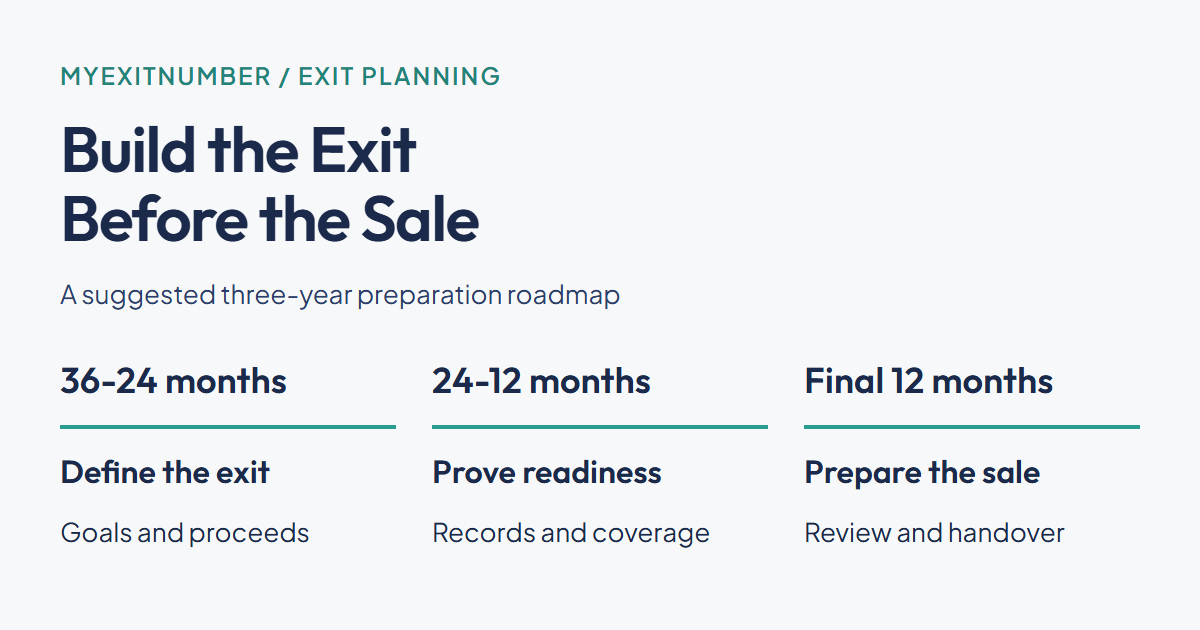
This timeline is for US owner-operated businesses considering an outside sale, especially companies with $200,000 to $5 million in annual revenue. It organizes preparation across three years. The intervals are suggested planning windows, not a required waiting period or a prediction of when a buyer will close. Each stage ends with evidence to check before moving forward.
1. Start Exit Planning Before You Need a Buyer
Start while you still have room to change the business, your departure date, and the type of transaction you would accept.
Exit planning is the ongoing work of preparing for an owner's departure from leadership or ownership. SCORE's exit-planning guide describes it as a written strategy for a voluntary or involuntary departure. Planning therefore has a purpose even when selling is several years away.
An exit timeline turns that intention into dated actions with accountable people. Three years can provide space to improve records, transfer responsibilities, and observe whether changes hold through an operating cycle. A company with sound records and trained staff may need less preparation; unresolved ownership disputes or essential personal licenses can require a different schedule.
Separate preparation from the sale process. Reaching your preferred listing month does not mean an acceptable buyer is available. Use the business-sale timing guide for the stages after marketing begins, and reserve flexibility around your intended departure.
2. At 36-24 Months, Define the Exit and Test the Numbers
Define your preferred departure, acceptable handover duties, and financial requirement before choosing improvements to fund.
Write a one-page owner brief: preferred closing window, when day-to-day work should end, acceptable transition hours, and the proceeds you need to discuss with your financial adviser. Identify any co-owner whose agreement matters. Compare an outside sale with other routes before assuming it fits; SCORE's succession guide includes transfers to family, partners, employees, and outside buyers.
Then estimate today's business value using documented earnings. Keep the accounting period, compensation treatment, and assets included explicit. Use the three-method calculation guide for the arithmetic rather than rebuilding the valuation model inside the exit schedule.
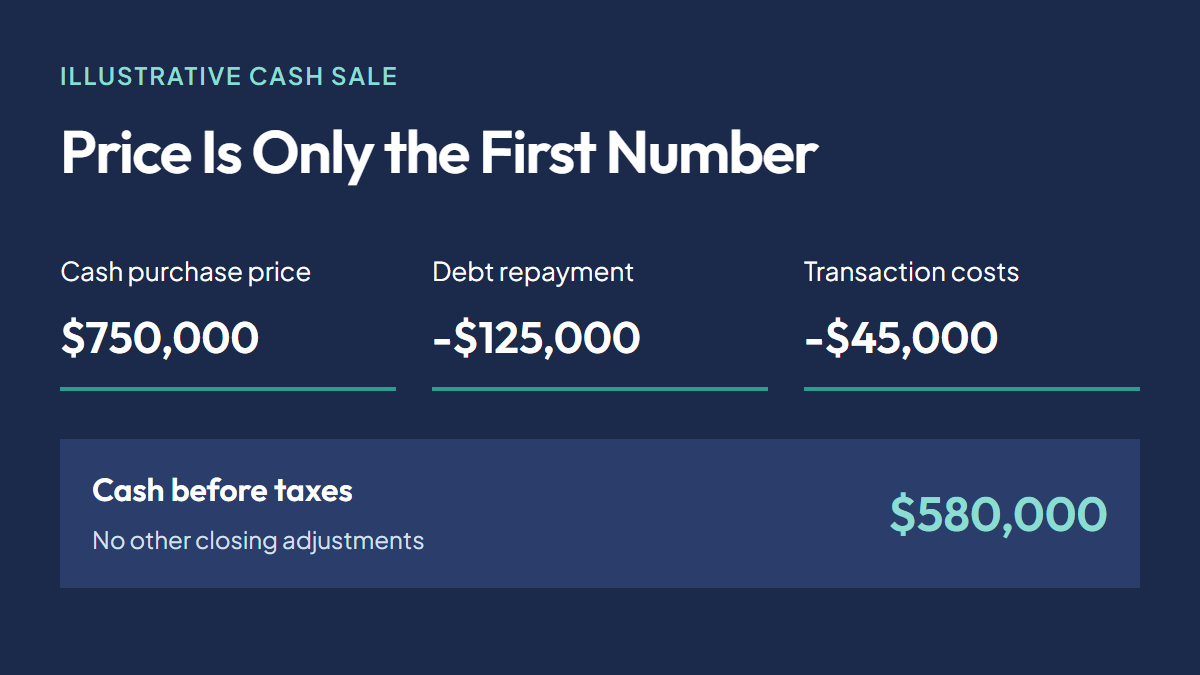
Net sale proceeds are the amount left after the transaction's applicable deductions. They are different from a headline purchase price. For illustration, assume a sole owner receives $750,000 cash at closing, separately repays $125,000 of business debt, and pays $45,000 in transaction costs. Assume no deferred consideration, real estate, or additional closing adjustments.
| Illustrative cash bridge | Amount |
|---|---|
| Cash purchase price received | $750,000 |
| Seller's debt repayment | -$125,000 |
| Assumed transaction costs | -$45,000 |
| Cash remaining before taxes | $580,000 |
The calculation is $750,000 - $125,000 - $45,000 = $580,000. These are teaching assumptions, not fee benchmarks or an appraisal. If the owner's goal is $650,000 before taxes, the illustrative shortfall is $650,000 - $580,000 = $70,000. An after-tax goal needs a separate tax estimate.
Discuss that gap before promising yourself a retirement date. The IRS explains that business assets can receive different tax treatment when sold. Your accountant must assess the actual structure and allocation. Do not deduct debt twice if an offer already states the amount payable after debt settlement.
(MyExitNumber's free account lets you save and compare valuations as your financial inputs change.)
Checkpoint: you can explain the difference between estimated value, cash at closing, and your personal financial target.
3. At 24-12 Months, Build Evidence of Readiness
Use the second preparation year to demonstrate reliable reporting and operating coverage through ordinary business activity.
Choose two or three gaps that could obstruct a transfer. Assign each an owner, deadline, and observable result. “Improve the books” is vague; “reconcile monthly reports and document every proposed earnings adjustment” gives your accountant a task that can be checked.
Apply the same discipline to operations. If all renewals require your involvement, ask a colleague to lead the next renewal cycle and retain the outcome. The owner-dependency guide covers delegation in detail. In this timeline, the milestone is demonstrated continuity rather than a finished training document.
Keep a quarterly record of what changed and what still failed. Include financial performance, customer retention, and interventions you had to make. Hiring cover without accounting for its recurring cost can make the company easier to run while reducing earnings available to a buyer.
For example, replacing an owner-held scheduling role with a salaried employee changes both the handover and the expense base. Preserve before-and-after reports. A purchaser can examine actual payroll and completed work; a plan to hire someone after closing leaves both cost and execution unresolved.
Checkpoint: another person can verify the improvements from reports, completed assignments, and operating results.
4. In the Final Year, Prepare the Business for Buyer Review
Organize the evidence a buyer will request and investigate transfer obstacles before setting a launch date.
Build a controlled data room, a secure collection of documents shared with authorized reviewers. Assemble financial statements, tax returns, earnings-adjustment support, contracts, an asset register, and staffing information. Use the sale-preparation checklist for the detailed document list, then assign someone to keep it current.
Ask your attorney to review material leases, customer agreements, ownership documents, and required licenses for the proposed transaction. Record who must provide consent, what information they require, and any known constraints. Do not assume that a relationship or permission passes to a purchaser because it has served your company for years.
Speak with a broker or transaction adviser about buyer fit and price support. The SBA's selling guidance recommends valuing the business before marketing it. An online estimate can support preliminary planning; the proposed transaction may require a professional assessment.
Checkpoint: your advisers have reviewed the important gaps, and each unresolved transfer issue has an assigned next action.
5. Before Listing, Pass Three Readiness Checks
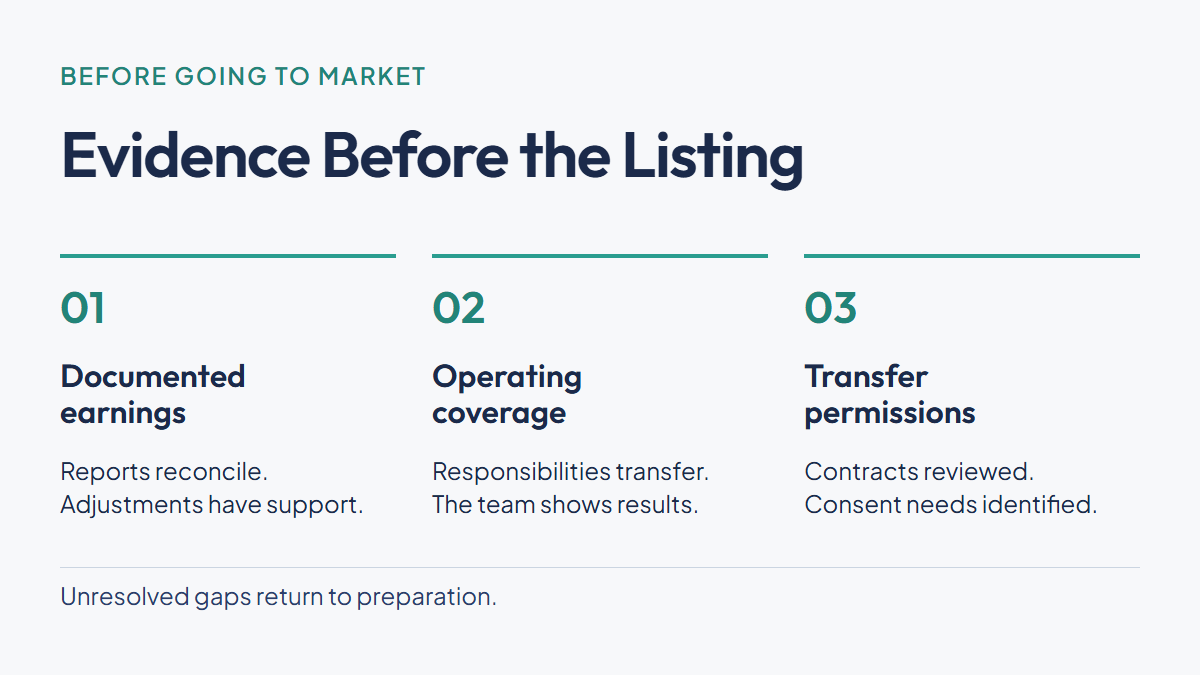
Proceed to market when the earnings, operating handover, and transfer requirements can withstand questions from a purchaser.
Run a rehearsal with your advisers. Ask them to request support for a significant add-back, identify who handles a difficult customer complaint, and examine one contract essential to trading. Track missing evidence and unanswered questions instead of treating a populated folder as proof of readiness.
| Readiness check | Evidence to inspect | Reason to revisit the launch |
|---|---|---|
| Documented earnings | Reconciled reports and supported adjustments | Material unexplained differences |
| Operating coverage | Named responsibilities and completed handovers | Critical work still depends on the seller |
| Transfer permissions | Reviewed contracts and consent requirements | Essential rights remain unresolved |
Agree how confidential information will be released. An initial anonymous summary, later financial detail, and sensitive customer information need an intentional sequence and appropriate protections. Keep a record of recipients and follow the process agreed with your advisers.
Continue producing fresh monthly results. A practical problem in diligence is that the business keeps trading while buyers review it. A strong historical pack cannot explain a recent decline by itself. Prepare updates and explanations while someone remains responsible for serving customers and collecting invoices.
Checkpoint: you can answer the rehearsal questions and maintain reporting while the sale process runs.
6. At Closing, Define the Work That Continues
Separate ownership transfer from your remaining duties, payment conditions, and the eventual end of your involvement.
The SBA's sales-agreement guidance calls for attorney review and attention to assets, liabilities, adjustments, and fees. Have your advisers reconcile the actual agreement and closing statement with your proceeds assumptions. Identify cash payable now and any amount dependent on later events.
Write the handover schedule around outcomes: introductions completed, access transferred, staff trained, and responsibilities accepted. Specify the hours, duties, compensation, and completion date for your support. A buyer's request for unlimited availability can conflict with the departure you planned three years earlier.
Plan communication with the purchaser and your advisers. Decide who informs employees, customers, and suppliers, when that happens, and who handles follow-up questions. Preserve required records and agree secure access arrangements. The closing signature is one milestone; the operating handover needs its own completion check.
Checkpoint: both sides understand what remains to be done, who does it, and when the seller's agreed work ends.
Exit Planning Small Business Owners Can Start Today
Begin with an owner brief, a supported valuation estimate, and the three gaps most likely to obstruct your departure.
If you have less than a year, compress the sequence rather than pretending the evidence already exists. First clarify proceeds and ownership constraints. Next fix unreliable reporting and investigate essential transfer permissions. Then test the handover with the team and discuss what buyers could reasonably accept.
If a sale cannot wait, disclose unresolved issues and assess realistic routes with qualified advisers. A shorter schedule changes what can be demonstrated. It does not turn projected earnings into historical results or make a pending consent certain.
Review the timetable quarterly and after a significant business or personal change. SCORE recommends reviewing a succession plan annually with advisers; quarterly project checks here are a suggested way to manage the work between those reviews. Keep the next action, responsible person, and evidence required visible.
Frequently Asked Questions
Do I have to wait three years before selling?
No. Three years is an illustrative preparation framework, not a rule. Your records, operating coverage, transfer requirements, and buyer availability determine whether a shorter schedule is workable.
Should my target date be listing or closing?
Record listing, closing, and the end of your involvement separately. Marketing begins the buyer search; closing transfers the agreed ownership or assets; a defined handover can continue afterward.
What if the proceeds estimate falls below my exit target?
Check the assumptions with your advisers before changing the price target. Consider debt, fees, taxes, timing, and deferred payments alongside business value. The gap may require a different timetable or transaction structure.
How can I measure progress during the preparation years?
Compare dated financial reports, supported earnings adjustments, completed responsibility transfers, and resolved permission questions. Record remaining exceptions so a completed task is distinguishable from a proven improvement.
What should I review if my proposed successor leaves?
Revisit role coverage, the handover schedule, and the intended exit route. Identify a replacement or backup and test the revised arrangement before relying on the old departure date.
Find Out What Your Business Is Worth
MyExitNumber calculates your business value using three proven methods - SDE, EBITDA, and Revenue multiples - so you get the full picture, not just one number.