
Customer Concentration Risk: When One Client Tanks Value
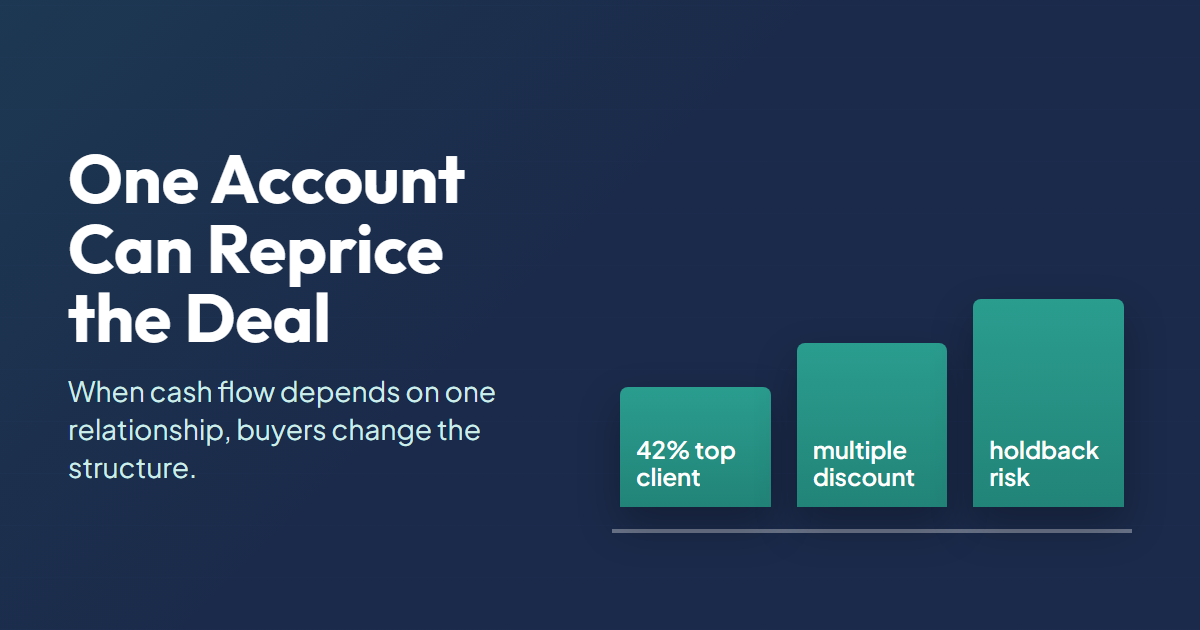
Landing the account felt like proof the business had arrived. The customer was big, credible, and easy to reference in sales calls. Three years later, that same account produces 42% of revenue, negotiates payment terms every renewal, and knows you cannot afford to lose them. That is customer concentration risk, and buyers notice it long before they debate your multiple.
This is the concentration-risk guide, not a broad valuation walkthrough. It explains how buyers measure dependency, how the risk changes price and deal structure, and what to do before you sell. For the wider pre-sale checklist, read How to Prepare Your Business for Sale. For how risk changes the multiple, read Business Valuation Multiples Explained.
Customer Concentration Risk: The Simple Formula
Customer concentration risk is measured by dividing revenue from a customer, or group of customers, by total revenue. Wall Street Prep summarizes the basic formula as customer revenue divided by total revenue, expressed as a percentage.
| Metric | Formula | Example |
|---|---|---|
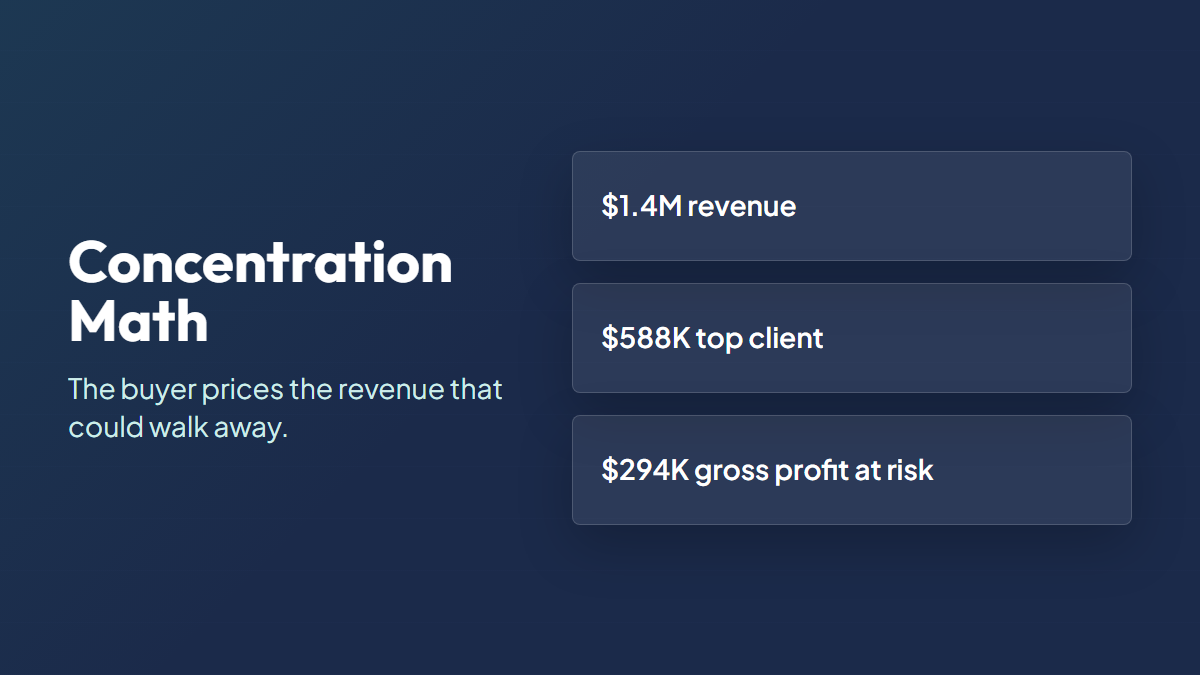
| Top customer concentration | Top customer revenue / total revenue | $588,000 / $1,400,000 = 42% |
| Top five concentration | Top five customer revenue / total revenue | $980,000 / $1,400,000 = 70% |
| Profit concentration | Gross profit from top customer / total gross profit | $294,000 / $622,160 = 47% |
The revenue percentage is the first pass. The profit percentage is the real pressure test. If your biggest customer is also your highest-margin customer, losing them hurts more than the sales number suggests. If the customer is low-margin and operationally demanding, concentration may still weaken valuation because the buyer inherits leverage held by the customer.
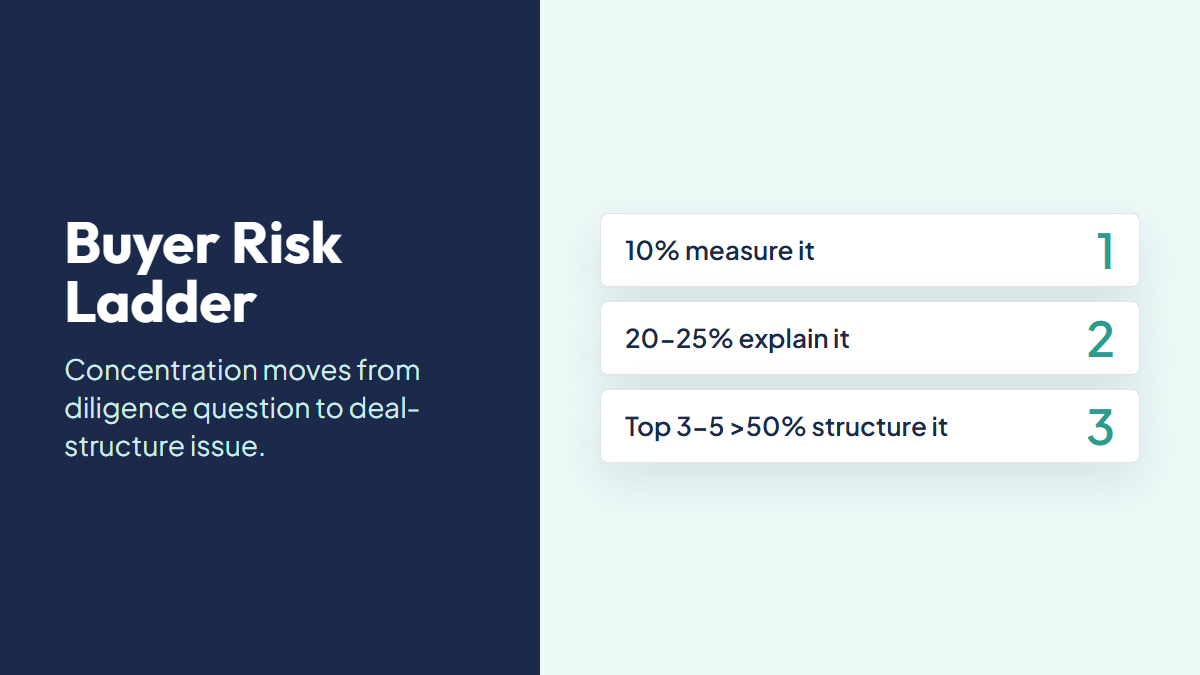
There is no universal threshold, but M&A advisors at GP Ventures note that some buyers get nervous around 20-25% from one customer or when the top three to five customers exceed 50% of sales. Wall Street Prep flags a customer over 10% as something to monitor. The exact threshold depends on industry, contract strength, margin, and buyer type.
Why Customer Concentration Risk Lowers Value
Buyers discount concentration because a valuation is a claim about future cash flow, not a trophy for past revenue. If one relationship can change the next owner's earnings materially, the buyer will protect themselves through price, terms, or both.
The first impact is a lower multiple. A diversified company with $300,000 in SDE might support a 3.0x multiple. In an illustrative buyer model, a similar company with 45% of revenue from one customer might be priced at a lower multiple even if the current SDE is identical. The risk is not today's profit. The risk is what happens after closing.
The second impact is deal structure. Instead of paying the full price at close, the buyer may ask for seller financing, a holdback, or an earnout tied to customer retention. That shifts risk back to the seller. It can preserve the headline price, but it changes the certainty of proceeds.
The third impact is lender appetite. A buyer using bank or SBA financing has to show that the business can repay debt. If the lender believes one account could leave and break coverage, the price may need to come down or the structure may need more seller support.
(MyExitNumber's full report includes customer concentration in the value drivers checklist, so the risk is visible alongside the valuation range.)
Worked Example: The 42% Account
Assume a B2B services company has $1.4 million in annual revenue and $280,000 in SDE. A diversified peer might sell around 3.0x SDE, or $840,000.
Now look at the customer file:
| Customer group | Revenue | Gross margin | Gross profit |
|---|---|---|---|
| Top customer | $588,000 | 50% | $294,000 |
| Customers 2-5 | $392,000 | 43% | $168,560 |
| All other customers | $420,000 | 38% | $159,600 |
| Total | $1,400,000 | 44% | $622,160 |
The top customer is 42% of revenue and 47% of gross profit. If that customer leaves after closing, the buyer does not just lose sales. They lose the highest-margin part of the business while many fixed costs remain.
A buyer might respond in three ways. First, move the offer down from the $840,000 peer case into a lower range to reflect the retention risk. Second, keep the price near $840,000 but require a $150,000 holdback released only if the customer stays for 12 months. Third, ask the seller to carry a larger note so the seller shares the retention risk.
None of those responses means the business is unsellable. They mean the buyer is pricing the risk that the current SDE does not fully show.
How Buyers Decide Whether the Risk Is Fixable
Buyers do not treat every concentration issue the same way. A single customer at 30% of revenue can be acceptable in one business and a deal-killer in another.
The first question is contract quality. Is there a signed agreement, or is the revenue based on recurring purchase orders? Can the contract be assigned to the buyer? Does the customer have termination rights? Is pricing locked, adjustable, or renegotiated every year?
The second question is relationship depth. If the seller is the only person who knows the account, the buyer sees transition risk. If the relationship includes multiple contacts, documented service history, account managers, and renewal notes, the risk is easier to defend.
The third question is margin and payment behavior. A concentrated account with strong margin and clean payment history is still risky, but it is better than a concentrated account that demands discounts, pays late, and consumes the owner's time.
The fourth question is customer reason for staying. Buyers want evidence that the account stays because of service quality, switching cost, integration, geographic fit, or contract terms, not because the owner plays golf with the procurement lead.
How to Reduce Concentration Without Pushing Away the Account
The goal is not to fire your best customer. The goal is to make the rest of the revenue base stronger so the buyer is not underwriting one relationship.
Start by measuring concentration every month. Pull trailing twelve month revenue by customer, then track the top one, top three, and top five accounts. Owners are often surprised when a concentration issue appears because one large project renews twice while smaller accounts churn quietly.
Next, grow revenue outside the large account. You reduce concentration by making the rest of the customer base larger. That may mean a focused new-logo campaign, a referral program, a second salesperson, a narrow industry offer, or a pricing change that funds acquisition.
Then broaden the relationship inside the large account. Add multiple contacts, formalize service-level expectations, document renewal history, and avoid making the owner the only point of continuity. If the customer values the company, not just the owner, the buyer has a better retention story.
Finally, improve contract terms where possible. A multi-year agreement, automatic renewal, assignment language, and clear termination notice do not eliminate risk, but they create evidence. Evidence is what keeps the conversation from turning into a pure price discount.
What If You Need to Sell Before It Is Fixed?
If concentration is still high, disclose it early and control the narrative. Hiding it only moves the problem into diligence, where it damages trust and gives the buyer leverage.
Prepare a concentration memo. Include revenue by customer for three years, gross margin by customer, contract terms, renewal dates, payment history, contact map, and the reason each major account stays. If the top customer has multiple divisions or locations, break that out. One corporate logo may represent several operational relationships.
Expect structure. A buyer may ask for a holdback, seller note, consulting agreement, earnout, or customer-retention condition. Those terms are not automatically bad. A fair structure can help the deal close if the risk is real and temporary. The mistake is pretending the buyer should ignore it.
If you have six to twelve months before listing, start diversifying now. If you have two years, make it a major value project. Concentration is one of the few risks that can change both the earnings base and the multiple, so fixing it can move the valuation faster than almost any cosmetic improvement.
Make Concentration Visible Before Buyers Do
Customer concentration risk gets expensive when the buyer discovers it before the seller has a plan. Measure it, explain it, reduce it where you can, and prepare a structure where you cannot.
The goal is not to pretend concentration is harmless. The goal is to show why the relationship is durable, what would protect cash flow after closing, and what structure is fair if the risk is still real.
Frequently Asked Questions
What is customer concentration risk?
Customer concentration risk is the risk that too much revenue or profit depends on one customer or a small group of customers. Buyers measure it as a percentage of total revenue.
What percentage of revenue from one customer is risky?
There is no universal cutoff. A single customer above 10% should be measured, and many buyers pay closer attention around 20-25% or when the top three to five customers exceed about half of revenue.
How does customer concentration affect valuation?
It can lower the multiple, reduce cash-flow credit, create seller financing, or move part of the price into a holdback or earnout tied to customer retention.
Can a long-term contract solve customer concentration risk?
A contract helps, but it does not erase the risk. Buyers still review termination rights, assignment clauses, renewal history, margins, and whether the relationship depends on the seller.
How can I reduce customer concentration before selling?
Grow revenue from other customers, add recurring contracts, broaden contacts inside the large account, document renewal history, and avoid letting one client control pricing or payment terms.
Find Out What Your Business Is Worth
MyExitNumber calculates your business value using three proven methods - SDE, EBITDA, and Revenue multiples - so you get the full picture, not just one number.