
Business Valuation SBA Loan Guide for Owners
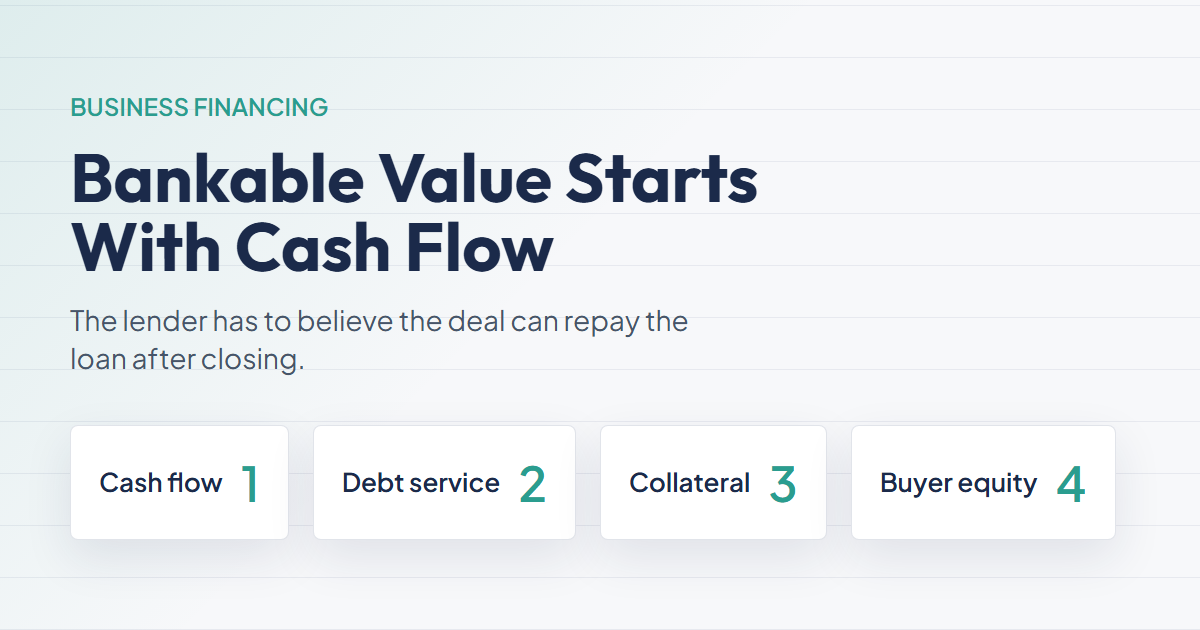
A bank does not fund a buyer's excitement. It funds a transaction that can repay principal and interest from the acquired company's cash flow. That is why a business valuation SBA loan review feels different from a seller's asking-price conversation. The lender is not asking, "Could this be worth it to the right buyer?" The lender is asking, "Will the business still cover debt if the buyer has an average first year?"
This is the bankability guide, not a complete SBA application checklist. It explains how valuation, cash flow, add-backs, buyer equity, and transferability affect an acquisition loan. For the core valuation formulas, start with How to Calculate the Value of a Small Business. For the broker lens, read What Do Business Brokers Look for in a Valuation?.
What a Business Valuation SBA Loan Review Actually Tests
A business valuation SBA loan review tests whether the purchase price is supportable and whether the business can repay the debt after closing. The U.S. Small Business Administration says most 7(a) term loans are repaid with monthly principal and interest payments from business cash flow, which is why lenders scrutinize normalized earnings before they accept the deal.
The SBA also notes that most 7(a) loans have a maximum loan amount of $5 million, and its lender guidance says interest rates are negotiated between borrower and lender but subject to SBA maximums. Those details matter, but they are not the first hurdle. The first hurdle is whether the business produces enough dependable cash flow to service the acquisition loan.
In a seller conversation, the headline may be "the business is worth $850,000." In a lender conversation, the practical question is "what annual debt service does that price create, and what cash flow remains after reasonable operating costs?"
When SBA Requires a Business Valuation
For a 7(a) change-of-ownership loan, SBA SOP 50 10 requires the lender's file to include a current business valuation that excludes real estate. The SOP also says the maximum 7(a) loan uses of proceeds for a change of ownership are capped at the business valuation amount, so a price above the supported valuation has to be covered by subordinate financing or additional equity.
The lender has to request the business valuation and have it prepared for the lender. The SOP says the lender may not use a business valuation prepared for the applicant or the seller. That distinction matters: a seller's valuation report can help with planning and negotiations, but it is not the same as the lender-ordered valuation used for SBA compliance.
The $250,000 rule is about the financed amount after subtracting appraised real estate and equipment. For non-special-purpose properties, if the amount being financed, including 7(a), 504, seller, or other financing, minus the appraised value of real estate and/or equipment being financed is $250,000 or less, the lender may perform its own business valuation unless its internal policy requires an independent valuation. If that amount is greater than $250,000, or if the buyer and seller have a close relationship, the lender must obtain an independent business valuation from a Qualified Source.
This is the part many owners miss. The valuation question is not only "what is the business worth?" It is also "which part of the purchase price is goodwill, customer lists, trade name, or other intangible value, and does the lender have the required support to finance it?"
The Cash Flow Test Comes Before the Multiple
Lenders care about valuation multiples, but they care about repayment first. A beautiful 3.2x SDE multiple does not help if the buyer needs so much debt that monthly payments consume the business's operating cash.
The simple coverage formula is:
| Metric | Formula |
|---|---|
| Normalized cash flow | Earnings after defensible add-backs and required operating costs |
| Annual debt service | Total yearly principal and interest payments |
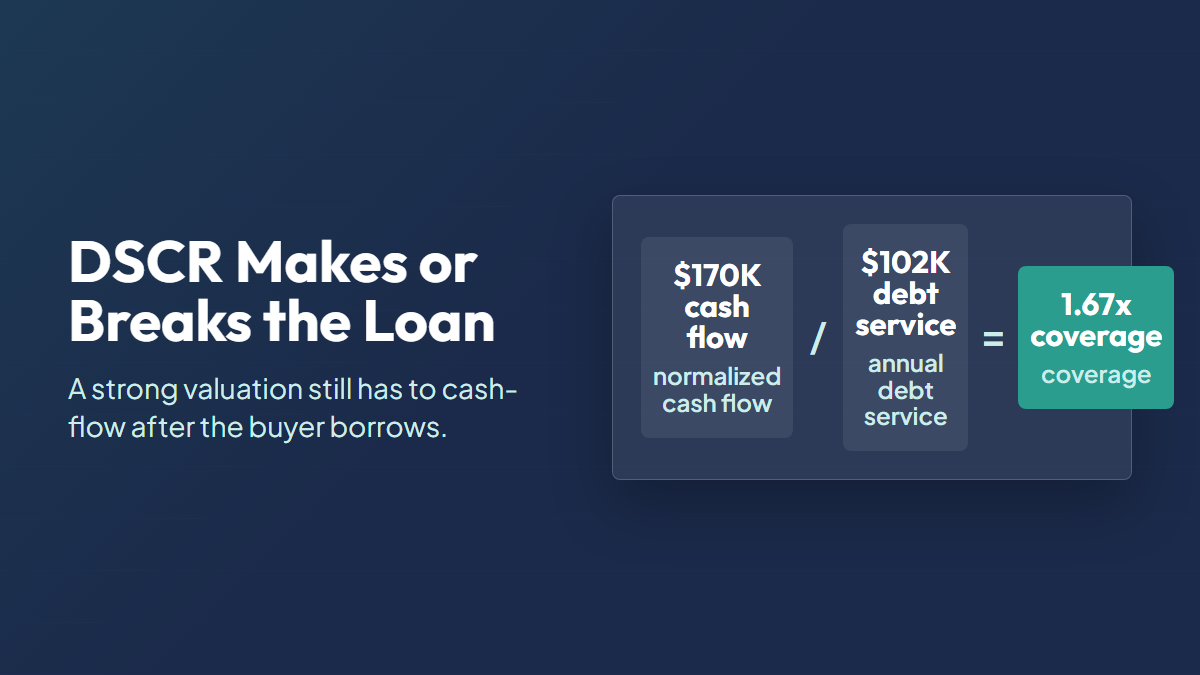
| DSCR | Normalized cash flow / Annual debt service |
Different lenders and deal types use different thresholds, so do not treat one DSCR number as a universal rule. The principle is constant: the larger the cushion, the easier the credit conversation becomes. Thin coverage forces the lender to question the price, the buyer's equity, the seller note, the working capital left in the business, or all four.
(MyExitNumber's free calculator gives you the valuation baseline. The $49 report adds the bank readiness snapshot and estimated DSCR for planning, not as a substitute for the lender-ordered SBA valuation.)
Worked Example: Same Business, Different Loan Outcome
Assume a buyer wants to purchase a niche HVAC service company. The business has $1.25 million in revenue and the seller claims $240,000 in SDE. The asking price is $700,000, or about 2.9x SDE.
At first glance, the price sounds reasonable. In this simplified example, before separate closing-cost and working-capital assumptions, the buyer contributes $70,000 of equity and borrows $630,000 over 10 years at a 10.5% assumed rate. Annual debt service is roughly $102,000. If the lender accepts $170,000 of normalized cash flow after required buyer salary and operating costs, the DSCR is about 1.67x.
That version has room to breathe. The price is not the problem because the cash flow supports the debt.
Now change two assumptions. During diligence, $40,000 of add-backs cannot be supported, and the buyer has to borrow $765,000 because the seller refuses to move below $850,000. At the same assumed rate and term, annual debt service is roughly $124,000. Normalized cash flow falls to $130,000. DSCR drops to about 1.05x.
Same business. Similar seller story. Very different lender reaction. The lender may ask for a lower price, more buyer equity, a larger seller note, a longer amortization if eligible, or a different structure. If none of those work, the deal may not fund.
What the Valuation Report Needs to Support
The lender is not trying to admire a polished report. The lender wants a bridge from tax-return reality to post-close repayment capacity. Every adjustment should be traceable.
Start with earnings. For owner-operated businesses, SDE explains the total financial benefit to one working owner. For lender review, the same business may also need a normalized cash-flow view that considers whether the buyer must pay a manager, replace the owner, or keep certain expenses in the business.
Then support the add-backs. Depreciation, amortization, and interest are straightforward because they appear on the financial statements. Non-recurring expenses need backup. If the seller claims a one-time legal settlement, show the invoice and proof it will not repeat. If the seller claims personal auto expenses, show why the buyer will not need that vehicle cost after closing.
Finally, reconcile the report to tax returns and monthly financials. A valuation that relies on management statements the tax returns do not support will slow underwriting. A lender may still consider year-to-date performance, but the story has to be consistent.
Five Bank Review Checks That Affect Value
The valuation number sits inside a broader credit file. If the rest of the file is weak, the valuation carries less weight.
| Review area | What the bank wants to know | Why it affects value |
|---|---|---|
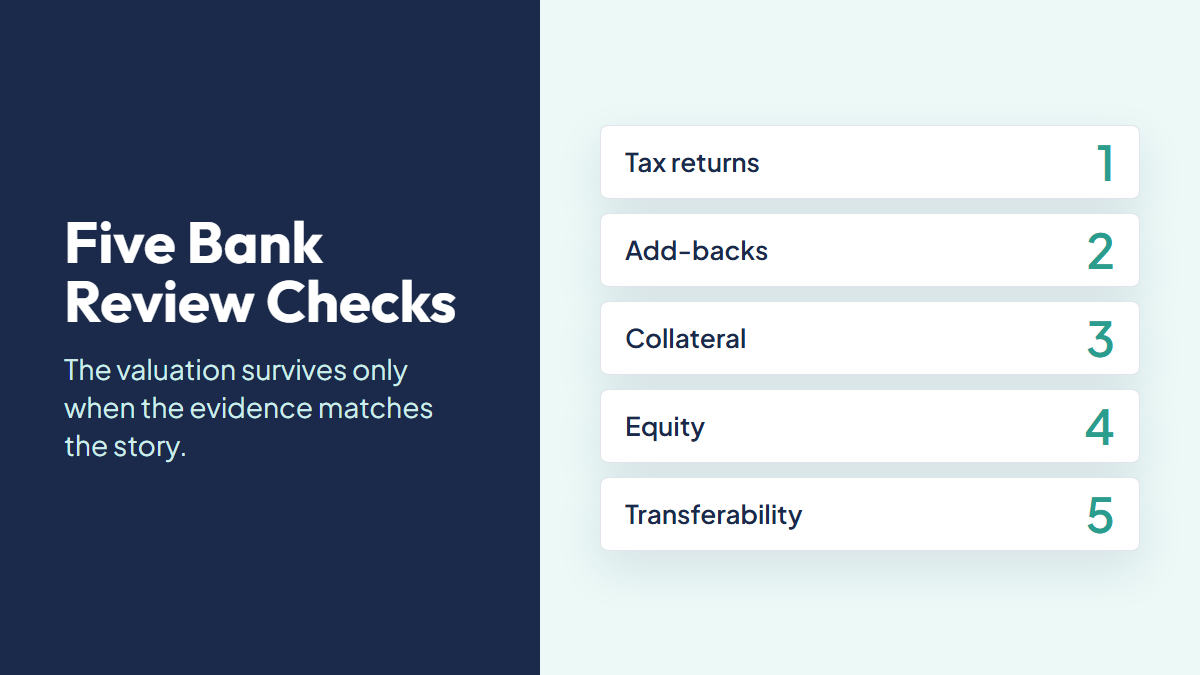
| Tax returns | Do historical earnings match the valuation story? | Unsupported earnings cannot carry debt |
| Add-backs | Are adjustments real, documented, and non-recurring? | Weak add-backs reduce cash flow |
| Buyer equity | Does the buyer have enough capital at risk? | Thin equity leaves no room for surprises |
| Collateral | What assets support the loan if cash flow weakens? | Weak collateral increases reliance on cash flow |
| Transferability | Can leases, licenses, contracts, and staff transfer? | Non-transferable value is not lender-friendly |
The transferability check is where sellers get surprised. A business can look profitable and still be hard to finance if the buyer cannot assume the lease, keep critical licenses, retain the team, or preserve key customer relationships. This is not just legal housekeeping. It determines whether the cash flow survives the sale.
Red Flags Banks Notice Quickly
The first red flag is owner dependency. If the seller is the only estimator, salesperson, technical lead, and customer relationship holder, the buyer is not just buying cash flow. They are buying a transition risk. That can force a lower multiple or a larger seller transition period.
The second red flag is customer concentration. If one customer produces 35% of revenue, the lender has to ask what happens if that account leaves after closing. Even a strong historical SDE number can lose power if the future revenue base looks fragile.
The third red flag is undocumented add-backs. A broker may accept a seller's explanation in a pricing conversation. A lender underwriter will want documents. If the general ledger says "miscellaneous" and the seller says "personal expenses," the adjustment is vulnerable.
The fourth red flag is insufficient working capital. Buyers can stretch to pay the seller and then discover there is not enough cash left to run payroll, fund inventory, or absorb a slow month. A bankable price has to leave the business operational on day one.
How to Prepare Before the Loan Conversation
Prepare like the lender is going to ask for proof, because they will. Build a folder with three years of business tax returns, interim financial statements, a debt schedule, payroll reports, lease documents, major contracts, equipment lists, and a clear add-back schedule.
Run the valuation at more than one price. A seller who only models the highest asking price does not know where the financeable line sits. Model the baseline price, a modest discount, and a version with seller financing. The exercise shows which variable matters most: purchase price, buyer equity, loan terms, or normalized cash flow.
Clean up the story before you let a buyer use lender feedback as leverage. If add-backs are weak, document them. If the buyer will need to hire a manager, model that salary now. If customer concentration is high, explain contracts, tenure, and renewal history before the underwriter asks.
Know the Bankable Range Before You Negotiate
The price that feels fair to the seller, the price a buyer is willing to pay, and the price a lender will finance are related but not identical. A deal closes where those three ranges overlap.
Use that overlap as the planning target. If the valuation is solid but the loan still strains coverage, the next work is evidence and structure, not a louder asking price.
Frequently Asked Questions
Do SBA loans require a business valuation?
For a 7(a) change-of-ownership loan, SBA SOP 50 10 requires a current business valuation in the lender file. The valuation must be requested by and prepared for the lender, not for the buyer or seller.
Who orders the business valuation for an SBA acquisition loan?
The lender orders it. SBA SOP 50 10 says the lender may not use a business valuation prepared for the applicant or the seller.
What is the SBA $250,000 business valuation threshold?
For many non-special-purpose properties, if the amount being financed, including 7(a), 504, seller, or other financing, minus the appraised value of real estate and/or equipment being financed is over $250,000, or if buyer and seller have a close relationship, the lender must obtain an independent valuation from a Qualified Source.
Is SDE or EBITDA more important for an SBA acquisition?
Both matter. SDE explains owner benefit in a Main Street sale, while EBITDA or normalized cash flow helps the lender evaluate repayment after a market-rate operator cost.
Can MyExitNumber replace an SBA lender valuation?
No. MyExitNumber gives an estimate for planning. The free calculator provides a baseline valuation, and the $49 report adds a bank readiness snapshot, but the lender controls the SBA valuation process.
Find Out What Your Business Is Worth
MyExitNumber calculates your business value using three proven methods - SDE, EBITDA, and Revenue multiples - so you get the full picture, not just one number.