
7 Ways to Increase Your Business Valuation Before Selling
A business with $300,000 in SDE can be priced anywhere from $750,000 to $1,350,000. Same earnings, same industry, same P&L. The $600,000 spread is not buyer luck or market timing. It is the result of decisions the seller did or did not make in the 12 to 24 months before listing. If you want to increase business valuation without hoping a generous buyer walks through the door, you need to work on what actually moves the number.
This post is the action guide, not the math walkthrough. It names the seven levers that reliably move price at the Main Street and lower-middle-market end, what each one is worth in dollars, and roughly how long you need to pull on it for a buyer to believe you. For how the underlying numbers are calculated, see SDE Explained, EBITDA for Small Business Owners, and Business Valuation Multiples Explained. For the wider pre-listing checklist, see How to Prepare Your Business for Sale.
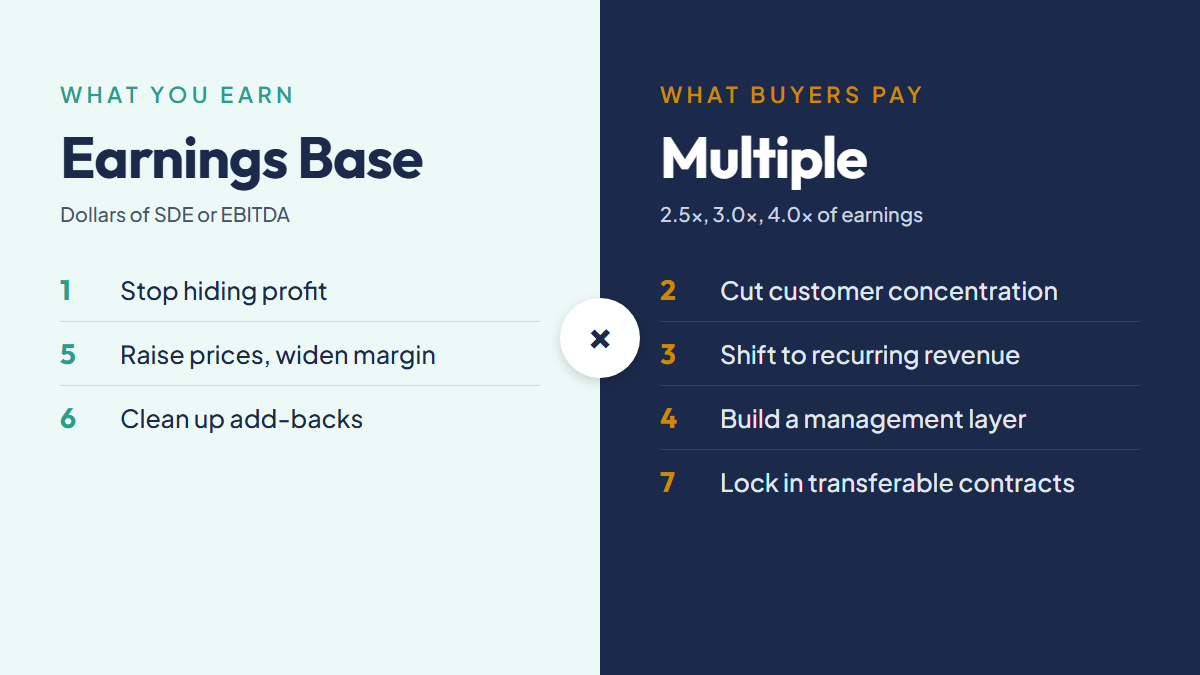
Short answer: seven levers reliably move small-business valuation before a sale. Three raise the earnings base (stop hiding profit, raise prices, clean up add-backs). Four raise the multiple buyers will pay (cut customer concentration, shift to recurring revenue, build a management layer, lock in transferable contracts). Together they can move the number 20% to 30% in 12 to 24 months.
Two Ways to Increase Business Valuation: Earnings or Multiple
Before you can increase business valuation with intent, you need to understand the formula buyers use:
Price = Normalized Earnings × Multiple
That is it. SDE or EBITDA gives you the earnings. The industry, the risk profile, and the quality of the operation give you the multiple. Every lever in this post does one of three things: raises the earnings number, raises the multiple buyers are willing to pay, or prevents a discount that would otherwise be applied.
A $100,000 increase in SDE at a 3.0x multiple is worth $300,000 at sale. A 0.5x multiple expansion on a $400,000 SDE is worth $200,000. Neither is cosmetic. The levers that move the multiple are usually harder and slower than the ones that move earnings, which is why most owners discover them too late.
(MyExitNumber calculates SDE, EBITDA, and all three valuation ranges in the same screen, so you can see immediately which lever has the most leverage for your specific numbers.)
1. Stop Running the Business Through Your Tax Return
Lever type: earnings base
Timeline: 12-24 months
Dollar impact: $50,000 of hidden profit is worth $150,000 at a 3.0x multiple
For years, your accountant helped you minimize taxes by burying marginal expenses inside the business. That is rational while you own it. It is expensive the moment you list.
Here is the trap: anything that is not on the tax return and cannot be documented with receipts, vendor invoices, and a defensible business purpose will not survive a Quality of Earnings review. A buyer's CPA cannot add back what they cannot verify. Your broker can type $50,000 of "personal expenses" into the add-back column, but the SBA lender will strike it out during underwriting.
The fix is uncomfortable but mechanical. Twelve to twenty-four months before listing, pull personal spending out of the business and let the P&L show what the company actually earns. You pay tax on that additional profit in the short term. In exchange, every dollar of newly visible earnings gets multiplied by your industry multiple at closing.
When this pays off
- Your industry SDE multiple is at least 2.5x
- You have at least 12 months of runway before listing
- Your current tax returns include clearly personal items that would be rejected in diligence
2. Get Customer Concentration Below 20%
Lever type: multiple (and bankability)
Timeline: 6-18 months
Dollar impact: 0.5x to 1.0x multiple discount avoided
If a single customer generates more than 20% of your revenue, buyers and SBA lenders treat your business as a risk position, not a going concern. The logic is simple: if that customer leaves the week after closing, the buyer still has to service the acquisition loan with less cash flow.
Brokers routinely discount the multiple by 0.5x to 1.0x for businesses with a customer concentration over 30% of revenue from a single account. On a $400,000 SDE business, that is $200,000 to $400,000 in lost valuation. More importantly, some deals become unfinanceable at all, which means no SBA-backed buyer can close.
How to reduce it
- Hire a second salesperson focused on new logo acquisition
- Raise prices on the concentrated account (the loss of some volume is fine if it rebalances the book)
- Expand into an adjacent customer segment with a dedicated offer
3. Convert Transactional Revenue Into Recurring Revenue
Lever type: multiple
Timeline: 12-24 months
Dollar impact: 0.3x to 0.7x multiple uplift
Buyers pay more for predictable cash flow than for one-off transactions, and SBA lenders underwrite repeat revenue more generously. A business with 40% of revenue under contract, on retainer, or in subscription form will command a higher multiple than an identical business running entirely on project-by-project invoicing.
You do not need to become a SaaS company to benefit. Practical conversions at the small-business level include:
- A landscaping company turning ad-hoc jobs into monthly service plans
- A bookkeeping firm moving clients from hourly engagements to flat monthly retainers
- An HVAC contractor selling annual maintenance agreements with auto-renewal
- A commercial cleaning service requiring 12-month contracts with cancellation notice
The multiple uplift is real and defensible in diligence because the contracts and billing history prove it.
4. Build a Management Layer So the Business Runs Without You
Lever type: multiple (and saleability)
Timeline: 12-24 months
Dollar impact: the difference between a sellable business and an unsellable one
An owner-dependent business is not just worth less. It is sometimes worth nothing, because no SBA-backed buyer will take the risk. If you are the only person who can quote jobs, manage vendors, or talk to key customers, the buyer is not buying a business. They are buying your job, plus a loan payment.
The test buyers apply is simple: can the business operate for 30 days with the owner unreachable? If the answer is no, the multiple drops and the pool of qualified buyers shrinks.
What a management layer looks like
- A general manager or operations lead with signing authority on day-to-day decisions
- Documented SOPs for quoting, production, and customer onboarding
- A second point of contact on every major customer relationship
- Scheduling, payroll, and vendor payments running without owner input
Hiring a GM at $75,000 reduces SDE by that amount. On a $400,000-SDE business at a 2.5x multiple, the pre-hire valuation is $1,000,000. Post-hire, SDE drops to $325,000 but the multiple goes to 3.3x because the business is now transferable. New valuation: $1,072,500. The hire paid for itself in multiple expansion alone, and it turned the business from a long shot into a financeable deal.
5. Raise Prices Methodically to Expand Gross Margin
Lever type: earnings base
Timeline: 6-12 months
Dollar impact: a 3% price increase on $1.2M revenue adds roughly $75,000 to $108,000 at a 3.0x multiple
Many small business owners are underpriced relative to what their customers will tolerate. Raising prices by 3% to 5% on a defensible schedule rarely loses more than 1% to 2% of volume, and every dollar of the increase flows almost entirely to the bottom line because variable costs do not rise in step with pricing.
The mechanics matter. A blanket "we are raising prices 10% across the board" announcement triggers churn. A segmented approach, where you raise prices first on the least price-sensitive customer cohorts or on new customers only, captures the bulk of the upside with a fraction of the risk.
Why this lever is underused: owners assume their competitors are also holding the line on prices. In reality, that competitor raised prices quietly six months ago and nobody noticed. A 3% lift on a $1.2M revenue, 40% gross margin business adds roughly $25,000 to $36,000 to SDE depending on volume retention, worth $75,000 to $108,000 at a 3.0x multiple, and it usually takes less than a year to prove it to a buyer.
6. Clean Up Add-Backs So They Survive Quality of Earnings
Lever type: earnings base (defense)
Timeline: 6-12 months
Dollar impact: $40,000 of disallowed add-backs is worth $120,000 at a 3.0x multiple
Add-backs are where valuations die. A seller claims $500,000 in SDE with $80,000 of add-backs on top of taxable income. The buyer's diligence team rejects $40,000 of those add-backs because there is no documentation. SDE falls to $460,000. At a 3.0x multiple, the deal price drops by $120,000, and the buyer's trust in every other number on the P&L drops with it.
Defensible add-backs typically include: owner's above-market compensation (proved against a market salary benchmark), documented one-time legal or repair expenses, owner's personal health insurance (with the benefits statement), and related-party rent above market. Indefensible items: unspecified "meals and entertainment," cash transactions without receipts, and "miscellaneous" categories.
Build a file for every add-back as you go, not in the weeks before listing. The cost of a buyer's diligence team catching undocumented add-backs mid-deal is far higher than keeping the documentation current month to month.
7. Lock In Transferable Contracts
Lever type: multiple (and saleability)
Timeline: 3-9 months
Dollar impact: prevents catastrophic valuation loss or a broken deal
A valuation assumes the business can be handed to a new owner intact. If the lease, the key vendor agreement, or the non-compete on your top producer is not assignable, the business is not fully transferable, and buyers pay accordingly.
The biggest killer is the lease. A two-year lease with no renewal options on a location-dependent business is a deal-breaker for any SBA-backed buyer, because the lender's loan term is 10 years. Before you list, renegotiate the lease to include at least one five-year option to extend, and confirm the assignment clause in writing.
Also review: exclusivity or non-compete clauses that die with your ownership, key vendor rebate agreements that do not survive a change of control, and employee agreements for your top revenue producers. If the business relies on a contract, make sure it transfers. For the broker's full risk-flag checklist, see What Do Business Brokers Look for in a Valuation?
Worked Example: Stacking Three Levers
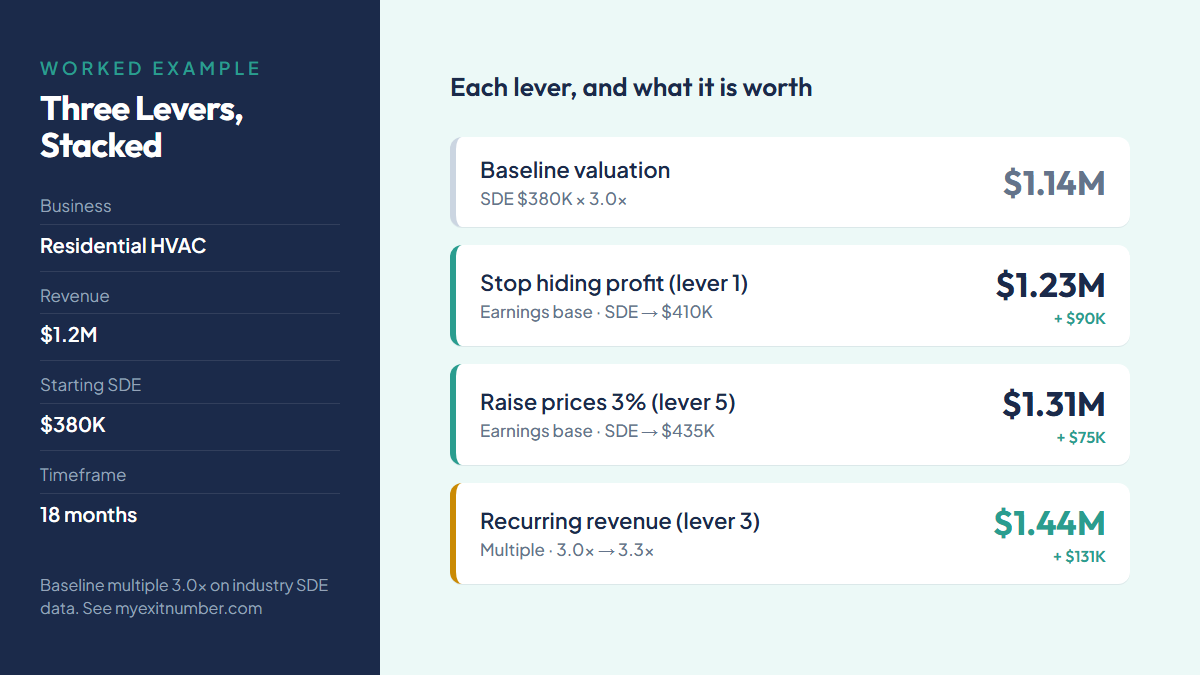
Consider a residential HVAC company: $1.2M revenue, $380K SDE, industry SDE multiple of 3.0x. Baseline valuation is $1,140,000.
The owner has 18 months before they want to list. They choose three levers:
- Stop hiding profit (lever 1): They remove $30,000 of personal expenses from the P&L. New SDE: $410,000. New valuation at 3.0x: $1,230,000.
- Pricing (lever 5): They raise prices 3% across residential service calls over nine months. Revenue adds $36,000; $25,000 flows to SDE. New SDE: $435,000. New valuation at 3.0x: $1,305,000.
- Recurring revenue (lever 3): They convert 35% of their customers to annual maintenance plans. Broker and buyers now apply a 3.3x multiple instead of 3.0x. New valuation: $1,435,500.
Total increase: $295,500 on a $1,140,000 baseline, or 26%, in about 18 months. No buyer magic, no market timing, no discount. Just three levers, pulled deliberately, documented as they happened.
Start With Your Baseline
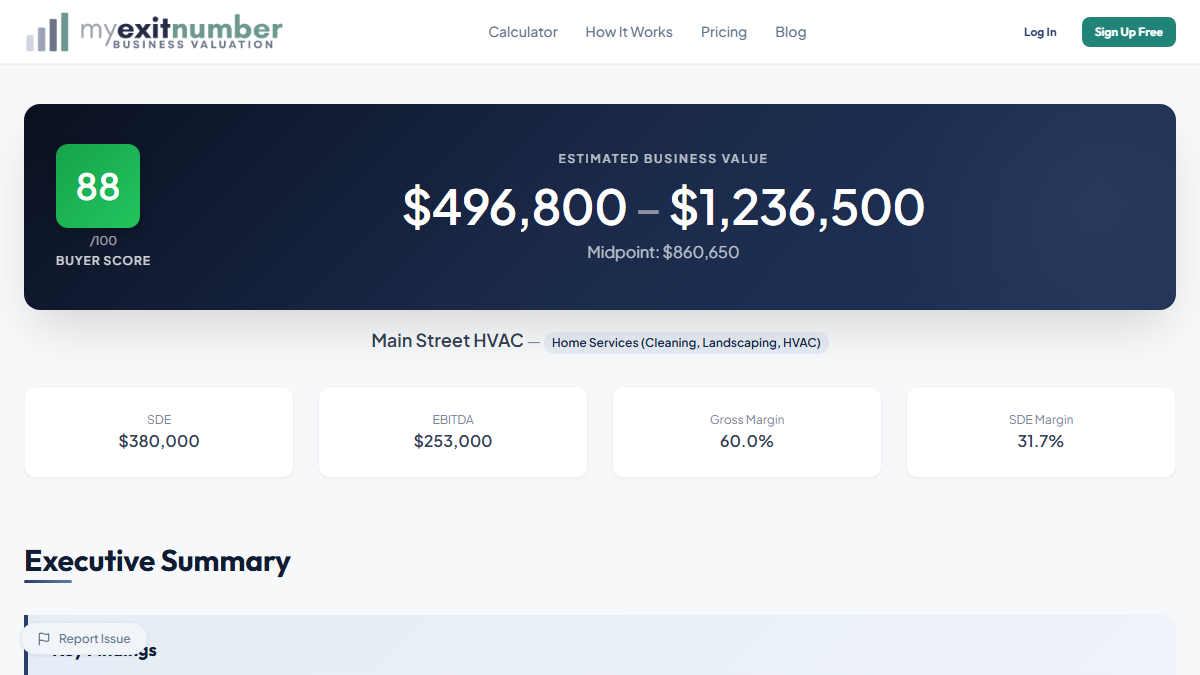
None of these levers work without knowing where you stand today. If you do not know your current SDE, EBITDA, industry multiple, or blended valuation range, the right starting move is to get the baseline number. MyExitNumber calculates all three methods in minutes, free and with no signup, so you can see which of the seven levers has the most dollar leverage on your specific business before you decide where to spend the next 12 months.
Frequently Asked Questions
How much time do I need before selling to move my valuation meaningfully?
Twelve to twenty-four months is the realistic window. Price and contract levers can move inside six months. Earnings cleanup, recurring revenue shifts, and management-layer builds need a full fiscal year of results for buyers and lenders to believe them.
Can I move my valuation in less than six months?
You can avoid discounts by fixing the lease, documenting add-backs, and securing key contracts, and you can pull pricing levers. You cannot credibly raise the multiple in that window, because buyers want to see a trailing twelve months of the new behavior on the P&L.
Do buyers reward projected improvements or trailing results?
Trailing, almost always. A run-rate projection might earn a small premium from a strategic buyer, but SBA lenders underwrite on historical tax returns. If the change is not on two to three years of P&Ls, it is not in the multiple.
Which lever is worth the most dollars per month of effort?
Pricing moves the fastest in dollar terms for businesses that are underpriced. Recurring revenue moves the multiple the most if the conversion sticks. Customer concentration cleanup is the most expensive to ignore.
Is paying extra tax to show real profit actually worth it?
Usually yes, if your multiple is above 2.5x and you have at least a year of runway. Every $1 of newly visible SDE becomes $2.50 to $4.00 at closing. The extra tax is a fraction of that.
Find Out What Your Business Is Worth
MyExitNumber calculates your business value using three proven methods - SDE, EBITDA, and Revenue multiples - so you get the full picture, not just one number.