
Owner Dependent Business: Why Buyers Pay Less
Every quote waits for your approval. Customer complaints land on your phone. Nobody else knows which supplier will extend credit when a payment arrives late. These habits keep work moving today, but they leave a buyer wondering what happens when you leave.
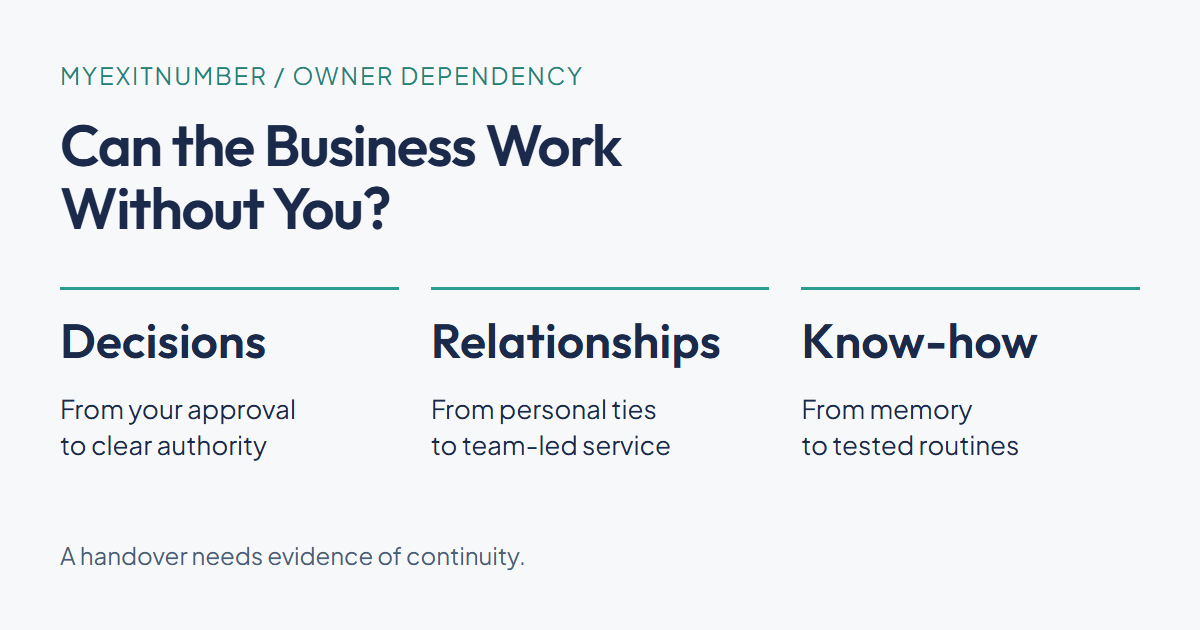
An owner dependent business relies on its seller for decisions, relationships, or expertise that have no reliable substitute. The issue is not simply how many hours you work. It is how much of the operation stops when you are unavailable.
This guide focuses on finding those dependencies, estimating the cost of work that must continue, and building evidence of a successful handover. For the broader preparation process, use the business sale checklist. Here, the practical question is narrower: what could another person take over tomorrow, and what still lives in your head?
What Makes an Owner Dependent Business Hard to Transfer?
Working in your company does not automatically make it difficult to sell. A buyer who intends to operate a shop may expect to manage staff and serve customers. A defined job with teachable routines is different from a role that requires your personal reputation, undocumented judgment, and constant intervention.
Start by recording your interruptions for two working weeks. Note the request, who raised it, why they needed you, and what would have happened without an answer. Use the log to build your handover list instead of relying on memory.
| Dependency | What to investigate | Evidence of progress |
|---|---|---|
| Pricing decisions | Can staff quote within approved limits? | Quotes completed without your intervention |
| Customer relationships | Does anyone else handle renewals? | Account meetings and renewals led by colleagues |
| Technical knowledge | Can someone resolve unusual jobs? | Completed work using documented instructions |
| Financial control | Who handles collections and supplier queries? | A working approval process with backup coverage |
Decision rights specify who may make a decision and within what limits. Distinguish lack of knowledge from lack of authority. An experienced employee may know exactly what to do but still need your permission to issue a small refund. Writing another procedure will not remove that delay unless decision rights change too.
How Dependency Affects Price and Sale Terms
A purchaser must consider both the cost of continuing your work and the uncertainty of transferring it. Hiring an estimator creates an identifiable expense. Discovering that clients refuse to discuss projects with anyone else creates a separate revenue risk.
BizBuySell's guide to seller's discretionary earnings identifies owner dependency among the factors affecting valuation multiples. There is no universal percentage discount for being indispensable. The consequences depend on what must transfer, who the buyer is, and what the records demonstrate.
The effect can also appear in the handover obligations. A buyer may seek a longer training period or continued consulting support. BDC's transition guidance advises sellers to anticipate requests for involvement after a sale and to plan the transition with the buyer.
Compare offers alongside the work you would still have to do. A price attached to six months of loosely defined availability means something different from the same price with a specific training schedule. List hours, duties, compensation, and the expected end of your involvement before treating the headline amounts as equivalent.
Worked Example: Cost the Work That Must Continue
Subtract incremental staffing costs from normalized earnings to model the work a buyer will need others to perform.
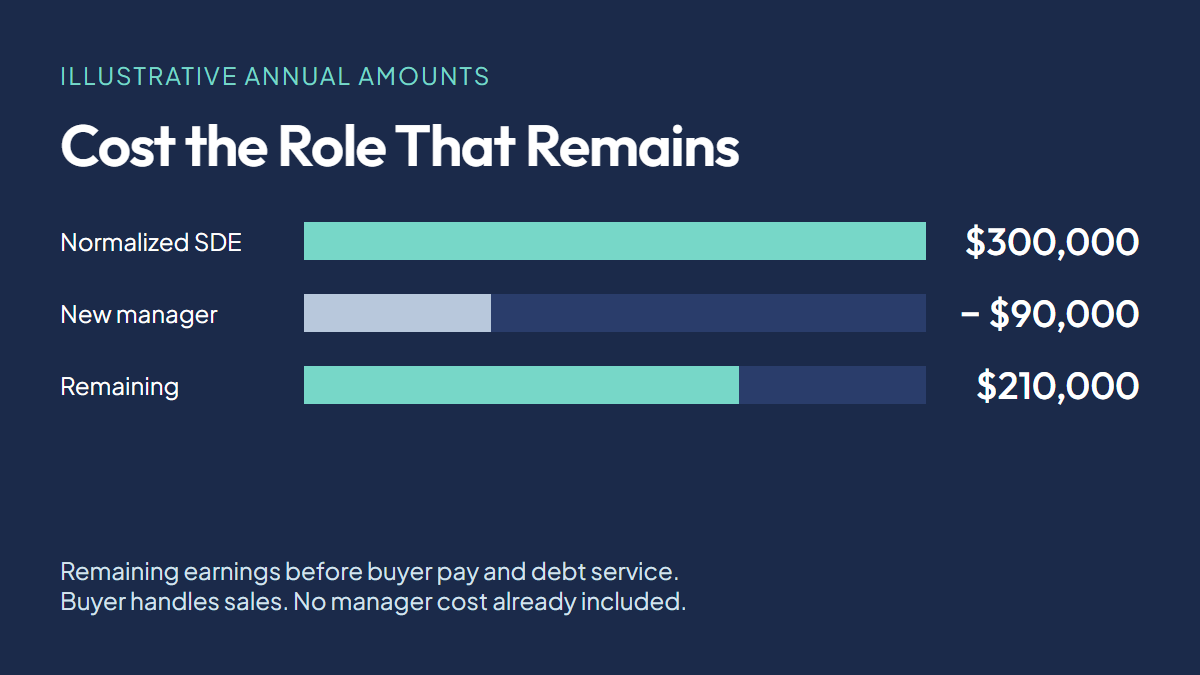
Suppose a service company has $300,000 in normalized seller's discretionary earnings, or SDE. That represents the financial benefit available to one working owner before acquisition debt service and other buyer-specific cash needs. For the underlying calculation, see SDE explained.
Consider a buyer who plans to handle sales but needs someone else to run scheduling and field operations. Assume the seller currently performs both functions, no operations manager is already on payroll, and the new role costs $90,000 annually including salary, employer taxes, and benefits. Both the $300,000 SDE and the $90,000 hiring cost are assumed annual figures, not observed market data or compensation benchmarks. For your own version, use a documented SDE calculation and a hiring budget that includes salary, employer taxes, and benefits.
| Annual earnings bridge | Amount |
|---|---|
| Normalized SDE before the additional hire | $300,000 |
| Incremental operations-manager cost | -$90,000 |
| Remaining earnings before buyer pay and debt service | $210,000 |
The arithmetic is $300,000 - $90,000 = $210,000. This is a staffing scenario, not a formal conversion to EBITDA or a sale-price calculation. The buyer still performs sales work, and taxes, capital spending, working capital, and acquisition financing require separate consideration.
An owner-operator able to perform the seller's complete role might not need that hire. An absentee buyer might need additional sales coverage as well. Define the operating model before subtracting replacement wages, and never deduct a cost already included in the earnings figure. BizBuySell's SDE calculator guidance distinguishes the compensation of one working owner from the replacement wage for another working owner.
(MyExitNumber's paid scenario tool lets you change operating expenses to explore an additional hire's effect on estimated value.)
Treat the hire as an ongoing operating expense, not a discretionary add-back. Nor does hiring a manager guarantee a higher sale price: the added cost reduces earnings unless other improvements offset it. Whether improved continuity supports a different multiple requires evidence and buyer judgment.
Transfer Decisions, Relationships, and Knowledge
Use the interruption log to choose one costly dependency to address first. The aim is a working transfer that someone can demonstrate, not a folder of procedures assembled just before listing the company.
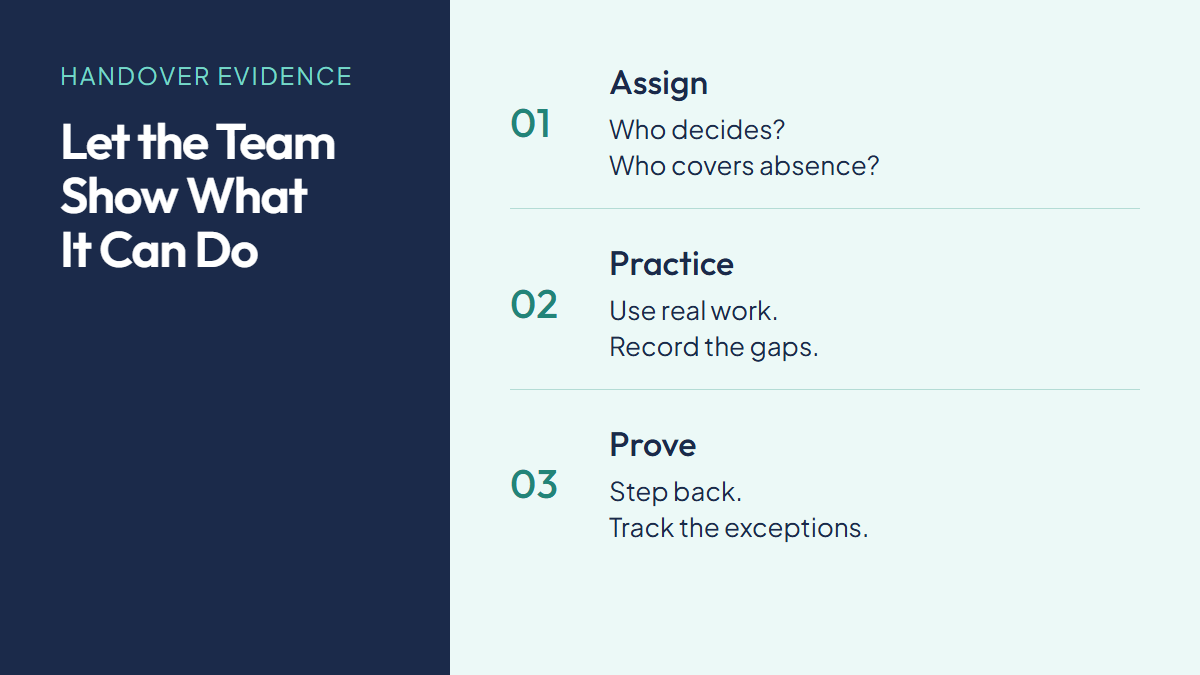
The four steps below put the graphic's three stages into practice: assign decision rights, practice customer handovers and operating routines, then test continuity while you step back. Its pace depends on staff capacity and the complexity of the work; completing a checklist does not establish that the business is ready for sale.
1. Give a named person a defined decision
Choose a recurring decision, such as approving routine quotes. Write the permitted price range, margin floor, exceptions, and escalation route. Assign a backup so the process does not simply move from one indispensable person to another.
Review outcomes at an agreed interval instead of approving every transaction. Keep necessary financial controls: delegation can preserve separate approval for bank changes or large payments while removing your involvement from routine requests.
2. Let the team handle customer relationships
Introduce a colleague as someone who can resolve issues, not just someone copied on emails. Let that person lead a service review, prepare a renewal, and follow through on a complaint. Record agreed terms and account history in company systems.
Personal relationships and concentrated revenue are related but separate risks. If one customer also accounts for a large share of sales, use the customer concentration guide to assess that exposure. A second account contact does not diversify revenue.
3. Test instructions on real work
Document the steps, inputs, judgment calls, and exceptions for a task another employee will perform. Have that employee use the instructions on a live assignment with appropriate supervision. Their questions identify gaps that the author can easily overlook.
Include access and permissions in the handover. A documented collections process is incomplete if only your personal account can retrieve invoices. Use company-controlled access with individual credentials and suitable permissions rather than sharing passwords.
4. Step back and record the exceptions
Try a planned period of reduced availability after the team has practiced. Begin with a short interval appropriate to the business, retain emergency escalation, and extend it as coverage improves. Track delayed work, rework, customer complaints, and decisions sent back to you.
Do not quietly clear the backlog every evening and call the trial successful. Record those interventions. The unresolved exceptions tell you what still needs training, authority, staffing, or a different process.
Evidence a Buyer Can Check Before Closing
Build a small evidence file around the work transferred. Include role descriptions, approval limits, staff-led customer activity, training records, and operating results during your reduced involvement. Compare service and financial performance as well as your hours: fewer owner hours achieved by delaying orders is not an improvement.
A useful diligence question is, "Show the last difficult job handled without the owner." A dated quote, delivery record, and resolved complaint explain more than a claim that the team is autonomous. Select examples that represent normal operations, and disclose the exceptions rather than presenting an unusually quiet week as proof.
Document what remains dependent on you, including specialized expertise or credentials. Identify whether a replacement can acquire the necessary capability and how long training could take. Where licenses or contract permissions matter, verify the actual transfer requirements with the relevant adviser or authority.
Put the remaining work into a transition schedule with named responsibilities and completion criteria. For the related distinction between company reputation and relationships attached to an individual, see goodwill in a business valuation. The evidence here concerns operating continuity; it does not determine the legal ownership or accounting allocation of goodwill.
Frequently Asked Questions
Can I sell if I am still the main salesperson?
Yes, but show how inquiries originate, how proposals are prepared, and who can maintain the relationships. A buyer needs to distinguish a repeatable sales process from customers purchasing solely because of you.
Do I need to hire a general manager before listing?
Not necessarily. Map the work and the likely buyer's role first. Training existing employees or hiring for a narrower responsibility may fit better. Include any added recurring cost in the financial forecast.
Is a two-week vacation enough to prove independence?
It is one observation, not a certification. Two quiet weeks may exclude renewals, difficult jobs, or month-end collections. Look for evidence across the operating cycle, including exceptions the team handled.
What if one employee becomes as indispensable as I was?
You have moved the dependency. Cross-train a backup, document decisions, and make access recoverable through company administration. Assess that employee's responsibilities and continuity arrangements as part of the handover.
Will staying on after closing solve the problem?
A defined transition can bridge a training gap. An open-ended promise to remain available leaves the dependency unresolved. Agree what the successor must be able to do, the support provided, and when that support ends.
Find Out What Your Business Is Worth
MyExitNumber calculates your business value using three proven methods - SDE, EBITDA, and Revenue multiples - so you get the full picture, not just one number.