
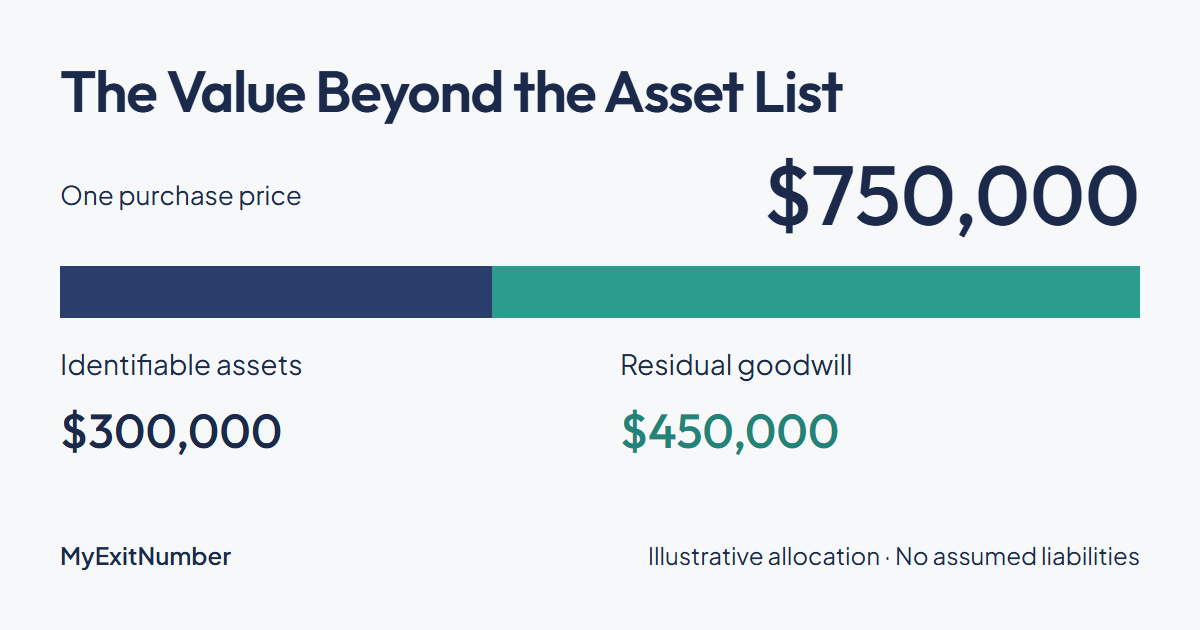
What Is Goodwill in a Business Valuation?
Would someone pay for your business if they could buy the same equipment elsewhere for less? If the answer is yes, part of what they want is the operation you have built around those assets: its reputation, established routines, and ability to keep earning after a handover.
Understanding goodwill in a business valuation helps explain that extra value. But the gap between the asking price and the equipment list is not automatically all goodwill. Customer relationships, trademarks, and other identifiable intangible assets may need separate values first.
This guide explains what goodwill represents, how it fits into a purchase-price allocation, and how to avoid counting it twice. A simplified $750,000 transaction connects the concepts to the documents a seller will review.
What Goodwill Means in a Business Valuation
Goodwill is the residual value in an acquisition after the purchase consideration has been allocated to identifiable net assets under the applicable rules. In a straightforward purchase of an entire business, it is what remains after those assets and assumed liabilities have been measured.
The IFRS Foundation's summary of business-combination accounting describes that sequence: identify and measure the acquired assets and liabilities, then allocate the remaining acquisition cost to goodwill. This is the accounting concept; a small-business sale also needs its own transaction and tax analysis.
Commercially, the residual can reflect the benefit of acquiring an established operation instead of assembling one from scratch. A functioning service company has a dispatch process, people who know their jobs, and a reputation that helps the phone ring. Their combined earning potential can exceed the separately identified asset values.
That does not make goodwill a reward for years of effort. A buyer still needs evidence that future earnings justify the total price. Time spent building the company explains its history; the operation's prospects support its value.
Goodwill vs. Equipment and Identifiable Intangible Assets
Identifiable intangible assets are nonphysical assets that can be recognized separately from goodwill under the relevant allocation rules. Equipment is easy to picture, but physical visibility is not the test for separate value.
For example, an acquired customer relationship or trade name may receive its own allocation. Calling everything beyond vans and inventory "goodwill" skips this assessment. The IRS Form 8594 instructions distinguish customer-based intangibles and trade names from goodwill and going-concern value in qualifying U.S. asset acquisitions.
| Item | What the purchaser is acquiring | Allocation consideration |
|---|---|---|
| Equipment and inventory | Physical operating assets and saleable stock | Assess the assets included and their current values |
| Customer relationships | An established connection to customers | May be valued separately as an intangible asset |
| Trade name | Rights associated with the business name | May receive a separate intangible allocation |
| Goodwill | Residual acquisition value | Determined after the other required allocations |
Also distinguish current asset values from bookkeeping balances. A fully depreciated machine can still have a resale value. Subtracting its zero book value from the sale price would overstate the residual in a calculation that requires fair values.
Keep the asset list and earnings analysis connected. A customer relationship can help generate the earnings used to price the business and receive a separate allocation afterward. Those are two views of one transaction, not two amounts to charge the purchaser.
Worked Example: Allocating a $750,000 Purchase Price
Purchase-price allocation divides the transaction consideration among what is acquired; it does not independently establish what the business should sell for. The price needs support before the residual calculation begins.
Assume a buyer purchases a small service business for $750,000 in cash. For this simplified illustration, no liabilities are assumed, no real estate changes hands, and there are no deferred payments or closing adjustments. The following figures are invented teaching assumptions, not market benchmarks or an appraisal.
| Allocation item | Assumed value |
|---|---|
| Equipment and vehicles | $160,000 |
| Inventory | $40,000 |
| Identifiable customer relationships | $80,000 |
| Trade name | $20,000 |
| Total identifiable assets | $300,000 |
| Residual goodwill | $450,000 |
| Total purchase price | $750,000 |
The calculation is $750,000 - $300,000 = $450,000. Equipment and inventory account for $200,000; identifiable intangibles account for another $100,000. Subtracting only the physical assets would produce $550,000 and incorrectly absorb those separately valued intangibles into goodwill.
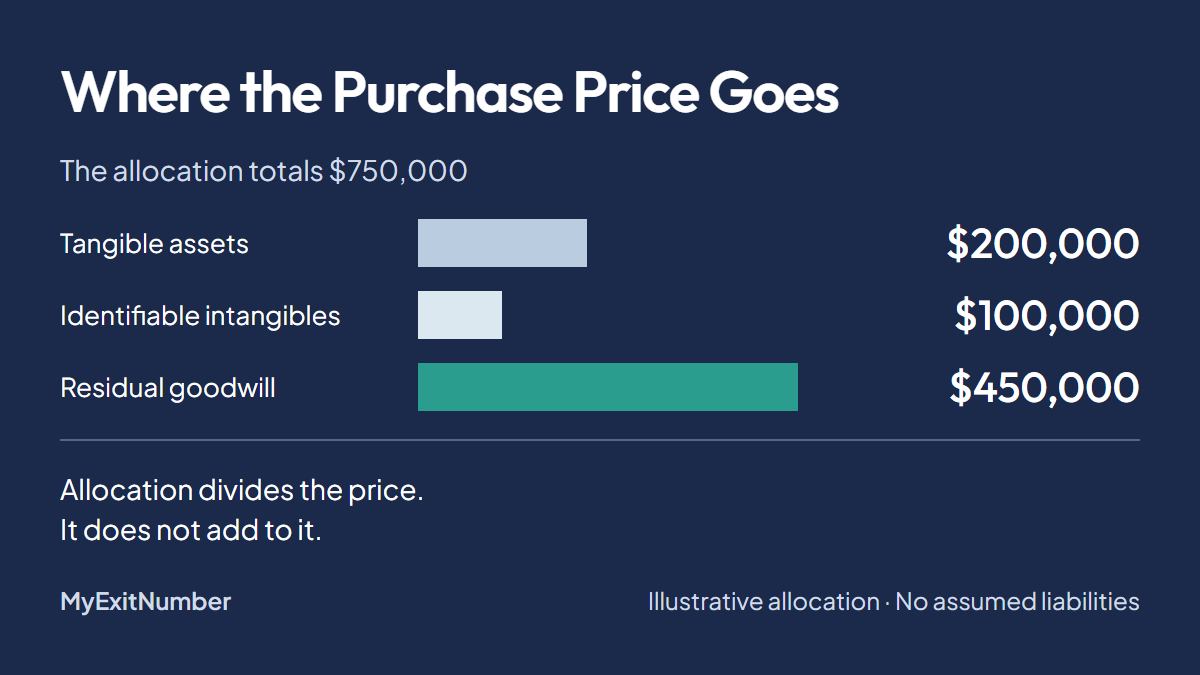
Here, goodwill represents $450,000 / $750,000 = 60% of the price. That percentage describes this example; it does not show whether the deal is cheap, expensive, or financeable. A large residual cannot substitute for an assessment of earnings durability.
Real transactions require more detail. Assumed liabilities, excluded assets, contingent payments, and the reporting framework can change the calculation. Have the transaction accountant reconcile the consideration and allocation schedules rather than subtracting a balance-sheet total from a headline offer.
Why You Should Not Add Goodwill to an Earnings Valuation
An earnings-based valuation of an operating business already reflects the earning benefits associated with goodwill. Adding a separate goodwill amount to that same valuation can count those benefits twice.
Suppose the example business has $250,000 in normalized SDE, meaning earnings adjusted to reflect the financial benefit available to one owner-operator. An illustrative 3.0x multiple produces $250,000 × 3.0 = $750,000. Assume that price covers the assets in the example. The 3.0x is a teaching assumption, not a recommended multiple.
The $450,000 residual is part of that $750,000 price. Adding it again would produce $750,000 + $450,000 = $1,200,000, without identifying any additional earnings or assets. Allocation explains the agreed price's components; it does not create an extra premium.
For the earnings calculation, see SDE Explained. For selecting and interpreting a multiple, see Business Valuation Multiples Explained. The goodwill question comes after clarifying what the valuation includes.
(MyExitNumber estimates business value using SDE, EBITDA, and revenue multiples; it does not separately appraise goodwill or allocate a purchase price.)
Deal conventions still matter. An offer might treat inventory separately or exclude real estate and surplus cash. Clarifying those inclusions can justify an adjustment, but an asset that is already covered by the valuation should not be added again under a goodwill label.
Business Goodwill vs. Relationships Tied to the Owner
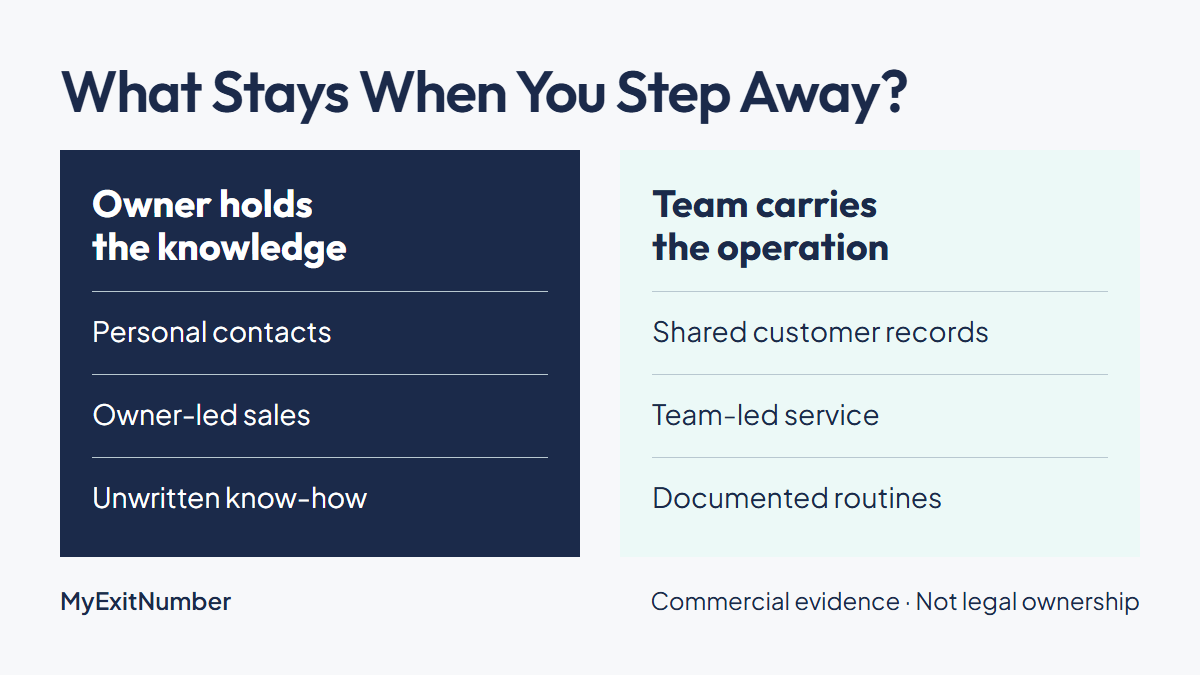
The commercial distinction is whether customers and operating knowledge remain with the business when its owner leaves. Reputation attached to the company can transfer differently from loyalty to a particular person.
Consider two service firms. At one, customers book through a shared office, technicians follow recorded procedures, and account history sits in a company system. At the other, the owner receives every enquiry on a personal phone and holds the pricing agreements in memory. The second handover has more unanswered questions.
Those observations do not automatically establish who legally owns goodwill. "Personal goodwill" can have a specific legal and tax meaning, and its treatment depends on the facts and agreements. Avoid assuming that calling relationships personal makes them separately saleable or creates a particular tax result.
For a practical handover review, trace a returning customer's path. Who receives the request, sets the price, delivers the work, and resolves a complaint? Identify each point where the owner is the only person who knows what to do.
A useful diligence exhibit pairs customer retention records with the staff member responsible for each account. It lets a purchaser investigate whether repeat business survives beyond the seller's direct involvement. Where a few accounts dominate revenue, the separate customer concentration guide explains the exposure.
What Sellers Should Document Before Negotiating Goodwill
Prepare evidence of what transfers, what supports continuing earnings, and how the proposed price is allocated. A large goodwill figure written into a spreadsheet proves none of those things by itself.
Build an asset schedule showing equipment, inventory, ownership records, and the assumptions behind their values. List relevant intangible rights and contracts alongside it, with any transfer conditions flagged for legal review. Record excluded property explicitly so the offer and allocation describe the same transaction.
Next, assemble customer retention history, operating procedures, staff responsibilities, and a specific transition plan. "The owner will help" leaves open who will make introductions, train staff, or resolve outstanding service issues. Named responsibilities and dates give both sides something concrete to assess.
For qualifying U.S. business asset sales, the IRS explains that consideration is allocated using the residual method. That allocation affects the seller's gain or loss and the purchaser's asset bases. Financial-reporting goodwill and a tax allocation should not be assumed identical.
Bring the proposed allocation to your transaction advisers before agreeing final terms. Ask them to reconcile it with the asset schedule, consideration, and relevant filing requirements. For the wider document pack, use the business sale preparation checklist.
Frequently Asked Questions
Is everything above equipment value goodwill?
No. Inventory, customer relationships, trade names, and other identifiable assets may also require allocation. Goodwill is the residual after the required allocations, not simply price minus equipment.
Does a 60% goodwill allocation mean the price is too high?
No. In the simplified example, 60% follows from $450,000 divided by $750,000. Judging the price requires evidence about earnings, risk, and what is included; the percentage alone does not answer that question.
Can I add goodwill to an SDE multiple valuation?
Not when the valuation already covers the operating business and its earning benefits. Adding the same goodwill again double-counts value. Check separately priced or excluded assets before adjusting any estimate.
Does a customer list count as goodwill?
A customer-based intangible may be identified and valued separately. Its treatment depends on the rights acquired and applicable rules; it should not automatically be placed in the goodwill residual.
Can the calculator tell me how much to allocate to goodwill?
No. A multiples-based estimate does not provide the asset valuations and transaction analysis needed for purchase-price allocation. That requires a separate assessment of the actual deal.
Find Out What Your Business Is Worth
MyExitNumber calculates your business value using three proven methods - SDE, EBITDA, and Revenue multiples - so you get the full picture, not just one number.