
How Long to Sell a Business: Realistic Timeline
You accept an offer in March, tell your spouse the hard part is over, and then spend the summer sending tax returns, lease documents, customer reports, bank statements, payroll detail, and one more version of the purchase agreement. The honest answer to how long to sell a business is not "as soon as you find a buyer." Finding the buyer starts the clock that diligence and financing have to finish.
This is the timeline guide, not the valuation math guide or the full sale-preparation checklist. It explains the realistic sequence, where owners lose weeks, and what to clean up before you list. For the price mechanics, read How Much Is My Business Worth?. For the pre-listing work, read How to Prepare Your Business for Sale.
How Long to Sell a Business: The Practical Range
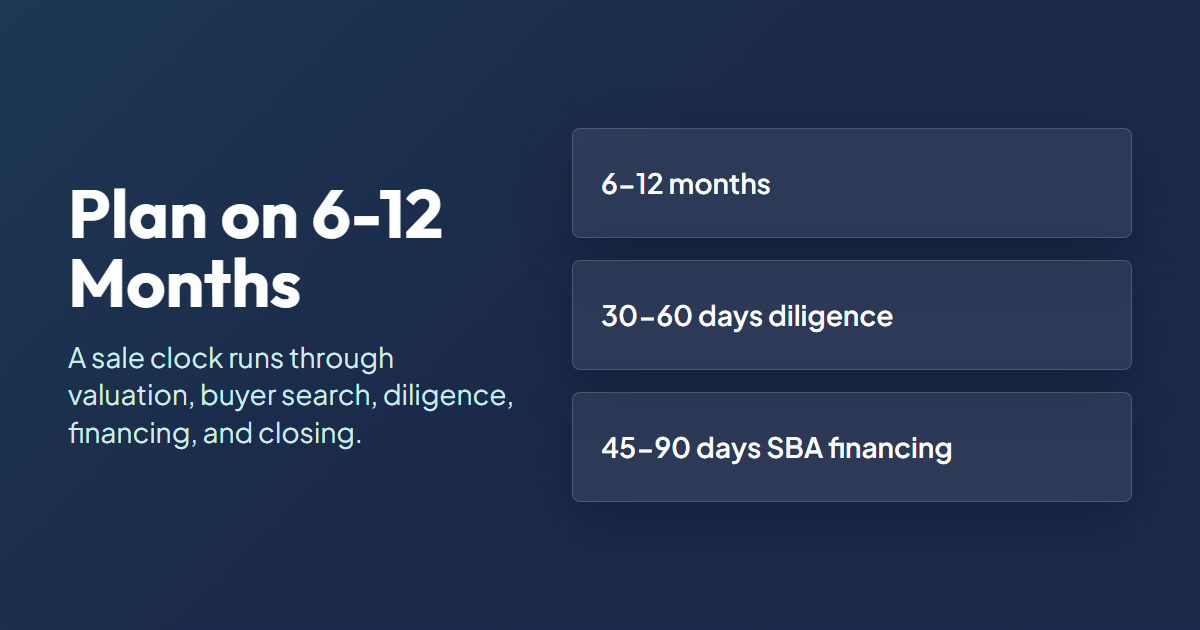
A realistic small-business sale takes about six to 12 months from listing to closing. A clean, well-priced, well-run process can land closer to six to nine months, but BizBuySell's timing guide is the better primary planning anchor: most sales take six to 12 months from the time the business is placed on the market to close. BizBuySell's full-year 2025 transaction tables also show that days on market varies materially by market and sector, so marketplace exposure is not the same thing as an owner's full prep-to-close calendar.
That range is planning guidance, not a promise. It does not include the months you spend cleaning the books before listing, and it does not guarantee the first buyer will close. Treat six months as the fast end of a well-run process, and nine to twelve months as the safer planning range if the business needs SBA financing, landlord consent, franchise approval, or extra cleanup.
The table below gives planning ranges, not sourced guarantees. Use them to reserve calendar time before you build a sale plan around a specific closing date:
| Situation | Planning range | Why it moves faster or slower |
|---|---|---|
| Clean cash buyer, simple service business | 60-120 days | No lender, clean books, few assets to transfer |
| Main Street business with broker and bank financing | 6-9 months | Buyer search, diligence, lending, legal work |
| SBA-backed acquisition | 7-12 months | Financing review can run alongside diligence but still adds checks |
| Complex business with real estate, licenses, or concentration risk | 9-15 months | More third-party approvals and risk questions |
The Six Phases of a Business Sale Timeline
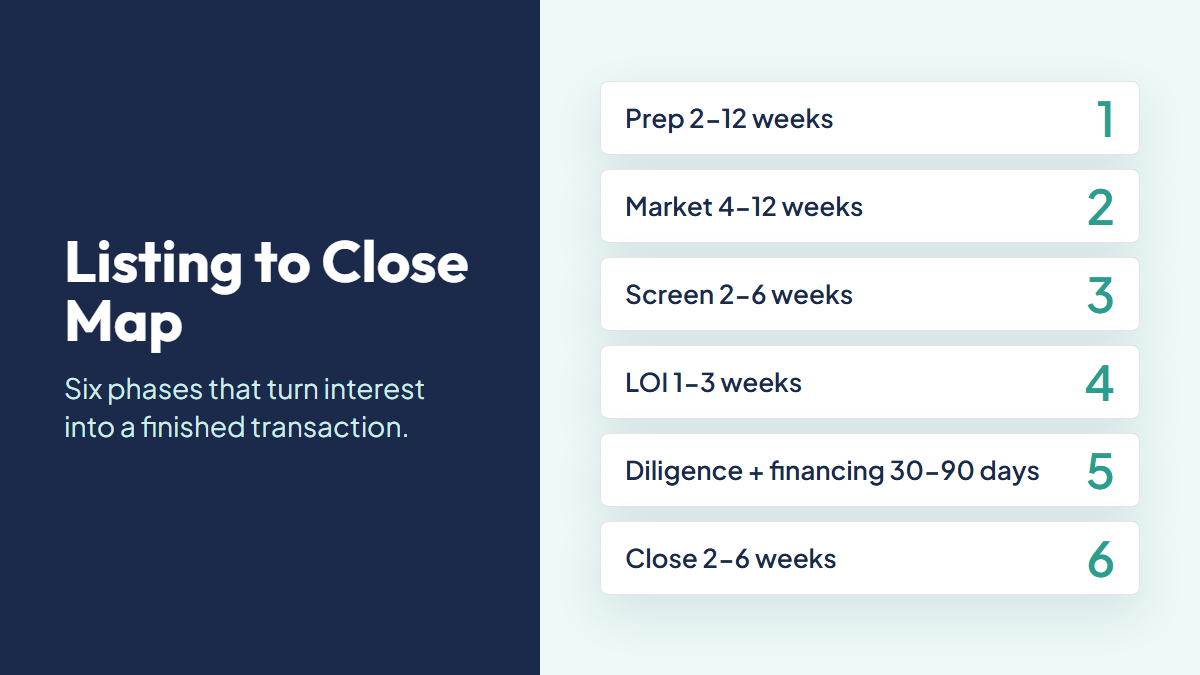
A sale moves through six phases, and each phase has a different bottleneck. Owners get frustrated when they treat the process as one long negotiation instead of a sequence of evidence checks.
| Phase | Normal time | What happens | Seller bottleneck |
|---|---|---|---|
| Pre-listing prep | 2-12 weeks | Valuation, document cleanup, broker selection | Messy financials |
| Listing and buyer outreach | 4-12 weeks | Confidential teaser, buyer calls, initial review | Weak buyer pool |
| Buyer screening | 2-6 weeks | NDA, financial package, management calls | Tire-kickers |
| LOI negotiation | 1-3 weeks | Price, structure, exclusivity, closing conditions | Unrealistic valuation |
| Diligence and financing | 30-90 days | Tax returns, contracts, customer detail, lender review | Slow answers |
| Closing and transition | 2-6 weeks | Purchase agreement, asset transfer, training | Legal and third-party approvals |
BizBuySell's buyer-side timeline guide breaks out similar timing for the middle of the deal: due diligence at 30-60 days, financing at 14-90 days, SBA loans at 45-90 days, and closing at 14-30 days. Those windows overlap, but they explain why "we have an offer" is not the same thing as "we are close."
Where Sale Timelines Slip
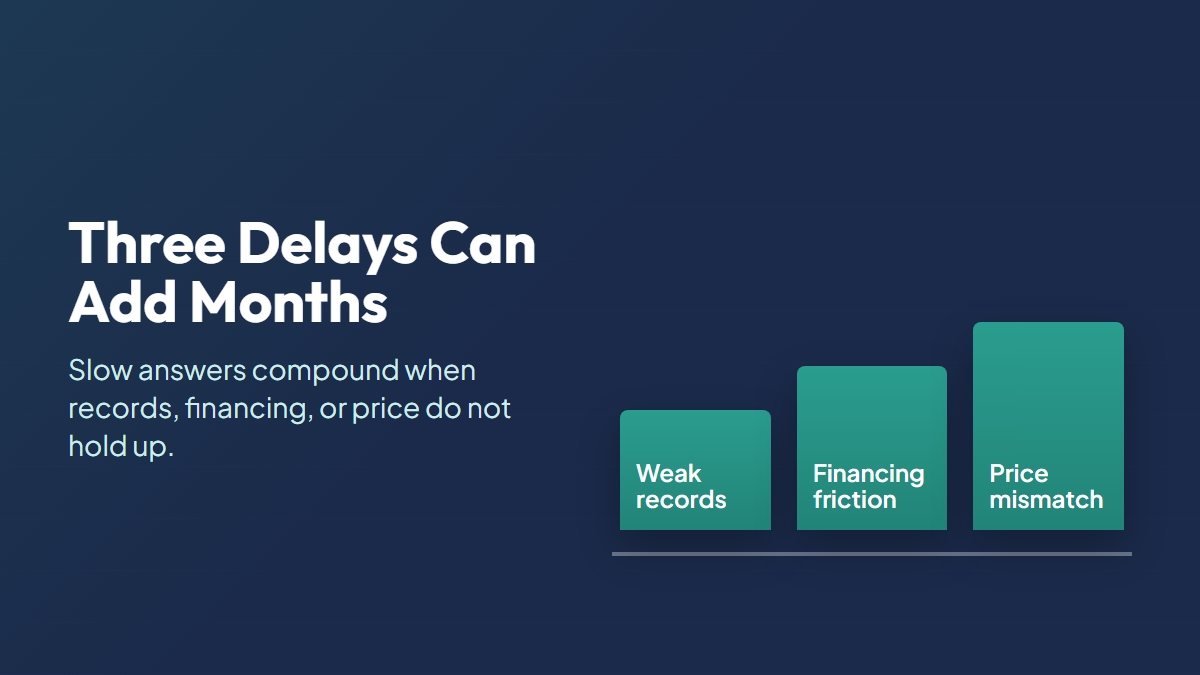
Deals slip when the buyer asks a reasonable question and the seller cannot answer it quickly. One missing lease amendment, one unexplained payroll add-back, or one customer concentration report built by hand can cost more time than a tough price negotiation.
The first delay is weak financial support. A buyer may accept your SDE story on the first call, but their accountant and lender will ask for proof. If your add-backs are buried inside miscellaneous expenses or your monthly P&Ls do not tie to tax returns, diligence slows down while everyone reconstructs the numbers.
The second delay is buyer financing. When a buyer uses an SBA-backed acquisition loan, the SBA says most 7(a) term loans are repaid from the cash flow of the business. That means the lender has to believe your earnings will cover the loan after closing.
The third delay is price mismatch. If you list at a price that cannot be supported by SDE, EBITDA, industry multiples, or lender cash-flow coverage, serious buyers will not simply negotiate. They will ask for more evidence, more seller financing, a lower price, or an earnout. Each alternative adds time.
How Valuation Affects the Timeline
Valuation affects timing because buyers and lenders use the number as a filter before they invest serious diligence effort. A fair price does not guarantee a fast close, but an inflated price attracts weak buyers and pushes serious buyers into defensive diligence.
For example, say a business shows $260,000 in SDE. At a 3.0x SDE multiple, a valuation-supported price might land around $780,000 before deal-structure details. If the seller lists at $1.15 million because a competitor "got five times earnings," the gap has to be explained. Was the competitor larger, recurring, professionally managed, or less dependent on the owner? If not, the process slows or stalls.
This is why a broker's valuation is partly about market appetite, not just math. A price needs to attract buyers, survive due diligence, and fit available financing. For that buyer-facing lens, see What Do Business Brokers Look for in a Valuation?.
(MyExitNumber calculates SDE, EBITDA, revenue multiples, and a blended valuation range in one pass, so you can sanity-check whether an asking price is supported by earnings and multiples.)
Worked Example: A Seven-Month Sale Calendar
Consider a specialty commercial cleaning company with $1.1 million in revenue and $240,000 in SDE. The owner wants to sell within the year but has not prepared a buyer package.
Month one is valuation and cleanup. The owner calculates SDE, normalizes one-time expenses, confirms the lease assignment clause, and builds a document folder with tax returns, monthly P&Ls, payroll records, customer revenue by month, contracts, insurance policies, and equipment lists.
Months two and three are broker launch and buyer screening. The broker confidentially markets the business, screens buyers, and schedules calls with the owner. The owner keeps running the business while answering the same three buyer questions: why are you selling, how much do you work in the business, and what happens if the top customer leaves?
Month four is LOI negotiation. A buyer offers $690,000 with 80% bank financing, 10% seller financing, and 10% buyer equity. The price is close enough to the valuation range that the owner signs an LOI with 60 days of exclusivity.
Months five and six are diligence and financing. The buyer's CPA checks add-backs, the lender reviews cash flow, the landlord confirms lease assignment, and the buyer verifies that customer contracts can transfer. The owner answers questions within 24 hours, which keeps the process moving.
Month seven is closing and transition. The asset purchase agreement is finalized, inventory and equipment schedules are updated, funds flow through escrow, and the owner begins a 30-day training period.
That is a clean sale. If the tax returns do not support SDE, the buyer is undercapitalized, or the landlord delays consent, the same transaction can become a ten-month process.
What to Do Before Listing if You Want a Faster Close
The fastest way to shorten a sale is to do diligence before the buyer asks for it. That does not mean hiring every advisor at once. It means building enough evidence that a qualified buyer can move without waiting for you to reconstruct the business.
Start with the financial package. You need three years of tax returns, year-to-date monthly financials, a clear add-back schedule, a debt schedule, payroll detail, and a short explanation of any unusual revenue or expense swings. If the story cannot be explained in one page, buyers will assume the risk is larger than you think.
Then pressure-test transferability. Review the lease, licenses, vendor agreements, customer contracts, franchise documents, software subscriptions, and employee agreements. A business can be profitable and still hard to sell if the buyer cannot take over the assets, location, or relationships that create the cash flow.
Finally, screen buyers before signing exclusivity. Ask how they plan to finance the acquisition, whether they have lender conversations underway, how much operating experience they bring, and whether they understand the industry. A weak buyer can consume the same 60-day diligence window as a strong buyer and still fail to close.
Plan Backward From the Close
If you want to close by December, do not start in September. Work backward from the desired closing date, reserve 60-90 days for diligence and financing, reserve another 60-90 days for buyer outreach and LOI negotiation, and reserve at least a month for valuation and document cleanup.
The useful output is not a perfect closing-date prediction. It is a calendar that gives each buyer, lender, landlord, and adviser enough time to say yes or no without forcing the deal into avoidable delays.
Frequently Asked Questions
How long does it take to sell a small business?
A realistic planning range is six to 12 months from listing to close. Clean cash deals can land closer to six to nine months, while SBA-financed or documentation-heavy deals can run longer.
What is the slowest part of selling a business?
Diligence and financing create the longest delays. Buyers need tax returns, monthly financials, contracts, lease documents, customer detail, and lender approval before the transaction can close.
Can a business sell in less than 90 days?
Yes, but the buyer usually needs cash, clean diligence, and a straightforward asset purchase. A lender-financed deal with missing records is unlikely to close that quickly.
Does a higher valuation make the sale take longer?
It can. A price that stretches beyond documented earnings needs more buyer conviction, more lender support, or more seller financing, which adds negotiation time.
When should I get a valuation before listing?
Get the valuation before broker outreach or buyer conversations. It sets the price range, exposes financing limits, and shows which documents must be cleaned up first.
Find Out What Your Business Is Worth
MyExitNumber calculates your business value using three proven methods - SDE, EBITDA, and Revenue multiples - so you get the full picture, not just one number.